


-
 Svizzera
Switzerland – Goodwill indemnity for termination of a distribution agreement
28 Gennaio 2020
- Distribuzione
Sommario – Secondo la giurisprudenza francese, un agente è soggetto alla tutela dello status giuridico di agente di commercio e ha quindi diritto a un’indennità di fine rapporto solo se in potere di negoziare liberamente il prezzo e le condizioni dei contratti di vendita. La Corte di Giustizia Europea ha recentemente stabilito che tale condizione non è conforme al diritto europeo. Tuttavia, i preponenti potrebbero ora prendere in considerazione altre opzioni per limitare o escludere l’indennità di fine rapporto.
Dire che la sentenza della Corte di giustizia europea del 4 giugno 2020 (n°C828/18, Trendsetteuse / DCA) fosse molto attesa sia dagli agenti francesi che dai loro preponenti è un eufemismo.
La richiesta fatta alla Corte di Giustizia CE
La questione posta dal Tribunale Commerciale di Parigi il 19 dicembre 2018 alla CGCE riguardava la definizione dello status di agente di commercio affinché quest’ultimo potesse beneficiare della Direttiva CE del 18 dicembre 1986 e di conseguenza dell’articolo L134 e seguenti del Codice Commerciale. La questione preliminare consisteva nel sottoporre alla CGCE la definizione adottata dalla Corte di Cassazione e da molte Corti d’Appello, a partire dal 2008: il beneficio dello status di agente di commercio è stato negato a qualsiasi agente che non abbia, secondo il contratto e de facto, il potere di negoziare liberamente il prezzo dei contratti di vendita conclusi, per conto del venditore, con un acquirente (tale libertà di negoziazione si estende anche ad altri termini essenziali della vendita, come i termini di consegna o di pagamento).
La restrizione fissata dai tribunali francesi
Questo approccio è stato criticato perché, tra l’altro, risultava essere contrario alla natura stessa della funzione economica e giuridica dell’agente di commercio, che deve sviluppare l’attività del preponente nel rispetto della sua politica commerciale, in modo uniforme e nel rigoroso rispetto delle istruzioni impartite.
Poiché la maggior parte dei contratti di agenzia soggetti al diritto francese escludono espressamente la libertà dell’agente di negoziare i prezzi o le condizioni principali dei contratti di vendita, i giudici hanno regolarmente riqualificato il contratto da contratto di agenzia commerciale a contratto di mandato di interesse comune. Tuttavia, questo contratto di mandato d’interesse comune non è disciplinato dalle disposizioni degli articoli L 134 e seguenti del Codice di commercio, molti dei quali sono di ordine pubblico interno, ma dalle disposizioni del Codice civile relative al mandato, che in generale non sono considerate di ordine pubblico.
La principale conseguenza di questa dicotomia di status consiste nella possibilità per il preponente vincolato da un contratto di mandato di mettere espressamente da parte l’indennità di fine rapporto, essendo questa clausola perfettamente valida in un contratto di questo tipo, a differenza del contratto di agente di commercio (si veda il capitolo francese della Guida pratica ai contratti di agenzia commerciale internazionale).
La decisione della CGCE e gli effetti
La sentenza della CGCE del 4 giugno 2020 pone fine all’approccio restrittivo dei tribunali francesi. Secondo quest’ultima l’interpretazione corretta dell’articolo 1, paragrafo 2, della direttiva del 18 dicembre 1986 è che gli agenti non devono necessariamente avere il potere di modificare i prezzi dei beni che vendono per conto di un preponente per essere classificati come agenti di commercio.
La Corte ricorda in particolare che la direttiva europea è valida per qualsiasi agente che abbia il potere di negoziare o di negoziare e concludere contratti di vendita. La Corte aggiunge che il concetto di negoziazione non può essere letto attraverso la lente restrittiva adottata dai giudici francesi. La definizione del concetto di “negoziazione” deve non solo tenere conto del ruolo economico che ci si aspetta da tale intermediario (essendo il concetto di negoziazione molto ampio: ad es. la contrattazione), ma anche della necessità di preservare gli obiettivi della direttiva, soprattutto garantire la tutela di questo tipo di intermediario.
In pratica, quindi, i preponenti non potranno più nascondersi dietro una clausola che vieta all’agente di negoziare liberamente i prezzi e i termini dei contratti di vendita per negare lo status di agente di commercio.
Opzioni alternative per i preponenti
Quali sono i mezzi di cui dispongono ora i produttori e i commercianti francesi o stranieri per evitare di pagare un indennizzo al termine del contratto di agenzia?
- Innanzitutto, in caso di contratti internazionali, i preponenti stranieri avranno probabilmente più interesse a sottoporre il proprio contratto a una legge straniera (a condizione che non sia più restrittiva della legge francese …). Anche se le regole dell’agenzia di commercio non sono considerate delle norme imperative preminenti dai tribunali francesi (contrariamente ai casi Ingmar e Unamar della CGCE), per garantire la possibilità di escludere il diritto francese il contratto dovrebbe anche prevedere una clausola di giurisdizione esclusiva per un tribunale straniero o una clausola arbitrale (si veda il capitolo francese della Guida pratica ai contratti di agenzia commerciale internazionale).
- C’è anche la probabilità che il preponente chieda un compenso all’agente per il contributo della sua banca dati clienti (preesistente) e che il pagamento di tale compenso venga differito alla fine del contratto … al fine di compensare, se necessario, in tutto o in parte, il corrispettivo allora dovuto all’agente di commercio.
- È certo che i contratti di agenzia stabiliranno in modo più chiaro e completo i doveri dell’agente che il preponente considera essenziali e la cui violazione potrebbe costituire una grave mancanza, escludendo il diritto ad un compenso di fine contratto. Sebbene i giudici siano liberi di valutare la gravità della violazione, possono comunque utilizzare le disposizioni contrattuali per identificare ciò che è importante nell’intenzione comune delle parti.
- Alcuni preponenti metteranno probabilmente in dubbio anche l’opportunità di continuare ad utilizzare gli agenti di commercio, e in alcuni casi la loro attività potrebbe essere meno legata a una questione di contratto di agenzia commerciale, ma piuttosto a un contratto di servizi promozionali. La distinzione tra questi due contratti deve comunque essere rigorosamente osservata sia nel testo dell’accordo che nella realtà, e bisognerebbe valutare altre conseguenze, come il regime del preavviso (vedi il nostro articolo sulla risoluzione improvvisa dei contratti).
Infine, il ragionamento utilizzato dalla CGCE in questa sentenza (interpretazione autonoma alla luce del contesto e dello scopo di questa direttiva) potrebbe indurre i preponenti a mettere in discussione la norma della giurisprudenza francese che consiste nel concedere, a occhi quasi chiusi, due anni di commissioni lorde a titolo di indennizzo forfettario, mentre l’articolo 134-12 del Codice commerciale non fissa l’importo di questo indennizzo di fine contratto, ma si limita ad indicare che il danno effettivo subito dall’agente deve essere risarcito; così come l’articolo 17.3 della direttiva CE del 1986. Ci si potrebbe quindi chiedere se tale articolo 17.3 imponga all’agente di provare il danno effettivamente subito.
Summary: Since 12 July 2020, new rules apply for platform service providers and search engine operators – irrespective of whether they are established in the EU or not. The transition period has run out. This article provides checklists for platform service providers and search engine operators on how to adapt their services to the Regulation (EU) 2019/1150 on the promotion of fairness and transparency for commercial users of online intermediation services – the P2B Regulation.
The P2B Regulation applies to platform service providers and search engine operators, wherever established, provided only two conditions are met:
(i) the commercial users (for online intermediation services) or the users with a company website (for online search engines) are established in the EU; and
(ii) the users offer their goods/services to consumers located in the EU for at least part of the transaction.
Accordingly, there is a need for adaption for:
- Online intermediation services, e.g. online marketplaces, app stores, hotel and other travel booking portals, social media, and
- Online search engines.
The P2B Regulation applies to platforms in the P2B2C business in the following constellation (i.e. pure B2B platforms are exempt):
Provider -> Business -> Consumer
The article follows up on the introduction to the P2B Regulation here and the detailed analysis of mediation as method of dispute resolution here.
Checklist how to adapt the general terms and conditions of platform services
Online intermediation services must adapt their general terms and conditions – defined as (i) conditions / provisions that regulate the contractual relationship between the provider of online intermediation services and their business users and (ii) are unilaterally determined by the provider of online intermediation services.
The checklist shows the new main requirements to be observed in the general terms and conditions (“GTC”):
- Draft them in plain and intelligible language (Article 3.1 a)
- Make them easily available at any time (also before conclusion of contract) (Article 3.1 b)
- Inform on reasons for suspension / termination (Article 3.1 c)
- Inform on additional sales channels or partner programs (Article 3.1 d)
- Inform on the effects of the GTC on the IP rights of users (Article 3.1 e)
- Inform on (any!) changes to the GTC on a durable medium, user has the right of termination (Article 3.2)
- Inform on main parameters and relative importance in the ranking (incl. possible influence of remuneration), without algorithms or business secrets (Article 5.1, 5.3, 5.5)
- Inform on the type of any ancillary goods/services offered and any entitlement/condition that users offer their own goods/services (Article 6)
- Inform on possible differentiated treatment of goods / services of the provider or individual users towards other users (Article 7.1, 7.2, 7.3)
- No retroactive changes to the GTC (Article 8a)
- Inform on conditions under which users can terminate contract (Article 8b)
- Inform on available or non-available technical and contractual access to information that the Service maintains after contract termination (Article 8c)
- Inform on technical and contractual access or lack thereof for users to any data made available or generated by them or by consumers during the use of services (Article 9)
- Inform on reasons for possible restrictions on users to offer their goods/services elsewhere under other conditions (“best price clause”); reasons must also be made easily available to the public (Article 10)
- Inform on access to the internal complaint-handling system (Article 11.3)
- Indicate at least two mediators for any out-of-court settlement of disputes (Article 12)
These requirements – apart from the clear, understandable language of the GTC, their availability and the fundamental ineffectiveness of retroactive adjustments to the GTC – clearly go beyond what e.g. the already strict German law on general terms and conditions requires.
Checklist how to adapt the design of platform services and search engines
In addition, online intermediation services and online search engines must adapt their design and, among other things, introduce internal complaint-handling. The checklist shows the main design requirements for:
a) Online intermediation services
- Make identity of commercial user clearly visible (Article 3.5)
- State reasons for suspension / limitation / termination of services (Article 4.1, 4.2)
- Explain possible differentiated treatment of goods / services of providers themselves or users in relation to other users (Article 7.1, 7.2, 7.3), see above
- Set an internal complaint handling system, with publicly available info, annual updates (Article 11, 4.3)
b) Online search engines
- Explain the ranking’s main parameters and their relative importance, public, easily available, always up to date (incl. possible influence of remuneration), without algorithms or trade secrets (Article 5.2, 5.3, 5.5)
- If ranking changes or delistings occur due to notification by third parties: offer to inspect such notification (Article 5.4)
- Explain possible differentiated treatment of goods / services of providers themselves or users in relation to other users (Article 7.1, 7.2, 7.3)
The European Commission will provide guidelines regarding the ranking rules in Article 5, as announced in the P2B Regulation – see the overview here. At the same time, providers of online intermediation services and online search engines shall draw up codes of conduct together with their users.
Practical Tips
- The Regulation significantly affects contractual freedom as it obliges platform services to adapt their general terms and conditions.
- The Regulation is to be enforced by “representative organisations” or associations and public bodies, with the EU Member States ensuring adequate and effective enforcement. The European Commission will monitor the impact of the Regulation in practice and evaluate it for the first time on 13.01.2022 (and every three years thereafter).
- The P2B Regulation may affect distribution relationships, in particular platforms as distribution intermediaries. Under German distribution law, platforms and other Internet intermediation services acting as authorised distributors may be entitled to a goodwill indemnity at termination (details here) if they disclose their distribution channels on the basis of corresponding platform general terms and conditions, as the Regulation does not require, but at least allows to do (see also: Rohrßen, ZVertriebsR 2019, 341, 344–346). In addition, there are numerous overlaps with antitrust, competition and data protection law.
It is usually said that “conflict is not necessarily bad, abnormal, or dysfunctional; it is a fact of life[1]” I would perhaps add that quite often conflict is a suitable opportunity to evolve and to solve problems[2]. It is, in fact, a useful part of life[3] and particularly, should I add, of businesses. And conflicts not only arise at the end of the business relationship or to terminate it, but also during it and the parties remain willing to continue it.
The 2008 EU Directive on certain aspects of mediation in civil and commercial matters states that «agreements resulting from mediation are more likely to be complied with voluntarily and are more likely to preserve an amicable and sustainable relationship between the parties.»
Can, therefore, mediation be used not only as an alternative to court or arbitration when terminating distribution agreements, but also to re-organize them or to change contract conditions? Would it be useful to solve these conflicts? What could be the advantages?
In distribution/agency/franchise agreements, particularly for those lasting several years, parties can have neglected their obligations (for instance minimum sales targets not attained).
Sometimes they could have tolerated the situation although they remain not very happy with the other party’s performance because they are still doing acceptable business.
It could also happen that one of the parties wishes to restructure the entire distribution network (Can we change the distribution structure to an agency one?), but does not want to face a complete termination because there are other benefits in the relationship.
There may be just some changes to be introduced, or changes in the legal structures (A mere reseller transformed in distributor?), legal frameworks, legal conditions (Which one is the applicable law?), limitation of the scope of contract, territory…
And now, we face the Covid-19 crisis where everything is still more uncertain.
In some cases, it could happen that there is no written contract and the parties wish to draft it; in other cases, agreements could have been defectively drafted with incomplete, contradictory or no regulation at all (Was it an exclusive agreement?).
The contracts could be perfect for the situation imagined when signed several years ago but not anymore (What happen with online sales?) or circumstances, markets, services, products have changed and need to be reconsidered (mergers, change of directors…).
Sometimes, even more powerful parties have not the elements to oblige the weaker party to respect new terms, or they simply prefer not to impose their conditions, but to build up a more collaborative relationship for the future.
In all these cases, negotiation is the usual strategy parties follow: each one is focused in obtaining its own benefits with a clear idea of, for instance, which clause(s) should be modified or drafted.
Nevertheless, mediation could add some neutrality, and some space to a more efficient, structured and useful approach to the modification of the commercial relationship, particularly in distribution agreements where the collaboration (in the past, but also in the future if the parties wish so) is of paramount importance.
In most of these situations, personal emotional aspects could also be involved and make more difficult a neutral negotiation: a distributor that has been seen by the manufacturer as not performing very well and feels hurt, an agent that could consider a retirement, parties from different cultures that need to understand different ways of performing, franchisees that have been treated differently in the network and feel discriminated, etc.
In these circumstances and in other similar ones, where all persons involved, assisted by their respective lawyers, wish to continue the relationship although maybe in a different way, a sort of facilitative mediation can be a great help.
These are, in my opinion, the main reasons:
- Mediation is a legal and organized procedure that could help the parties to increase their awareness of the necessity to redraft the agreement (or drafting for the first time if it was not already done).
- Parties can be heard more easily, negotiation is eased in the interest of both of them, encourages them to act more reasonably vis-à-vis the other side, restores relationship if necessary, deadlock can be easily broken and, if the circumstances advice so, parties can be engaged separately with the help of the mediator.
- Mediation can consider other elements different to the mere commercial or legal ones: emotions linked to performance, personal situations (retirement, succession, illness) or even differences in cultural approaches.
- It helps to find the real (possibly new or not shown) interests in the commercial relationship of the parties, focusing in developments, strategies, new proposals… The mere negotiation between the parties and they attorneys could not make appear these new interests and therefore be limited only to the discussion on the change of concrete obligations, clauses or situations. Mediation helps to go beyond.
- Mediation techniques can also help the parties to face their current situation, to take responsibility of their performance without focusing on blame or incompetence but on a constructive and future collaboration in new specific terms.[4]
- It can also avoid the increasing of the conflict into a more severe one (breaching) and in case mediation does not end with a new/redrafted agreement, the basis for a mediated termination can be established, if the parties wish so, instead of litigation.
- Mediation can conclude into a new agreement where the parties are more reassured, more comfortable with, and more willing to respect because they were involved in their construction with the assistance of their respective lawyers, and because all their interests (not only new drafted clauses) were considered.
- And, in any case, mediation does not affect the party’s collaborative position and does not reduce their possibility to use other alternatives, including litigation or arbitration to terminate the agreement or to oblige the other party to respect its legal obligations.
The use of mediation does not need the parties to have foreseen it in the agreement (although it could be easier if they did so) but they can use it freely at any time.
This said, a lawyer proposing mediation as a contractual clause or, in case it was not included in the agreement, as a procedure to face this sort of conflicts in distribution agreements, will be certainly seen by his/her client as problem-solving attorney looking for the client’s interests rather than a litigator pushing them to a more uncertain situation, with unknown costs and unforeseeable timeframe.
Parties in distribution agreements should have this possibility in mind and lawyers have the opportunity to actively participate in mediation from the first steps by recommending it in the initial agreement, during the process helping the clients to express their concerns and interests, and in the drafting of the final (new) agreement, representing the clients’ and as co-author of their success.
If you would like to hear more on the topic of mediation and distribution agreements you can check out the recording of our webinar on Mediation in International Conflicts
[1] Moore, Christopher W. The Mediation Process: Practical Strategies for Resolving Conflict. Jossey-Bass. Wiley, 2014.
[2] Mnookin, Robert H. Beyond Winning. Negotiating to create value in deals and disputes (p. 53). Harvard University Press, 2000.
[3] Fisher, R; Ury, W. Getting to Yes: Negotiating an agreement without giving in. Random House.
[4] «Talking about blame distracts us from exploring why things went wrong and how we might correct them going forward. Focusing instead on understanding the contribution system allows us to learn about the real causes of the problem, and to work on correcting them.» [Stone, Douglas. “Difficult Conversations: How to Discuss What Matters Most”. Penguin Publishing Group]
Riassunto
Anche in Italia l’emergenza Covid-19 ha accelerato parecchio la transizione verso l’e-commerce, sia nei rapporti B2C che in molti settori B2B. Molte imprese si sono trovate ad operare su internet per la prima volta, spostando nel mondo digitale le relazioni commerciali e i rapporti con i clienti.
Purtroppo, accade spesso che dietro a manifestazioni di interesse di potenziali clienti si nascondano dei tentativi di truffa. E’ il caso, in particolare, di nuovi contatti commerciali provenienti dalla Cina, via email o tramite il sito web aziendale o i profili sui social network dell’azienda.
Vediamo quali sono gli schemi ricorrenti di truffe, piccole e grandi, che ricorrono frequentemente, soprattutto nel mondo del vino, nel settore alimentare e in quello della moda.
Di cosa parlo in questo post:
- La richiesta di prodotti via internet da un compratore cinese
- La legalizzazione del contratto in Cina, la firma dal notaio cinese e altre spese
- La modifica dei termini di pagamento (Man in the mail)
- La falsa registrazione del marchio o dominio web
- Designer e prodotti di moda: la fantomatica piattaforma e-commerce
- La truffa dei bitcoin e delle criptovalute
- Come verificare i dati di una società cinese
- Come possiamo aiutarti
Affare imperdibile, normale richiesta commerciale o tentativo di raggiro?
Fortunatamente i malintenzionati in Cina (e non solo: spesso questo tipo di truffe viene perpetrato anche da criminali di altri paesi) non sono molto creativi e gli schemi utilizzati per i “bidoni” sono ben noti e ricorrenti: vediamo i principali.
L’invito a firmare il contratto in Cina
Il caso più frequente è quello di una società cinese che, dopo aver reperito informazioni sui prodotti italiani attraverso il sito web dell’azienda italiana, comunica via email la disponibilità ad acquistare importanti quantitativi di merce.
Segue di solito un primo scambio corrispondenza via email tra le parti, all’esito del quale la società cinese comunica la decisione di acquistare i prodotti e chiede di finalizzare l’accordo in tempi molto rapidi, invitando la parte italiana a recarsi in Cina per concludere la trattativa e non lasciar sfumare l’affare.
Molti ci credono e non resistono alla tentazione di saltare sul primo aereo: sbarcati in Cina la situazione sembra ancor più allettante, visto che il potenziale compratore si dimostra un negoziatore molto arrendevole, disponibile ad accettare tutte le condizioni proposte dalla parte italiana e frettoloso di concludere il contratto.
Questo però non è un buon segno, anzi: deve suonare come un campanello d’allarme. E’ noto che i cinesi sono negoziatori abili e molto pazienti e le trattative commerciali di solito sono lunghe e snervanti: una trattativa troppo semplice, soprattutto se si tratta del primo incontro tra le parti, è molto sospetta.
Che ci si trovi di fronte ad un tentativo di truffa è certificato poi dalla richiesta di alcuni pagamenti in Cina al fine di poter concludere l’affare.
Esistono diverse varianti di questo primo schema.
Le più comuni sono la richiesta di pagare una tassa di registrazione del contratto presso un notaio cinese; un contributo spese per incombenti amministrativi o doganali; un pagamento in contanti per ammorbidire le autorità preposte ed ottenere in tempi rapidi licenze o permessi di importazione dei beni, l’offerta di pranzi o cene a potenziali partner commerciali (a prezzi gonfiati), il soggiorno in un albergo prenotato dalla parte cinese, salvo poi ricevere la sorpresa di un conto esorbitante.
Rientrato in Italia, purtroppo, molto spesso il contratto firmato resterà un inutile pezzo di carta, il fantomatico cliente si renderà irreperibile e la società cinese risulterà inesistente. Si avrà allora la certezza che l’intera operazione era architettata al solo fine di estorcere all’incauto straniero qualche migliaio di euro.
Lo stesso schema (ossia l’ordine commerciale seguito da una serie di richieste di pagamento) può anche essere effettuato online, con motivazioni simili a quelle indicate: gli indizi della truffa sono sempre il contatto da parte di uno sconosciuto per un ordine di valore molto elevato, un negoziato molto rapido con richiesta di concludere l’affare in tempi stretti e la necessità di procedere a qualche pagamento anticipato prima di concludere il contratto.

Il pagamento su un diverso conto corrente
Un’altra truffa molto frequente è quella del conto corrente bancario diverso da quello solitamente utilizzato.
Qui le parti di solito sono invertite. La società cinese è il venditore dei prodotti, da cui l’imprenditore italiano intende acquistare o ha già acquistato una serie di partite di merce.
Un giorno il venditore o l’agente di riferimento informa il compratore che il conto corrente bancario normalmente utilizzato è stato bloccato (le scuse più frequenti sono che stato ecceduto il limite di valuta estera autorizzato, o sono in corso verifiche amministrative, o semplicemente si è cambiata la banca utilizzata), con invito a provvedere al pagamento del prezzo su un diverso conto corrente, intestato ad altro soggetto.
In altri casi la richiesta è motivata dal fatto che la fornitura dei prodotti avviene per il tramite di un’altra società, che è titolare della licenza di esportazione dei prodotti ed è autorizzata a ricevere il pagamento per conto del venditore.
Dopo avere eseguito il pagamento, il compratore italiano riceve l’amara sorpresa: il venditore dichiara non ha mai ricevuto il pagamento, che il diverso conto corrente non appartiene alla società e che la richiesta di pagamento su altro conto proveniva da un hacker che ha intercettato la corrispondenza tra le parti.
Solo a quel punto, verificando l’indirizzo email dal quale è stata trasmessa la richiesta di utilizzo del nuovo conto corrente, il compratore si avvede in genere di qualche piccola differenza nell’account email utilizzato per la richiesta di pagamento sul diverso conto (es. diverso nome a dominio, diverso provider o differente nome utente).
Il venditore a quel punto si renderà disponibile a spedire la merce solo a condizione che il pagamento venga rinnovato sul conto corrente corretto, cosa che – evidentemente – è bene non fare per non essere ingannati una seconda volta. Le ricerche di verifica dell’intestatario del falso conto corrente in genere non portano ad alcuna risposta da parte della banca e sarà di fatto impossibile identificare gli autori della truffa.

La truffa della falsa registrazione del marchio o del dominio web in Cina
Un altro classico schema cinese è l’invio di un’email con la quale si informa di aver ricevuto una richiesta da parte di un soggetto cinese, intenzionato a registrare un marchio o un dominio web identico a quello della società destinataria della comunicazione.
A scrivere è una sedicente agenzia cinese del settore, che comunica la propria disponibilità ad intervenire e sventare il pericolo, bloccando la registrazione, a condizione che si provveda in tempi rapidissimi e si paghi anticipatamente il servizio.
Anche in questo caso siamo di fronte ad un maldestro tentativo di truffa: meglio cestinare subito l’email.
A proposito: se non avete registrato il vostro marchio in Cina, fatelo subito. Ci fosse interessato ad approfondire l’argomento può farlo qui.

Designer e prodotti di moda: la fantomatica piattaforma di e-commerce
Una truffa molto diffusa è quella che riguarda designer e aziende del settore moda: anche in questo caso il contatto arriva tramite il sito web o l’account social media dell’azienda ed esprime un grande interesse per importare e distribuire in Cina prodotti del designer o del brand italiano.
Nei casi che di cui mi sono occupato in passato la proposta è accompagnata da un corposo contratto di distribuzione in inglese, che prevede la concessione in esclusiva del marchio e del diritto di vendere i prodotti in Cina a favore di una fantomatica piattaforma online cinese, in corso di costruzione, che consentirà di raggiungere un elevatissimo numero di clienti.
Dopo avere firmato il contratto i pretesti per estorcere denaro all’azienda italiana sono simili a quelli visti in precedenza: invito in Cina e richiesta di una serie di pagamenti in loco, oppure necessità di coprire una serie di costi di cui si deve far carico la parte cinese per avviare le operazioni commerciali in Cina: registrazione del brand, adempimenti doganali, ottenimento di licenze, etc (ovviamente tutti inventati).

La truffa dei bitcoin e delle criptovalute
Di recente uno schema di truffa di provenienza cinese è quello della proposta di investire in bitcoin, con garanzia di un ritorno minimo garantito sull’investimento molto allettante (in genere 20 o 30%).
Il presunto trader si presenta in questi casi come rappresentante di un’agenzia con sede in Cina, spesso facendo riferimento ad un sito web costruito ad hoc e a presentazioni dei servizi di investimento realizzate in inglese.
Nello schema si coinvolge solitamente anche una banca internazionale, che funge da agente o depositaria delle somme: in realtà chi scrive è sempre l’organizzazione criminale, da un account fasullo che assomiglia a quello della banca o dell’intermediario finanziario.
Una volta pagate le somme il broker scompare e non è possibile rintracciare i fondi perché il conto corrente bancario viene chiuso e la società scompare, o perché i pagamenti sono stati fatti tramite bitcoin.
Gli indizi della truffa anche in questo caso sono simili a quelli visti in precedenza: contatto proveniente da internet o via email, proposta commerciale molto allettante, fretta di concludere l’accordo.
Come capire se abbiamo a che fare con una truffa via internet
Nei casi visti sopra, ed in altri simili, una volta perpetrata la truffa è pressoché inutile cercare di porvi rimedio: i costi e le spese legali sono di solito superiori al valore del danno e nella maggioranza dei casi è impossibile rintracciare il responsabile del raggiro.
Ecco allora qualche consiglio utile – oltre al buon senso – per evitare di cadere in tranelli simili a quelli descritti:
Come verificare i dati di una società cinese
La denominazione della società in caratteri latini e il sito web in inglese non hanno alcuna valenza ufficiale, sono semplici traduzioni di fantasia: l’unico modo di verificare i dati della società cinese e delle persone che la rappresentano (o dicono di farlo) è quello di verificare la business licence originale e accedere al data base del SAIC (State Administration for Industry and Commerce).
Ogni società cinese ha infatti una business license (equivalente alla visura CCIAA italiana) rilasciata dalla SAIC (che contiene le seguenti informazioni:
- nome ufficiale della società in caratteri cinesi;
- numero di registrazione;
- sede;
- oggetto sociale;
- data di costituzione e scadenza;
- legale rappresentante;
- capitale registrato e versato.
Si tratta di un documento in lingua cinese, simile al seguente:
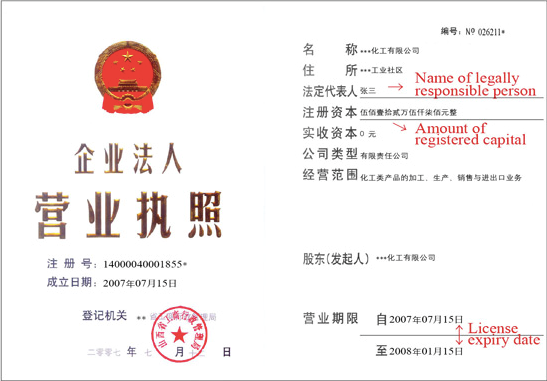
Verificare le informazioni, con l’aiuto di un professionista competente, consentirà di appurare se la società esiste o meno, l’identità dell’interlocutore, l’affidabilità della società e il fatto che il sedicente rappresentante possa in effetti spendere il nome della società.
Chiedere referenze commerciali
A prescindere che l’interesse sia per importare vino italiano, per il settore della moda o del design o altro prodotto Made in Italy, una verifica semplice da fare è quella di chiedere con che altre società italiane o internazionali il nostro interlocutore ha lavorato in precedenza, per validare le informazioni ricevute.
Nella maggior parte dei casi la parte cinese opporrà di non poter dare referenze per motivi di privacy, il che conferma il sospetto che in realtà tali fantomatici casi di successo non esistano e si tratti di un tentativo di truffa.
Gestire con attenzione i pagamenti
Smarcati positivamente i primi punti, è bene procedere comunque con molta prudenza, specie nel caso di nuovo cliente o fornitore. Nel caso di vendita di prodotti ad un compratore cinese è opportuno chiedere un pagamento in acconto anticipato e il saldo del prezzo all’avviso di merce pronta, oppure l’apertura di una lettera di credito.
Nel caso in cui la parte cinese sia il fornitore è raccomandato prevedere un’ispezione on site della merce, con incarico a società terza di certificare la qualità dei prodotti e la rispondenza alle specifiche contrattuali.
Verificare le richieste di cambiamento delle modalità di pagamento
Se una relazione commerciale è già in corso e viene chiesto di cambiare la modalità di pagamento del prezzo, va verificata con attenzione l’identità e l’account email del richiedente e per sicurezza è bene chiedere conferma dell’istruzione anche attraverso altri canali di comunicazione (scrivendo ad altra persona in azienda, telefonando o mandando un messaggio via wechat).
Come possiamo aiutarti
Legalmondo offre la possibilità di lavorare con un avvocato specializzato per esaminare la tua esigenza o assisterti nella redazione di un contratto o nei negoziati contrattuali con la Cina.
Accedi al nostro servizio di Contrattualistica Internazionale
Photo by Andy Beales on Unsplash.
Riassunto: In Germania, al termine di un contratto di distribuzione, gli intermediari di una rete di distribuzione (in particolare, i distributori/franchisee) possono chiedere un’indennità al proprio produttore/fornitore, se si configura una fattispecie analoga a quella dell’agente commerciale. Tali condizioni sussistono se l’intermediario è integrato nella rete commerciale del fornitore ed è obbligato a trasferire il proprio portafoglio clienti al fornitore, cioè a trasmettere i dati dei propri clienti in modo che il fornitore possa immediatamente e senza ulteriori indugi sfruttare i vantaggi del portafoglio clienti al termine del contratto. Una recente decisione giudiziaria mira ora ad estendere il diritto all’indennità del distributore a casi in cui il fornitore abbia in qualche modo beneficiato del rapporto commerciale con il distributore, anche nel caso in cui il distributore non abbia fornito i dati dei clienti al fornitore. Questo articolo illustra tale novità e fornisce suggerimenti su come superare le incertezze emerse a seguito di questa nuova decisione.
Un tribunale tedesco ha recentemente ampliato il diritto del distributore all’indennità di fine rapporto: i fornitori potrebbero dover pagare l’indennità ai propri distributori autorizzati anche nel caso in cui questi ultimi non fossero obbligati a trasferire la propria clientela al fornitore. Al contrario, potrebbe essere sufficiente il conseguimento di un qualsiasi avviamento – inteso come vantaggi sostanziali che, a seguito della cessazione del rapporto, il fornitore possa derivare dalla relazione commerciale con il distributore, indipendentemente da che cosa le parti abbiano stipulato nell’accordo di distribuzione.
Questa decisione potrebbe influire su tutti i tipi di business in cui i prodotti siano venduti tramite distributori (e franchisee, vedi sotto) – in particolare, quindi, sul commercio al dettaglio (soprattutto per quanto riguarda prodotti di elettronica, cosmetica, gioielleria e talvolta anche moda), sul settore automobilistico e sul commercio all’ingrosso. I distributori sono imprenditori autonomi e indipendenti i quali vendono e promuovono i prodotti
- stabilmente ed in nome proprio (differentemente dagli agenti commerciali),
- per proprio conto (differentemente dagli agenti commissionari),
- perciò sopportando il rischio ed i cui margini di profitto – per contro – sono piuttosto alti.
Nel diritto tedesco i distributori sono meno protetti rispetto agli agenti commerciali. Tuttavia, anche i distributori e gli agenti commissionari (vedi qui) hanno diritto ad ottenere un’indennità alla cessazione del contratto, qualora sussistano due prerequisiti:
- il distributore o agente commissionario sia integrato nella rete di vendita del concedente/fornitore (più di un semplice rivenditore) e
- sia obbligato (contrattualmente o di fatto) ad inoltrare al fornitore i dati della clientela durante o al termine dell’esecuzione del contratto (Corte Federale tedesca, decisione del 26 novembre 1997, R.G. n. VIII ZR 283/96).
Ora, il Tribunale Regionale di Norimberga-Fürth ha stabilito che il secondo prerequisito sussiste già se il distributore ha procurato un avviamento al concedente:
“… l’unico fattore decisivo, ai fini di un’applicazione analogica, è se il convenuto (il concedente) ha tratto beneficio dalla relazione commerciale con l’attore (distributore). …
… il concedente deve corrispondere un’indennità se ha un “avviamento”, ossia una giustificata aspettativa di profitto dalle relazioni commerciali con la clientela procurata dal distributore.”
(cfr. decisione del 27 novembre 2018, R.G. n. 2 HK O 10103/12).
Al fine di giustificare tale estensiva applicazione, il tribunale ha fatto riferimento in via astratta alle conclusioni dell’avvocato generale della Corte UE nel caso Marchon/Karaszkiewicz, rese il 10 settembre 2015. Tale caso, tuttavia, non concerneva distributori, bensì il diritto all’indennità dell’agente commerciale, in particolare il concetto di “nuovi clienti” ai sensi della Direttiva 86/653/EEC sugli agenti commerciali.
Nel presente caso, secondo il tribunale, è sufficiente che il fornitore abbia sul proprio computer i dati sui clienti procurati dal distributore e possa fare liberamente uso degli stessi. Altre ipotesi in cui potrebbe sorgere il diritto del distributore all’indennità, persino a prescindere dai dati concreti sulla clientela, sarebbero casi in cui il fornitore rilevi il negozio dal distributore e i clienti conseguentemente continuino a visitare proprio quel negozio anche dopo che il distributore lo ha lasciato.
Consigli pratici:
1. La decisione rende l’inquadramento giuridico dei distributori / franchisee meno chiaro. L’interpretazione estensiva del tribunale, tuttavia, deve essere vista alla luce della giurisprudenza della Corte Federale: ancora nel 2015, la Corte ha negato il diritto all’indennità ad un distributore, contestando la mancanza del secondo requisito, in quanto il distributore non era obbligato a trasferire i dati sulla clientela (decisione del 5 febbraio 2015, R.G. n. VII ZR 315/13, facendo seguito alla propria precedente decisione nel caso Toyota del 17 aprile 1996, R.G. n. VIII ZR 5/95). Inoltre, la Corte Federale ha negato ai franchisee il diritto all’indennità qualora il franchising abbia ad oggetto un business anonimo di massa e la clientela continui ad essere clientela regolare soltanto in via di fatto (decisione del 5 febbraio 2015, R.G. n. VII ZR 109/13 nel caso della catena di panetterie “Kamps”). Resta da vedere come si evolverà questa giurisprudenza.
2. In ogni caso, prima di entrare nel mercato tedesco, i fornitori devono valutare se intendano assumersi il rischio di dover pagare un’indennità alla cessazione del contratto.
3. Lo stesso vale per i franchisor: i franchisee saranno probabilmente in grado di far valere il diritto ad un’indennità sulla base dell’applicazione analogica della normativa sull’agenzia commerciale. Fino ad ora, la Corte Federale ha negato il diritto all’indennità del franchisee caso per caso, lasciando così aperta la questione se i franchisee possano in via generale far valere un tale diritto (cfr. ad esempio la decisione del 23 luglio 1997, R.G. n. VIII ZR 134/96 nella causa sui negozi Benetton). Nondimeno, i tribunali tedeschi potrebbero probabilmente riconoscere il diritto all’indennità nel caso del franchising distributivo (in cui il franchisee compra i prodotti dal franchisor), qualora la situazione sia simile alla distribuzione e all’agenzia commerciale. Questo potrebbe essere il caso in cui il franchisee sia stato incaricato di distribuire i prodotti del franchisor e solo il franchisor abbia, al termine del contratto, diritto ad accedere ai nuovi clienti acquisiti dal franchisee durante il contratto (cfr. Corte Federale tedesca, decisione del 29 aprile 2010, R.G. n. I ZR 3/09, Joop). Nessun diritto all’indennità, tuttavia, può essere fatto valere se
- il franchise ha ad oggetto un business anonimo di massa e i clienti continuano ad essere regolari soltanto di fatto (decisione del 5 febbraio 2015, nella causa sulla catena di panetterie “Kamps”) o
- nei franchising di produzione (contratti di imbottigliamento, ecc.), in cui il franchisor o titolare della licenza non opera nello stesso identico settore dei prodotti distribuiti dal franchisee / licenziatario (decisione del 29 aprile 2010, R.G. n. I ZR 3/09, Joop).
4. Nel diritto tedesco, il diritto all’indennità dei distributori – o, potenzialmente, dei franchisee – può ancora essere escluso:
- scegliendo di applicare al contratto un altro diritto sostanziale che non preveda un’indennità;
- obbligando il fornitore a bloccare, non usare e, se necessario, cancellare i dati della clientela alla cessazione del contratto (Corte Federale tedesca, decisione del 5 febbraio 2015, R.G. n. VII ZR 315/13: “fatte salve le disposizioni riportate all’articolo [●] sotto, il fornitore deve bloccare i dati forniti dal distributore dopo che sarà terminata la partecipazione del distributore al servizio clienti, deve cessare di utilizzarli e, su richiesta del distributore, deve cancellarli.”). Sebbene tale disposizione contrattuale sembri essere diventata irrilevante alla luce della decisione del Tribunale di Norimberga sopraccitata, il Tribunale non ha fornito alcun argomento sul perché la consolidata giurisprudenza della Corte Federale non debba trovare più applicazione;
- pattuendo espressamente l’esclusione del diritto all’indennità, il che, tuttavia, potrebbe funzionare solo qualora (i) il distributore operi al di fuori dello SEE e (ii) non sussista una norma locale inderogabile che preveda tale indennità (si veda l’articolo qui).
5. Inoltre, se il fornitore accetta deliberatamente di pagare l’indennità in cambio di un solido portafoglio clienti con una quantità di dati potenzialmente utilizzabili in modo significativo (in conformità con il Regolamento UE sulla Protezione Generale dei dati), può pattuire con il distributore il pagamento di “quote d’ingresso” (“entry fees”), al fine di mitigare il peso della propria obbligazione. Il pagamento di tali quote d’ingresso o oneri contrattuali potrebbe essere posticipato fino alla cessazione del contratto e successivamente compensato con il diritto all’indennità del distributore.
6. L’indennità di fine rapporto del distributore viene calcolata sulla base del margine di guadagno conseguito con nuovi clienti apportati dal distributore o con clienti già esistenti con cui il distributore abbia sensibilmente sviluppato gli affari. Il calcolo esatto può essere estremamente complesso ed i tribunali tedeschi applicano differenti metodi. In totale, l’indennità non può superare la media dei margini annualmente conseguiti dall’agente con tali clienti negli ultimi anni.
According to the well-established jurisprudence of the Spanish Supreme Court, a distributor may be entitled to compensation for clientele if article 28 of the Agency Law is applied analogically (the “inspiring idea“). This compensation is calculated for the agent based on the remunerations received in the last five years.
In a distribution contract, however, there are no “remunerations” such as those received by the agent (commissions, fixed amounts or others), but “commercial margins” (differences between the purchase and resale price). The question is, then, what magnitude to consider for the clientele compensation in a distribution contract: either the “gross margin” (the aforementioned difference between the purchase price and the resale price), or the “net margin” (that same difference but deducing other expenses and taxes in which the distributor had incurred in).
The conclusion until now seemed to be to calculate the compensation of the distributor from his “gross margins” since this is a magnitude more comparable to the “remuneration” of the agent: other expenses and taxes of the distributor could not be deduced in the same way as in an agency contract neither expenses and taxes were deduced.
The Supreme Court (November 17, 1999) had pointed out that in order to calculate compensation for clients “it is more appropriate to consider it as a gross contribution, since with it the agent must cover all the disbursements of its commercial organization“. In addition, the “earnings obtained” “do not constitute remuneration in the same sense” (October 21, 2008), given that such “benefits“, “belong to the internal scope of the agent’s own organization” (March 12, 2012).
Recently, however, the judgment of the Supreme Court of March 1, 2017 (confirmed by another of May 19, 2017) considers that the determination of the amount of clientele compensation in a distribution contract cannot be based on the “gross margins” obtained by the distributor, but in the “net margin”. To reach this conclusion, the Court refers to a judgment of the same court of 2016 and to others of 2010 and 2007.
Does this imply a change in the case-law? In my opinion, this reading that the Supreme makes is not correct. Let’s see why.
In the judgment of March 2017, the disjunctive between gross or net margin is mentioned in the Second Legal Argument and refers to the ruling of 2016.
In that judgment of 2016 it was said that although in another of 2010 it was not concluded whether the calculation had to be made on gross or net margins, in a previous one of 2007, it was admitted that what was similar to the remuneration of the agent was the net profit obtained by the distributor (profits once deduced expenses and taxes) and not the margin that is the difference between purchase and resale prices.
Now, in my opinion, in the judgment of March 2017 the Supreme Court is referring in last instance to the judgement 296/2007 for something that the latter did not say. In 2007, the Supreme Court did not quantify clientele compensation, but rather damages. More specifically, and after stating that “the compensation for customers must be requested clearly in the lawsuit, without confusion or ambiguity“, the Court concluded that the Chamber “must resolve what corresponds according to the terms in which the debate was raised…in the initial lawsuit. And since…an indemnity of damages was interested mainly based on the time that the relationship had lasted…the solution more adjusted to the jurisprudence of this Court…consists in fixing as indemnification of damages an amount equivalent to the net benefits that [were] obtained by the distribution of the products…during the year immediately prior to the termination of the contract“. Therefore, in that the judgment of 2007 the Court did not decide on clientele compensation, but on damages.
In this way, the conclusion reached in 2007 to calculate compensation for damages on net margins, was transferred without further analysis to 2016 but for the calculation of clientele compensation. This criterion is now reiterated in the judgments of 2017 almost automatically.
In my opinion, however, and despite the jurisprudential change, the thesis that should prevail is that in order to apply analogically clientele compensation in distribution contracts, the magnitude equivalent to the “remuneration” of the agent is the “gross margin” obtained by the distributor and not its “net margin”: it does not make much sense that if the analogy is applied to recognize the clientele compensation to a distributor, it is deducted from its gross margins amounts to reach its margin or net profit. The agent also has his expenses and also pays his taxes starting from his “remunerations” and nothing in Directive 86/653/EEC nor in the Agency Contract Act allows to deduce such magnitudes to calculate his clientele compensation. In my opinion, therefore, and in line with this, distributors should be equal: the magnitudes that could be compared should be the (gross) retributions of the agent with the (gross) margins of the distributor (i. e. the difference between purchase and resale price).
In conclusion, judgments of March 1 and May 19, 2017 insist on what I consider a prior mistake and generate additional confusion to an issue that has already been discussed: the analogical application of clientele compensation to the distribution contracts and the calculation method.
Updating Notice (January 27, 2020)
In a recent Order (“Auto”) of the Supreme Court of November 20, 2019 (ATS 12255/2019 of inadmissibility of an appeal), the Court has had occasion to return to this matter and to confirm the criteria of the last jurisprudence: that in the distribution contracts, the magnitude to consider to apply the analogy and calculate the goodwill indemnity are the “net margins”.
In this procedure, a distributor appealed the decision of the Provincial Court of Barcelona that recognized compensation based on net margins and not gross margins. Said distributor requested the Supreme Court to annul said judgment on the grounds that it was taken following the latest jurisprudence, erroneous according to previous one in the appellant’s opinion.
The Supreme Court, however, seems to confirm that, contrary to the thesis that I defended above in this Post, « there is no alleged error in the most recent jurisprudence in the analogical interpretation of art. 28.3 of the Agency Law for the distribution contract, nor, therefore, the need to review the most recent jurisprudence on the subject ». Consequently, if the Supreme Court does not review its latest jurisprudence and considers that the judgment that applied the net margins was acceptable, we must consider that the magnitude to be considered in the compensation for clientele in distribution contracts is that of the net margins and not gross margins
With this decision it seems (or just “its seems”?), therefore, that the Court settles the discussion that, however and in my opinion, will nevertheless continue to rise to numerous discussions.
Quick summary – Under Swiss law, a distributor may be entitled to a goodwill indemnity after termination of a distribution agreement. The Swiss Supreme Court has decided that the Swiss Code of Obligations, which provides commercial agents with an inalienable claim to a compensation for acquired customers at the end of the agency relationship, may be applied by analogy to distribution relationships under certain circumstances.
In Switzerland, distribution agreements are innominate contracts, i.e., agreements which are not specifically governed by the Swiss Code of Obligations (“CO”). Distribution agreements are primarily governed by the general provisions of Swiss contract law. In addition to that, certain provisions of Swiss agency law (articles 418a et seqq. CO) may be applied by analogy to distribution relationships.
Particularly with regard to the consequences of a termination of a distribution agreement, the Swiss Supreme Court has decided in a leading case of 2008 (BGE 134 III 497) concerning an exclusive distribution agreement that article 418u CO may be applied by analogy to distribution agreements. Article 418u CO entitles commercial agents to a goodwill indemnity (sometimes also referred to as “compensation for clientele“) at the end of the agency relationship. The goodwill indemnity serves as a mean to compensate an agent for “surrendering” its customer base to the principal upon termination of the agency relationship.
The assessment whether a distributor is entitled to a goodwill indemnity consists of two stages: In a first stage, it is necessary to analyse whether the requirements stipulated by the Swiss Supreme Court for an analogous application of article 418u CO to the distribution relationship at stake are met. If so, it must be analysed, in a second stage, whether all requirements for a goodwill indemnity set forth in article 418u CO are fulfilled.
Application by analogy of article 418u CO to the distribution agreement
An analogous application of Article 418u CO to distribution agreements requires that the distributor is integrated to a large extent into the supplier’s distribution organisation. Because of such strong integration, distributors must find themselves in an agent-like position and dispose of only limited economic autonomy.
The following criteria indicate a strong integration into the supplier’s distribution organisation:
- The distributor must comply with minimum purchase obligations.
- The supplier has the right to unilaterally change prices and delivery terms.
- The supplier has the right to unilaterally terminate the manufacturing and distribution of productscovered by the agreement.
- The distributor must comply with minimum marketing expenditure obligations.
- The distributor is obliged to maintain minimum stocks of contract products.
- The distribution agreement imposes periodical reporting obligations (e.g., regarding achieved sales and activities of competitors) on the distributor.
- The supplier is entitled to inspect the distributor’s books and to conduct audits.
- The distributor is prohibited from continuing distributing the products following the end of the distribution relationship.
The more of these elements are present in a distribution agreement, the higher the chance that article 418u CO may be applied by analogy to the distribution relationship at stake. If, however, none or only a few of these elements exist, article 418u CO will most likely not be applicable and no goodwill indemnity will be due.
Requirements for an entitlement to a goodwill indemnity
In case an analogous application of article 418u CO can be affirmed, the assessment continues. It must then be analysed whether all requirements for a goodwill indemnity set forth in article 418u CO are met. In that second stage, the assessment resembles the test to be carried out for “normal” commercial agency relationships.
Applied by analogy to distribution relationships, article 418u CO entitles distributors to a goodwill indemnity in cases where four requirements are met:
- Considerable expansion of customer base by distributor
First, the distributor’s activities must have resulted in a “considerable expansion” of the supplier’s customer base. The distributor’s activities may not only include targeting specific customers, but also building up a new brand of the supplier.
Due to the limited case law available from the Swiss Supreme Court, there is legal uncertainty as to what “considerable expansion” means. Two elements seem to be predominant: on the one hand the absolute number of customers and on the other hand the turnover achieved with such customers. The customer base existing at the beginning of the distribution relationship must be compared to the customer base upon termination of the agreement. The difference must be positive.
- Supplier must continue benefitting from customer base
Second, considerable benefits must accrue to the supplier even after the end of the distribution relationship from business relations with customers acquired by the distributor. That second requirement includes two important aspects:
Firstly, the supplier must have access to the customer base, i.e., know who customers are. In agency relationships, this is usually not an issue since contracts are concluded between customers and the principal, who will therefore know about the identity of customers. In distribution relationships, however, knowledge of the supplier about the identity of customers regularly requires a disclosure of customer lists by the distributor, may it be during or at the end of the distribution relationship.
Secondly, there must be some loyalty of the customers towards the supplier, so that the supplier can continue doing business with such customers after termination of the distribution relationship. This is the case, e.g., if retailers acquired by a former wholesale distributor continue buying products directly from the supplier once the relationship with the wholesale distributor ended. Furthermore, a supplier may also continue benefitting from customers acquired by the distributor if it can make profitable after-sales business, e.g., by supplying consumables, spare parts and providing maintenance and repair services.
Swiss case law distinguishes between two different kinds of customers: personal customers and real customers. The former are linked to the distributor because of a special relationship of trust and will usually remain with the distributor once the distribution relationship comes to an end. The latter are attached to a brand or product and normally follow the supplier. In principle, only real customers may give rise to a goodwill indemnity.
The development of the supplier’s turnover after the end of a distribution relationship may serve as an indication for the loyalty of customers. A sharp downfall of the turnover and a need on the part of the supplier (or new distributor) to acquire new or re-acquire former customers suggests that customers are not loyal, so that no goodwill indemnity would be due.
- Equitability of goodwill indemnity
Third, a goodwill indemnity must not be inequitable. The following circumstances could render a goodwill indemnity inequitable:
- The distributor was able to achieve an extraordinarily high margin or received further remunerations that constitute a sufficient consideration for the value of customers passed on to the supplier.
- The distribution relationship lasted for a long time, so that the distributor already had ample opportunity to economically benefit from the acquired customers.
- In return for complying with a post-contractual non-compete obligation, the distributor receives a special compensation.
In any event, courts dispose of a considerable discretion when deciding whether a goodwill indemnity is equitable.
- Termination not caused by distributor
Fourth, the distribution relationship must not have ended for a reason attributable to the distributor.
This will notably be the case if the supplier has terminated the distribution agreement because of a reason attributable to the distributor, e.g., in case of a breach of contractual obligations or an insufficient performance by the distributor.
Furthermore, no goodwill indemnity will be due in case the distributor has terminated the distribution agreement itself, unless such termination is justified by reasons attributable to the supplier (e.g., a violation of the exclusivity granted to the distributor by the supplier).
A goodwill indemnity cannot only be due in case a distribution agreement for an indefinite period of time ended due to a notice of termination, but also in case of the expiry respectively non-renewal of a fixed-term distribution relationship.
Quantum of a goodwill indemnity
Where article 418u CO is applicable by analogy to a distribution relationship and all above-mentioned requirements for a goodwill indemnity are met, the indemnity payable to the distributor may amount up to the distributor’s net annual earnings from the distribution relationship, calculated as the average earnings of the last five years. Where the distribution relationship lasted shorter, the average earnings over the entire duration of the distribution relationship are decisive.
In order to calculate the net annual earnings, the distributor must deduct from the income obtained through the distribution relationship (e.g., gross margin, further remunerations etc.) any costs linked to its activities (e.g., marketing expenses, travel costs, salaries, rental fees etc.). A loss-making business cannot give rise to a goodwill indemnity.
In case a distributor marketed products from various suppliers, it must calculate the net annual earnings on a product-specific basis, i.e., limited to the products from the specific supplier. The distributor cannot calculate a goodwill indemnity on the basis of its business as a whole. Fixed costs must be allocated proportionally, to the extent that they cannot be assigned to a specific distribution relationship.
Mandatory nature of the entitlement to a goodwill indemnity
Suppliers regularly attempt to exclude goodwill indemnities in distribution agreements. However, if an analogous application of article 418u CO to the distribution agreement is justified and all requirements for a goodwill indemnity are met, the entitlement is mandatory and cannot be contractually excluded in advance. Any such provisions would be null and void.
Having said that, specific provisions in distribution agreements dealing with a goodwill indemnity, as, e.g., contractual provisions that address how the supplier shall compensate the distributor for acquired customers, still remain relevant. Such rules could render an entitlement to a goodwill indemnity inequitable.
Are insurers liable for breach of the GDPR on account of their appointed intermediaries?
Insurers acting out of their traditional borders through a local intermediary should choose carefully their intermediaries when distributing insurance products, and use any means at their disposal to control them properly. Distribution of insurance products through an intermediary can be a fast way to distribute insurance products and enter a territory with a minimum of investments. However, it implies a strict control of the intermediary’s activities.
The reason is that Insurers in FOS can be held jointly liable with the intermediary if this one violates personal data regulation and its obligations as set by the GDPR (Regulation 2016/679 of 27 April 2016 on the protection of natural persons with regard to the processing of personal data and on the free movement of such data).
In a decision dated 18 July 2019 , the CNIL (Commission Nationale Informatique et Libertés), the French authority in charge of personal data protection rendered a decision against ACTIVE ASSURANCE, a French intermediary, for several breaches of the GDPR. The intermediary was found guilty and fined EUR 180,000 for failing to properly protect the personal data of its clients. Those were found easily accessible on the web by any technician well versed in data processing. Moreover, the personal access codes of the clients were too simple and therefore easily accessible by third parties.
Although in this particular case insurers were not fined by the CNIL, the GDPR considers that they can be jointly liable with the intermediary in case of breach of personal data. In particular, the controller is liable for any acts of the processor he has appointed, this one being considered as a sub-contractor (clauses 24 and 28 of the GDPR).
This illustrates the risks to distribute insurance products through an intermediary without controlling its activities. Acting through intermediaries, in particular for insurance companies acting from foreign EU countries in FOS under the EU Directive on freedom of insurance services (Directive 2016/97 of 20 January 2016 on insurance distribution) requires a strict control through enacting contractual dispositions whereas are defined:
- a clear distribution of the duties between insurer and distributor (who is controller/joint controller/processor ?) as regards technical means used for protecting personal data (who shall do/control what ?) and legal requirements (who must report to the authorities in case of breach of security/ who shall reply to requests from data owners?, etc.);
- the right of the insurer to audit the distributors’ technical means used for this protection at any time during the term of the contract. In addition to this, one should always keep in mind that this audit should be conducted efficiently by the insurer at regular times. As Napoleon rightly said: “You can govern from afar, but you can only administer closely”.


 Spagna



 Cina

 Canada

 Polonia


Cartels, Compliance, and Data Privacy: The New “Brazil Risk”
- Compliance
- Privacy e Trattamento dati
-
 Brasile

UE-Mercosur e il commercio del vino: cosa devono sapere gli avvocati prima dell’entrata in vigore dell’accordo
- Distribuzione
- Fisco e tasse
-
Brasile


France | Pre-contractual disclosure in distribution and franchise agreements
- Distribuzione
- Franchising
-
 Francia






Scrivi a Renato
Insurance in FOS (Freedom of Service) – Joint liability with intermediaries for violation of GDPR
26 Novembre 2019
- Distribuzione
- Assicurazioni
- Privacy e Trattamento dati
Sommario – Secondo la giurisprudenza francese, un agente è soggetto alla tutela dello status giuridico di agente di commercio e ha quindi diritto a un’indennità di fine rapporto solo se in potere di negoziare liberamente il prezzo e le condizioni dei contratti di vendita. La Corte di Giustizia Europea ha recentemente stabilito che tale condizione non è conforme al diritto europeo. Tuttavia, i preponenti potrebbero ora prendere in considerazione altre opzioni per limitare o escludere l’indennità di fine rapporto.
Dire che la sentenza della Corte di giustizia europea del 4 giugno 2020 (n°C828/18, Trendsetteuse / DCA) fosse molto attesa sia dagli agenti francesi che dai loro preponenti è un eufemismo.
La richiesta fatta alla Corte di Giustizia CE
La questione posta dal Tribunale Commerciale di Parigi il 19 dicembre 2018 alla CGCE riguardava la definizione dello status di agente di commercio affinché quest’ultimo potesse beneficiare della Direttiva CE del 18 dicembre 1986 e di conseguenza dell’articolo L134 e seguenti del Codice Commerciale. La questione preliminare consisteva nel sottoporre alla CGCE la definizione adottata dalla Corte di Cassazione e da molte Corti d’Appello, a partire dal 2008: il beneficio dello status di agente di commercio è stato negato a qualsiasi agente che non abbia, secondo il contratto e de facto, il potere di negoziare liberamente il prezzo dei contratti di vendita conclusi, per conto del venditore, con un acquirente (tale libertà di negoziazione si estende anche ad altri termini essenziali della vendita, come i termini di consegna o di pagamento).
La restrizione fissata dai tribunali francesi
Questo approccio è stato criticato perché, tra l’altro, risultava essere contrario alla natura stessa della funzione economica e giuridica dell’agente di commercio, che deve sviluppare l’attività del preponente nel rispetto della sua politica commerciale, in modo uniforme e nel rigoroso rispetto delle istruzioni impartite.
Poiché la maggior parte dei contratti di agenzia soggetti al diritto francese escludono espressamente la libertà dell’agente di negoziare i prezzi o le condizioni principali dei contratti di vendita, i giudici hanno regolarmente riqualificato il contratto da contratto di agenzia commerciale a contratto di mandato di interesse comune. Tuttavia, questo contratto di mandato d’interesse comune non è disciplinato dalle disposizioni degli articoli L 134 e seguenti del Codice di commercio, molti dei quali sono di ordine pubblico interno, ma dalle disposizioni del Codice civile relative al mandato, che in generale non sono considerate di ordine pubblico.
La principale conseguenza di questa dicotomia di status consiste nella possibilità per il preponente vincolato da un contratto di mandato di mettere espressamente da parte l’indennità di fine rapporto, essendo questa clausola perfettamente valida in un contratto di questo tipo, a differenza del contratto di agente di commercio (si veda il capitolo francese della Guida pratica ai contratti di agenzia commerciale internazionale).
La decisione della CGCE e gli effetti
La sentenza della CGCE del 4 giugno 2020 pone fine all’approccio restrittivo dei tribunali francesi. Secondo quest’ultima l’interpretazione corretta dell’articolo 1, paragrafo 2, della direttiva del 18 dicembre 1986 è che gli agenti non devono necessariamente avere il potere di modificare i prezzi dei beni che vendono per conto di un preponente per essere classificati come agenti di commercio.
La Corte ricorda in particolare che la direttiva europea è valida per qualsiasi agente che abbia il potere di negoziare o di negoziare e concludere contratti di vendita. La Corte aggiunge che il concetto di negoziazione non può essere letto attraverso la lente restrittiva adottata dai giudici francesi. La definizione del concetto di “negoziazione” deve non solo tenere conto del ruolo economico che ci si aspetta da tale intermediario (essendo il concetto di negoziazione molto ampio: ad es. la contrattazione), ma anche della necessità di preservare gli obiettivi della direttiva, soprattutto garantire la tutela di questo tipo di intermediario.
In pratica, quindi, i preponenti non potranno più nascondersi dietro una clausola che vieta all’agente di negoziare liberamente i prezzi e i termini dei contratti di vendita per negare lo status di agente di commercio.
Opzioni alternative per i preponenti
Quali sono i mezzi di cui dispongono ora i produttori e i commercianti francesi o stranieri per evitare di pagare un indennizzo al termine del contratto di agenzia?
- Innanzitutto, in caso di contratti internazionali, i preponenti stranieri avranno probabilmente più interesse a sottoporre il proprio contratto a una legge straniera (a condizione che non sia più restrittiva della legge francese …). Anche se le regole dell’agenzia di commercio non sono considerate delle norme imperative preminenti dai tribunali francesi (contrariamente ai casi Ingmar e Unamar della CGCE), per garantire la possibilità di escludere il diritto francese il contratto dovrebbe anche prevedere una clausola di giurisdizione esclusiva per un tribunale straniero o una clausola arbitrale (si veda il capitolo francese della Guida pratica ai contratti di agenzia commerciale internazionale).
- C’è anche la probabilità che il preponente chieda un compenso all’agente per il contributo della sua banca dati clienti (preesistente) e che il pagamento di tale compenso venga differito alla fine del contratto … al fine di compensare, se necessario, in tutto o in parte, il corrispettivo allora dovuto all’agente di commercio.
- È certo che i contratti di agenzia stabiliranno in modo più chiaro e completo i doveri dell’agente che il preponente considera essenziali e la cui violazione potrebbe costituire una grave mancanza, escludendo il diritto ad un compenso di fine contratto. Sebbene i giudici siano liberi di valutare la gravità della violazione, possono comunque utilizzare le disposizioni contrattuali per identificare ciò che è importante nell’intenzione comune delle parti.
- Alcuni preponenti metteranno probabilmente in dubbio anche l’opportunità di continuare ad utilizzare gli agenti di commercio, e in alcuni casi la loro attività potrebbe essere meno legata a una questione di contratto di agenzia commerciale, ma piuttosto a un contratto di servizi promozionali. La distinzione tra questi due contratti deve comunque essere rigorosamente osservata sia nel testo dell’accordo che nella realtà, e bisognerebbe valutare altre conseguenze, come il regime del preavviso (vedi il nostro articolo sulla risoluzione improvvisa dei contratti).
Infine, il ragionamento utilizzato dalla CGCE in questa sentenza (interpretazione autonoma alla luce del contesto e dello scopo di questa direttiva) potrebbe indurre i preponenti a mettere in discussione la norma della giurisprudenza francese che consiste nel concedere, a occhi quasi chiusi, due anni di commissioni lorde a titolo di indennizzo forfettario, mentre l’articolo 134-12 del Codice commerciale non fissa l’importo di questo indennizzo di fine contratto, ma si limita ad indicare che il danno effettivo subito dall’agente deve essere risarcito; così come l’articolo 17.3 della direttiva CE del 1986. Ci si potrebbe quindi chiedere se tale articolo 17.3 imponga all’agente di provare il danno effettivamente subito.
Summary: Since 12 July 2020, new rules apply for platform service providers and search engine operators – irrespective of whether they are established in the EU or not. The transition period has run out. This article provides checklists for platform service providers and search engine operators on how to adapt their services to the Regulation (EU) 2019/1150 on the promotion of fairness and transparency for commercial users of online intermediation services – the P2B Regulation.
The P2B Regulation applies to platform service providers and search engine operators, wherever established, provided only two conditions are met:
(i) the commercial users (for online intermediation services) or the users with a company website (for online search engines) are established in the EU; and
(ii) the users offer their goods/services to consumers located in the EU for at least part of the transaction.
Accordingly, there is a need for adaption for:
- Online intermediation services, e.g. online marketplaces, app stores, hotel and other travel booking portals, social media, and
- Online search engines.
The P2B Regulation applies to platforms in the P2B2C business in the following constellation (i.e. pure B2B platforms are exempt):
Provider -> Business -> Consumer
The article follows up on the introduction to the P2B Regulation here and the detailed analysis of mediation as method of dispute resolution here.
Checklist how to adapt the general terms and conditions of platform services
Online intermediation services must adapt their general terms and conditions – defined as (i) conditions / provisions that regulate the contractual relationship between the provider of online intermediation services and their business users and (ii) are unilaterally determined by the provider of online intermediation services.
The checklist shows the new main requirements to be observed in the general terms and conditions (“GTC”):
- Draft them in plain and intelligible language (Article 3.1 a)
- Make them easily available at any time (also before conclusion of contract) (Article 3.1 b)
- Inform on reasons for suspension / termination (Article 3.1 c)
- Inform on additional sales channels or partner programs (Article 3.1 d)
- Inform on the effects of the GTC on the IP rights of users (Article 3.1 e)
- Inform on (any!) changes to the GTC on a durable medium, user has the right of termination (Article 3.2)
- Inform on main parameters and relative importance in the ranking (incl. possible influence of remuneration), without algorithms or business secrets (Article 5.1, 5.3, 5.5)
- Inform on the type of any ancillary goods/services offered and any entitlement/condition that users offer their own goods/services (Article 6)
- Inform on possible differentiated treatment of goods / services of the provider or individual users towards other users (Article 7.1, 7.2, 7.3)
- No retroactive changes to the GTC (Article 8a)
- Inform on conditions under which users can terminate contract (Article 8b)
- Inform on available or non-available technical and contractual access to information that the Service maintains after contract termination (Article 8c)
- Inform on technical and contractual access or lack thereof for users to any data made available or generated by them or by consumers during the use of services (Article 9)
- Inform on reasons for possible restrictions on users to offer their goods/services elsewhere under other conditions (“best price clause”); reasons must also be made easily available to the public (Article 10)
- Inform on access to the internal complaint-handling system (Article 11.3)
- Indicate at least two mediators for any out-of-court settlement of disputes (Article 12)
These requirements – apart from the clear, understandable language of the GTC, their availability and the fundamental ineffectiveness of retroactive adjustments to the GTC – clearly go beyond what e.g. the already strict German law on general terms and conditions requires.
Checklist how to adapt the design of platform services and search engines
In addition, online intermediation services and online search engines must adapt their design and, among other things, introduce internal complaint-handling. The checklist shows the main design requirements for:
a) Online intermediation services
- Make identity of commercial user clearly visible (Article 3.5)
- State reasons for suspension / limitation / termination of services (Article 4.1, 4.2)
- Explain possible differentiated treatment of goods / services of providers themselves or users in relation to other users (Article 7.1, 7.2, 7.3), see above
- Set an internal complaint handling system, with publicly available info, annual updates (Article 11, 4.3)
b) Online search engines
- Explain the ranking’s main parameters and their relative importance, public, easily available, always up to date (incl. possible influence of remuneration), without algorithms or trade secrets (Article 5.2, 5.3, 5.5)
- If ranking changes or delistings occur due to notification by third parties: offer to inspect such notification (Article 5.4)
- Explain possible differentiated treatment of goods / services of providers themselves or users in relation to other users (Article 7.1, 7.2, 7.3)
The European Commission will provide guidelines regarding the ranking rules in Article 5, as announced in the P2B Regulation – see the overview here. At the same time, providers of online intermediation services and online search engines shall draw up codes of conduct together with their users.
Practical Tips
- The Regulation significantly affects contractual freedom as it obliges platform services to adapt their general terms and conditions.
- The Regulation is to be enforced by “representative organisations” or associations and public bodies, with the EU Member States ensuring adequate and effective enforcement. The European Commission will monitor the impact of the Regulation in practice and evaluate it for the first time on 13.01.2022 (and every three years thereafter).
- The P2B Regulation may affect distribution relationships, in particular platforms as distribution intermediaries. Under German distribution law, platforms and other Internet intermediation services acting as authorised distributors may be entitled to a goodwill indemnity at termination (details here) if they disclose their distribution channels on the basis of corresponding platform general terms and conditions, as the Regulation does not require, but at least allows to do (see also: Rohrßen, ZVertriebsR 2019, 341, 344–346). In addition, there are numerous overlaps with antitrust, competition and data protection law.
It is usually said that “conflict is not necessarily bad, abnormal, or dysfunctional; it is a fact of life[1]” I would perhaps add that quite often conflict is a suitable opportunity to evolve and to solve problems[2]. It is, in fact, a useful part of life[3] and particularly, should I add, of businesses. And conflicts not only arise at the end of the business relationship or to terminate it, but also during it and the parties remain willing to continue it.
The 2008 EU Directive on certain aspects of mediation in civil and commercial matters states that «agreements resulting from mediation are more likely to be complied with voluntarily and are more likely to preserve an amicable and sustainable relationship between the parties.»
Can, therefore, mediation be used not only as an alternative to court or arbitration when terminating distribution agreements, but also to re-organize them or to change contract conditions? Would it be useful to solve these conflicts? What could be the advantages?
In distribution/agency/franchise agreements, particularly for those lasting several years, parties can have neglected their obligations (for instance minimum sales targets not attained).
Sometimes they could have tolerated the situation although they remain not very happy with the other party’s performance because they are still doing acceptable business.
It could also happen that one of the parties wishes to restructure the entire distribution network (Can we change the distribution structure to an agency one?), but does not want to face a complete termination because there are other benefits in the relationship.
There may be just some changes to be introduced, or changes in the legal structures (A mere reseller transformed in distributor?), legal frameworks, legal conditions (Which one is the applicable law?), limitation of the scope of contract, territory…
And now, we face the Covid-19 crisis where everything is still more uncertain.
In some cases, it could happen that there is no written contract and the parties wish to draft it; in other cases, agreements could have been defectively drafted with incomplete, contradictory or no regulation at all (Was it an exclusive agreement?).
The contracts could be perfect for the situation imagined when signed several years ago but not anymore (What happen with online sales?) or circumstances, markets, services, products have changed and need to be reconsidered (mergers, change of directors…).
Sometimes, even more powerful parties have not the elements to oblige the weaker party to respect new terms, or they simply prefer not to impose their conditions, but to build up a more collaborative relationship for the future.
In all these cases, negotiation is the usual strategy parties follow: each one is focused in obtaining its own benefits with a clear idea of, for instance, which clause(s) should be modified or drafted.
Nevertheless, mediation could add some neutrality, and some space to a more efficient, structured and useful approach to the modification of the commercial relationship, particularly in distribution agreements where the collaboration (in the past, but also in the future if the parties wish so) is of paramount importance.
In most of these situations, personal emotional aspects could also be involved and make more difficult a neutral negotiation: a distributor that has been seen by the manufacturer as not performing very well and feels hurt, an agent that could consider a retirement, parties from different cultures that need to understand different ways of performing, franchisees that have been treated differently in the network and feel discriminated, etc.
In these circumstances and in other similar ones, where all persons involved, assisted by their respective lawyers, wish to continue the relationship although maybe in a different way, a sort of facilitative mediation can be a great help.
These are, in my opinion, the main reasons:
- Mediation is a legal and organized procedure that could help the parties to increase their awareness of the necessity to redraft the agreement (or drafting for the first time if it was not already done).
- Parties can be heard more easily, negotiation is eased in the interest of both of them, encourages them to act more reasonably vis-à-vis the other side, restores relationship if necessary, deadlock can be easily broken and, if the circumstances advice so, parties can be engaged separately with the help of the mediator.
- Mediation can consider other elements different to the mere commercial or legal ones: emotions linked to performance, personal situations (retirement, succession, illness) or even differences in cultural approaches.
- It helps to find the real (possibly new or not shown) interests in the commercial relationship of the parties, focusing in developments, strategies, new proposals… The mere negotiation between the parties and they attorneys could not make appear these new interests and therefore be limited only to the discussion on the change of concrete obligations, clauses or situations. Mediation helps to go beyond.
- Mediation techniques can also help the parties to face their current situation, to take responsibility of their performance without focusing on blame or incompetence but on a constructive and future collaboration in new specific terms.[4]
- It can also avoid the increasing of the conflict into a more severe one (breaching) and in case mediation does not end with a new/redrafted agreement, the basis for a mediated termination can be established, if the parties wish so, instead of litigation.
- Mediation can conclude into a new agreement where the parties are more reassured, more comfortable with, and more willing to respect because they were involved in their construction with the assistance of their respective lawyers, and because all their interests (not only new drafted clauses) were considered.
- And, in any case, mediation does not affect the party’s collaborative position and does not reduce their possibility to use other alternatives, including litigation or arbitration to terminate the agreement or to oblige the other party to respect its legal obligations.
The use of mediation does not need the parties to have foreseen it in the agreement (although it could be easier if they did so) but they can use it freely at any time.
This said, a lawyer proposing mediation as a contractual clause or, in case it was not included in the agreement, as a procedure to face this sort of conflicts in distribution agreements, will be certainly seen by his/her client as problem-solving attorney looking for the client’s interests rather than a litigator pushing them to a more uncertain situation, with unknown costs and unforeseeable timeframe.
Parties in distribution agreements should have this possibility in mind and lawyers have the opportunity to actively participate in mediation from the first steps by recommending it in the initial agreement, during the process helping the clients to express their concerns and interests, and in the drafting of the final (new) agreement, representing the clients’ and as co-author of their success.
If you would like to hear more on the topic of mediation and distribution agreements you can check out the recording of our webinar on Mediation in International Conflicts
[1] Moore, Christopher W. The Mediation Process: Practical Strategies for Resolving Conflict. Jossey-Bass. Wiley, 2014.
[2] Mnookin, Robert H. Beyond Winning. Negotiating to create value in deals and disputes (p. 53). Harvard University Press, 2000.
[3] Fisher, R; Ury, W. Getting to Yes: Negotiating an agreement without giving in. Random House.
[4] «Talking about blame distracts us from exploring why things went wrong and how we might correct them going forward. Focusing instead on understanding the contribution system allows us to learn about the real causes of the problem, and to work on correcting them.» [Stone, Douglas. “Difficult Conversations: How to Discuss What Matters Most”. Penguin Publishing Group]
Riassunto
Anche in Italia l’emergenza Covid-19 ha accelerato parecchio la transizione verso l’e-commerce, sia nei rapporti B2C che in molti settori B2B. Molte imprese si sono trovate ad operare su internet per la prima volta, spostando nel mondo digitale le relazioni commerciali e i rapporti con i clienti.
Purtroppo, accade spesso che dietro a manifestazioni di interesse di potenziali clienti si nascondano dei tentativi di truffa. E’ il caso, in particolare, di nuovi contatti commerciali provenienti dalla Cina, via email o tramite il sito web aziendale o i profili sui social network dell’azienda.
Vediamo quali sono gli schemi ricorrenti di truffe, piccole e grandi, che ricorrono frequentemente, soprattutto nel mondo del vino, nel settore alimentare e in quello della moda.
Di cosa parlo in questo post:
- La richiesta di prodotti via internet da un compratore cinese
- La legalizzazione del contratto in Cina, la firma dal notaio cinese e altre spese
- La modifica dei termini di pagamento (Man in the mail)
- La falsa registrazione del marchio o dominio web
- Designer e prodotti di moda: la fantomatica piattaforma e-commerce
- La truffa dei bitcoin e delle criptovalute
- Come verificare i dati di una società cinese
- Come possiamo aiutarti
Affare imperdibile, normale richiesta commerciale o tentativo di raggiro?
Fortunatamente i malintenzionati in Cina (e non solo: spesso questo tipo di truffe viene perpetrato anche da criminali di altri paesi) non sono molto creativi e gli schemi utilizzati per i “bidoni” sono ben noti e ricorrenti: vediamo i principali.
L’invito a firmare il contratto in Cina
Il caso più frequente è quello di una società cinese che, dopo aver reperito informazioni sui prodotti italiani attraverso il sito web dell’azienda italiana, comunica via email la disponibilità ad acquistare importanti quantitativi di merce.
Segue di solito un primo scambio corrispondenza via email tra le parti, all’esito del quale la società cinese comunica la decisione di acquistare i prodotti e chiede di finalizzare l’accordo in tempi molto rapidi, invitando la parte italiana a recarsi in Cina per concludere la trattativa e non lasciar sfumare l’affare.
Molti ci credono e non resistono alla tentazione di saltare sul primo aereo: sbarcati in Cina la situazione sembra ancor più allettante, visto che il potenziale compratore si dimostra un negoziatore molto arrendevole, disponibile ad accettare tutte le condizioni proposte dalla parte italiana e frettoloso di concludere il contratto.
Questo però non è un buon segno, anzi: deve suonare come un campanello d’allarme. E’ noto che i cinesi sono negoziatori abili e molto pazienti e le trattative commerciali di solito sono lunghe e snervanti: una trattativa troppo semplice, soprattutto se si tratta del primo incontro tra le parti, è molto sospetta.
Che ci si trovi di fronte ad un tentativo di truffa è certificato poi dalla richiesta di alcuni pagamenti in Cina al fine di poter concludere l’affare.
Esistono diverse varianti di questo primo schema.
Le più comuni sono la richiesta di pagare una tassa di registrazione del contratto presso un notaio cinese; un contributo spese per incombenti amministrativi o doganali; un pagamento in contanti per ammorbidire le autorità preposte ed ottenere in tempi rapidi licenze o permessi di importazione dei beni, l’offerta di pranzi o cene a potenziali partner commerciali (a prezzi gonfiati), il soggiorno in un albergo prenotato dalla parte cinese, salvo poi ricevere la sorpresa di un conto esorbitante.
Rientrato in Italia, purtroppo, molto spesso il contratto firmato resterà un inutile pezzo di carta, il fantomatico cliente si renderà irreperibile e la società cinese risulterà inesistente. Si avrà allora la certezza che l’intera operazione era architettata al solo fine di estorcere all’incauto straniero qualche migliaio di euro.
Lo stesso schema (ossia l’ordine commerciale seguito da una serie di richieste di pagamento) può anche essere effettuato online, con motivazioni simili a quelle indicate: gli indizi della truffa sono sempre il contatto da parte di uno sconosciuto per un ordine di valore molto elevato, un negoziato molto rapido con richiesta di concludere l’affare in tempi stretti e la necessità di procedere a qualche pagamento anticipato prima di concludere il contratto.
Il pagamento su un diverso conto corrente
Un’altra truffa molto frequente è quella del conto corrente bancario diverso da quello solitamente utilizzato.
Qui le parti di solito sono invertite. La società cinese è il venditore dei prodotti, da cui l’imprenditore italiano intende acquistare o ha già acquistato una serie di partite di merce.
Un giorno il venditore o l’agente di riferimento informa il compratore che il conto corrente bancario normalmente utilizzato è stato bloccato (le scuse più frequenti sono che stato ecceduto il limite di valuta estera autorizzato, o sono in corso verifiche amministrative, o semplicemente si è cambiata la banca utilizzata), con invito a provvedere al pagamento del prezzo su un diverso conto corrente, intestato ad altro soggetto.
In altri casi la richiesta è motivata dal fatto che la fornitura dei prodotti avviene per il tramite di un’altra società, che è titolare della licenza di esportazione dei prodotti ed è autorizzata a ricevere il pagamento per conto del venditore.
Dopo avere eseguito il pagamento, il compratore italiano riceve l’amara sorpresa: il venditore dichiara non ha mai ricevuto il pagamento, che il diverso conto corrente non appartiene alla società e che la richiesta di pagamento su altro conto proveniva da un hacker che ha intercettato la corrispondenza tra le parti.
Solo a quel punto, verificando l’indirizzo email dal quale è stata trasmessa la richiesta di utilizzo del nuovo conto corrente, il compratore si avvede in genere di qualche piccola differenza nell’account email utilizzato per la richiesta di pagamento sul diverso conto (es. diverso nome a dominio, diverso provider o differente nome utente).
Il venditore a quel punto si renderà disponibile a spedire la merce solo a condizione che il pagamento venga rinnovato sul conto corrente corretto, cosa che – evidentemente – è bene non fare per non essere ingannati una seconda volta. Le ricerche di verifica dell’intestatario del falso conto corrente in genere non portano ad alcuna risposta da parte della banca e sarà di fatto impossibile identificare gli autori della truffa.
La truffa della falsa registrazione del marchio o del dominio web in Cina
Un altro classico schema cinese è l’invio di un’email con la quale si informa di aver ricevuto una richiesta da parte di un soggetto cinese, intenzionato a registrare un marchio o un dominio web identico a quello della società destinataria della comunicazione.
A scrivere è una sedicente agenzia cinese del settore, che comunica la propria disponibilità ad intervenire e sventare il pericolo, bloccando la registrazione, a condizione che si provveda in tempi rapidissimi e si paghi anticipatamente il servizio.
Anche in questo caso siamo di fronte ad un maldestro tentativo di truffa: meglio cestinare subito l’email.
A proposito: se non avete registrato il vostro marchio in Cina, fatelo subito. Ci fosse interessato ad approfondire l’argomento può farlo qui.
Designer e prodotti di moda: la fantomatica piattaforma di e-commerce
Una truffa molto diffusa è quella che riguarda designer e aziende del settore moda: anche in questo caso il contatto arriva tramite il sito web o l’account social media dell’azienda ed esprime un grande interesse per importare e distribuire in Cina prodotti del designer o del brand italiano.
Nei casi che di cui mi sono occupato in passato la proposta è accompagnata da un corposo contratto di distribuzione in inglese, che prevede la concessione in esclusiva del marchio e del diritto di vendere i prodotti in Cina a favore di una fantomatica piattaforma online cinese, in corso di costruzione, che consentirà di raggiungere un elevatissimo numero di clienti.
Dopo avere firmato il contratto i pretesti per estorcere denaro all’azienda italiana sono simili a quelli visti in precedenza: invito in Cina e richiesta di una serie di pagamenti in loco, oppure necessità di coprire una serie di costi di cui si deve far carico la parte cinese per avviare le operazioni commerciali in Cina: registrazione del brand, adempimenti doganali, ottenimento di licenze, etc (ovviamente tutti inventati).
La truffa dei bitcoin e delle criptovalute
Di recente uno schema di truffa di provenienza cinese è quello della proposta di investire in bitcoin, con garanzia di un ritorno minimo garantito sull’investimento molto allettante (in genere 20 o 30%).
Il presunto trader si presenta in questi casi come rappresentante di un’agenzia con sede in Cina, spesso facendo riferimento ad un sito web costruito ad hoc e a presentazioni dei servizi di investimento realizzate in inglese.
Nello schema si coinvolge solitamente anche una banca internazionale, che funge da agente o depositaria delle somme: in realtà chi scrive è sempre l’organizzazione criminale, da un account fasullo che assomiglia a quello della banca o dell’intermediario finanziario.
Una volta pagate le somme il broker scompare e non è possibile rintracciare i fondi perché il conto corrente bancario viene chiuso e la società scompare, o perché i pagamenti sono stati fatti tramite bitcoin.
Gli indizi della truffa anche in questo caso sono simili a quelli visti in precedenza: contatto proveniente da internet o via email, proposta commerciale molto allettante, fretta di concludere l’accordo.
Come capire se abbiamo a che fare con una truffa via internet
Nei casi visti sopra, ed in altri simili, una volta perpetrata la truffa è pressoché inutile cercare di porvi rimedio: i costi e le spese legali sono di solito superiori al valore del danno e nella maggioranza dei casi è impossibile rintracciare il responsabile del raggiro.
Ecco allora qualche consiglio utile – oltre al buon senso – per evitare di cadere in tranelli simili a quelli descritti:
Come verificare i dati di una società cinese
La denominazione della società in caratteri latini e il sito web in inglese non hanno alcuna valenza ufficiale, sono semplici traduzioni di fantasia: l’unico modo di verificare i dati della società cinese e delle persone che la rappresentano (o dicono di farlo) è quello di verificare la business licence originale e accedere al data base del SAIC (State Administration for Industry and Commerce).
Ogni società cinese ha infatti una business license (equivalente alla visura CCIAA italiana) rilasciata dalla SAIC (che contiene le seguenti informazioni:
- nome ufficiale della società in caratteri cinesi;
- numero di registrazione;
- sede;
- oggetto sociale;
- data di costituzione e scadenza;
- legale rappresentante;
- capitale registrato e versato.
Si tratta di un documento in lingua cinese, simile al seguente:
Verificare le informazioni, con l’aiuto di un professionista competente, consentirà di appurare se la società esiste o meno, l’identità dell’interlocutore, l’affidabilità della società e il fatto che il sedicente rappresentante possa in effetti spendere il nome della società.
Chiedere referenze commerciali
A prescindere che l’interesse sia per importare vino italiano, per il settore della moda o del design o altro prodotto Made in Italy, una verifica semplice da fare è quella di chiedere con che altre società italiane o internazionali il nostro interlocutore ha lavorato in precedenza, per validare le informazioni ricevute.
Nella maggior parte dei casi la parte cinese opporrà di non poter dare referenze per motivi di privacy, il che conferma il sospetto che in realtà tali fantomatici casi di successo non esistano e si tratti di un tentativo di truffa.
Gestire con attenzione i pagamenti
Smarcati positivamente i primi punti, è bene procedere comunque con molta prudenza, specie nel caso di nuovo cliente o fornitore. Nel caso di vendita di prodotti ad un compratore cinese è opportuno chiedere un pagamento in acconto anticipato e il saldo del prezzo all’avviso di merce pronta, oppure l’apertura di una lettera di credito.
Nel caso in cui la parte cinese sia il fornitore è raccomandato prevedere un’ispezione on site della merce, con incarico a società terza di certificare la qualità dei prodotti e la rispondenza alle specifiche contrattuali.
Verificare le richieste di cambiamento delle modalità di pagamento
Se una relazione commerciale è già in corso e viene chiesto di cambiare la modalità di pagamento del prezzo, va verificata con attenzione l’identità e l’account email del richiedente e per sicurezza è bene chiedere conferma dell’istruzione anche attraverso altri canali di comunicazione (scrivendo ad altra persona in azienda, telefonando o mandando un messaggio via wechat).
Come possiamo aiutarti
Legalmondo offre la possibilità di lavorare con un avvocato specializzato per esaminare la tua esigenza o assisterti nella redazione di un contratto o nei negoziati contrattuali con la Cina.
Accedi al nostro servizio di Contrattualistica Internazionale
Photo by Andy Beales on Unsplash.
Riassunto: In Germania, al termine di un contratto di distribuzione, gli intermediari di una rete di distribuzione (in particolare, i distributori/franchisee) possono chiedere un’indennità al proprio produttore/fornitore, se si configura una fattispecie analoga a quella dell’agente commerciale. Tali condizioni sussistono se l’intermediario è integrato nella rete commerciale del fornitore ed è obbligato a trasferire il proprio portafoglio clienti al fornitore, cioè a trasmettere i dati dei propri clienti in modo che il fornitore possa immediatamente e senza ulteriori indugi sfruttare i vantaggi del portafoglio clienti al termine del contratto. Una recente decisione giudiziaria mira ora ad estendere il diritto all’indennità del distributore a casi in cui il fornitore abbia in qualche modo beneficiato del rapporto commerciale con il distributore, anche nel caso in cui il distributore non abbia fornito i dati dei clienti al fornitore. Questo articolo illustra tale novità e fornisce suggerimenti su come superare le incertezze emerse a seguito di questa nuova decisione.
Un tribunale tedesco ha recentemente ampliato il diritto del distributore all’indennità di fine rapporto: i fornitori potrebbero dover pagare l’indennità ai propri distributori autorizzati anche nel caso in cui questi ultimi non fossero obbligati a trasferire la propria clientela al fornitore. Al contrario, potrebbe essere sufficiente il conseguimento di un qualsiasi avviamento – inteso come vantaggi sostanziali che, a seguito della cessazione del rapporto, il fornitore possa derivare dalla relazione commerciale con il distributore, indipendentemente da che cosa le parti abbiano stipulato nell’accordo di distribuzione.
Questa decisione potrebbe influire su tutti i tipi di business in cui i prodotti siano venduti tramite distributori (e franchisee, vedi sotto) – in particolare, quindi, sul commercio al dettaglio (soprattutto per quanto riguarda prodotti di elettronica, cosmetica, gioielleria e talvolta anche moda), sul settore automobilistico e sul commercio all’ingrosso. I distributori sono imprenditori autonomi e indipendenti i quali vendono e promuovono i prodotti
- stabilmente ed in nome proprio (differentemente dagli agenti commerciali),
- per proprio conto (differentemente dagli agenti commissionari),
- perciò sopportando il rischio ed i cui margini di profitto – per contro – sono piuttosto alti.
Nel diritto tedesco i distributori sono meno protetti rispetto agli agenti commerciali. Tuttavia, anche i distributori e gli agenti commissionari (vedi qui) hanno diritto ad ottenere un’indennità alla cessazione del contratto, qualora sussistano due prerequisiti:
- il distributore o agente commissionario sia integrato nella rete di vendita del concedente/fornitore (più di un semplice rivenditore) e
- sia obbligato (contrattualmente o di fatto) ad inoltrare al fornitore i dati della clientela durante o al termine dell’esecuzione del contratto (Corte Federale tedesca, decisione del 26 novembre 1997, R.G. n. VIII ZR 283/96).
Ora, il Tribunale Regionale di Norimberga-Fürth ha stabilito che il secondo prerequisito sussiste già se il distributore ha procurato un avviamento al concedente:
“… l’unico fattore decisivo, ai fini di un’applicazione analogica, è se il convenuto (il concedente) ha tratto beneficio dalla relazione commerciale con l’attore (distributore). …
… il concedente deve corrispondere un’indennità se ha un “avviamento”, ossia una giustificata aspettativa di profitto dalle relazioni commerciali con la clientela procurata dal distributore.”
(cfr. decisione del 27 novembre 2018, R.G. n. 2 HK O 10103/12).
Al fine di giustificare tale estensiva applicazione, il tribunale ha fatto riferimento in via astratta alle conclusioni dell’avvocato generale della Corte UE nel caso Marchon/Karaszkiewicz, rese il 10 settembre 2015. Tale caso, tuttavia, non concerneva distributori, bensì il diritto all’indennità dell’agente commerciale, in particolare il concetto di “nuovi clienti” ai sensi della Direttiva 86/653/EEC sugli agenti commerciali.
Nel presente caso, secondo il tribunale, è sufficiente che il fornitore abbia sul proprio computer i dati sui clienti procurati dal distributore e possa fare liberamente uso degli stessi. Altre ipotesi in cui potrebbe sorgere il diritto del distributore all’indennità, persino a prescindere dai dati concreti sulla clientela, sarebbero casi in cui il fornitore rilevi il negozio dal distributore e i clienti conseguentemente continuino a visitare proprio quel negozio anche dopo che il distributore lo ha lasciato.
Consigli pratici:
1. La decisione rende l’inquadramento giuridico dei distributori / franchisee meno chiaro. L’interpretazione estensiva del tribunale, tuttavia, deve essere vista alla luce della giurisprudenza della Corte Federale: ancora nel 2015, la Corte ha negato il diritto all’indennità ad un distributore, contestando la mancanza del secondo requisito, in quanto il distributore non era obbligato a trasferire i dati sulla clientela (decisione del 5 febbraio 2015, R.G. n. VII ZR 315/13, facendo seguito alla propria precedente decisione nel caso Toyota del 17 aprile 1996, R.G. n. VIII ZR 5/95). Inoltre, la Corte Federale ha negato ai franchisee il diritto all’indennità qualora il franchising abbia ad oggetto un business anonimo di massa e la clientela continui ad essere clientela regolare soltanto in via di fatto (decisione del 5 febbraio 2015, R.G. n. VII ZR 109/13 nel caso della catena di panetterie “Kamps”). Resta da vedere come si evolverà questa giurisprudenza.
2. In ogni caso, prima di entrare nel mercato tedesco, i fornitori devono valutare se intendano assumersi il rischio di dover pagare un’indennità alla cessazione del contratto.
3. Lo stesso vale per i franchisor: i franchisee saranno probabilmente in grado di far valere il diritto ad un’indennità sulla base dell’applicazione analogica della normativa sull’agenzia commerciale. Fino ad ora, la Corte Federale ha negato il diritto all’indennità del franchisee caso per caso, lasciando così aperta la questione se i franchisee possano in via generale far valere un tale diritto (cfr. ad esempio la decisione del 23 luglio 1997, R.G. n. VIII ZR 134/96 nella causa sui negozi Benetton). Nondimeno, i tribunali tedeschi potrebbero probabilmente riconoscere il diritto all’indennità nel caso del franchising distributivo (in cui il franchisee compra i prodotti dal franchisor), qualora la situazione sia simile alla distribuzione e all’agenzia commerciale. Questo potrebbe essere il caso in cui il franchisee sia stato incaricato di distribuire i prodotti del franchisor e solo il franchisor abbia, al termine del contratto, diritto ad accedere ai nuovi clienti acquisiti dal franchisee durante il contratto (cfr. Corte Federale tedesca, decisione del 29 aprile 2010, R.G. n. I ZR 3/09, Joop). Nessun diritto all’indennità, tuttavia, può essere fatto valere se
- il franchise ha ad oggetto un business anonimo di massa e i clienti continuano ad essere regolari soltanto di fatto (decisione del 5 febbraio 2015, nella causa sulla catena di panetterie “Kamps”) o
- nei franchising di produzione (contratti di imbottigliamento, ecc.), in cui il franchisor o titolare della licenza non opera nello stesso identico settore dei prodotti distribuiti dal franchisee / licenziatario (decisione del 29 aprile 2010, R.G. n. I ZR 3/09, Joop).
4. Nel diritto tedesco, il diritto all’indennità dei distributori – o, potenzialmente, dei franchisee – può ancora essere escluso:
- scegliendo di applicare al contratto un altro diritto sostanziale che non preveda un’indennità;
- obbligando il fornitore a bloccare, non usare e, se necessario, cancellare i dati della clientela alla cessazione del contratto (Corte Federale tedesca, decisione del 5 febbraio 2015, R.G. n. VII ZR 315/13: “fatte salve le disposizioni riportate all’articolo [●] sotto, il fornitore deve bloccare i dati forniti dal distributore dopo che sarà terminata la partecipazione del distributore al servizio clienti, deve cessare di utilizzarli e, su richiesta del distributore, deve cancellarli.”). Sebbene tale disposizione contrattuale sembri essere diventata irrilevante alla luce della decisione del Tribunale di Norimberga sopraccitata, il Tribunale non ha fornito alcun argomento sul perché la consolidata giurisprudenza della Corte Federale non debba trovare più applicazione;
- pattuendo espressamente l’esclusione del diritto all’indennità, il che, tuttavia, potrebbe funzionare solo qualora (i) il distributore operi al di fuori dello SEE e (ii) non sussista una norma locale inderogabile che preveda tale indennità (si veda l’articolo qui).
5. Inoltre, se il fornitore accetta deliberatamente di pagare l’indennità in cambio di un solido portafoglio clienti con una quantità di dati potenzialmente utilizzabili in modo significativo (in conformità con il Regolamento UE sulla Protezione Generale dei dati), può pattuire con il distributore il pagamento di “quote d’ingresso” (“entry fees”), al fine di mitigare il peso della propria obbligazione. Il pagamento di tali quote d’ingresso o oneri contrattuali potrebbe essere posticipato fino alla cessazione del contratto e successivamente compensato con il diritto all’indennità del distributore.
6. L’indennità di fine rapporto del distributore viene calcolata sulla base del margine di guadagno conseguito con nuovi clienti apportati dal distributore o con clienti già esistenti con cui il distributore abbia sensibilmente sviluppato gli affari. Il calcolo esatto può essere estremamente complesso ed i tribunali tedeschi applicano differenti metodi. In totale, l’indennità non può superare la media dei margini annualmente conseguiti dall’agente con tali clienti negli ultimi anni.
According to the well-established jurisprudence of the Spanish Supreme Court, a distributor may be entitled to compensation for clientele if article 28 of the Agency Law is applied analogically (the “inspiring idea“). This compensation is calculated for the agent based on the remunerations received in the last five years.
In a distribution contract, however, there are no “remunerations” such as those received by the agent (commissions, fixed amounts or others), but “commercial margins” (differences between the purchase and resale price). The question is, then, what magnitude to consider for the clientele compensation in a distribution contract: either the “gross margin” (the aforementioned difference between the purchase price and the resale price), or the “net margin” (that same difference but deducing other expenses and taxes in which the distributor had incurred in).
The conclusion until now seemed to be to calculate the compensation of the distributor from his “gross margins” since this is a magnitude more comparable to the “remuneration” of the agent: other expenses and taxes of the distributor could not be deduced in the same way as in an agency contract neither expenses and taxes were deduced.
The Supreme Court (November 17, 1999) had pointed out that in order to calculate compensation for clients “it is more appropriate to consider it as a gross contribution, since with it the agent must cover all the disbursements of its commercial organization“. In addition, the “earnings obtained” “do not constitute remuneration in the same sense” (October 21, 2008), given that such “benefits“, “belong to the internal scope of the agent’s own organization” (March 12, 2012).
Recently, however, the judgment of the Supreme Court of March 1, 2017 (confirmed by another of May 19, 2017) considers that the determination of the amount of clientele compensation in a distribution contract cannot be based on the “gross margins” obtained by the distributor, but in the “net margin”. To reach this conclusion, the Court refers to a judgment of the same court of 2016 and to others of 2010 and 2007.
Does this imply a change in the case-law? In my opinion, this reading that the Supreme makes is not correct. Let’s see why.
In the judgment of March 2017, the disjunctive between gross or net margin is mentioned in the Second Legal Argument and refers to the ruling of 2016.
In that judgment of 2016 it was said that although in another of 2010 it was not concluded whether the calculation had to be made on gross or net margins, in a previous one of 2007, it was admitted that what was similar to the remuneration of the agent was the net profit obtained by the distributor (profits once deduced expenses and taxes) and not the margin that is the difference between purchase and resale prices.
Now, in my opinion, in the judgment of March 2017 the Supreme Court is referring in last instance to the judgement 296/2007 for something that the latter did not say. In 2007, the Supreme Court did not quantify clientele compensation, but rather damages. More specifically, and after stating that “the compensation for customers must be requested clearly in the lawsuit, without confusion or ambiguity“, the Court concluded that the Chamber “must resolve what corresponds according to the terms in which the debate was raised…in the initial lawsuit. And since…an indemnity of damages was interested mainly based on the time that the relationship had lasted…the solution more adjusted to the jurisprudence of this Court…consists in fixing as indemnification of damages an amount equivalent to the net benefits that [were] obtained by the distribution of the products…during the year immediately prior to the termination of the contract“. Therefore, in that the judgment of 2007 the Court did not decide on clientele compensation, but on damages.
In this way, the conclusion reached in 2007 to calculate compensation for damages on net margins, was transferred without further analysis to 2016 but for the calculation of clientele compensation. This criterion is now reiterated in the judgments of 2017 almost automatically.
In my opinion, however, and despite the jurisprudential change, the thesis that should prevail is that in order to apply analogically clientele compensation in distribution contracts, the magnitude equivalent to the “remuneration” of the agent is the “gross margin” obtained by the distributor and not its “net margin”: it does not make much sense that if the analogy is applied to recognize the clientele compensation to a distributor, it is deducted from its gross margins amounts to reach its margin or net profit. The agent also has his expenses and also pays his taxes starting from his “remunerations” and nothing in Directive 86/653/EEC nor in the Agency Contract Act allows to deduce such magnitudes to calculate his clientele compensation. In my opinion, therefore, and in line with this, distributors should be equal: the magnitudes that could be compared should be the (gross) retributions of the agent with the (gross) margins of the distributor (i. e. the difference between purchase and resale price).
In conclusion, judgments of March 1 and May 19, 2017 insist on what I consider a prior mistake and generate additional confusion to an issue that has already been discussed: the analogical application of clientele compensation to the distribution contracts and the calculation method.
Updating Notice (January 27, 2020)
In a recent Order (“Auto”) of the Supreme Court of November 20, 2019 (ATS 12255/2019 of inadmissibility of an appeal), the Court has had occasion to return to this matter and to confirm the criteria of the last jurisprudence: that in the distribution contracts, the magnitude to consider to apply the analogy and calculate the goodwill indemnity are the “net margins”.
In this procedure, a distributor appealed the decision of the Provincial Court of Barcelona that recognized compensation based on net margins and not gross margins. Said distributor requested the Supreme Court to annul said judgment on the grounds that it was taken following the latest jurisprudence, erroneous according to previous one in the appellant’s opinion.
The Supreme Court, however, seems to confirm that, contrary to the thesis that I defended above in this Post, « there is no alleged error in the most recent jurisprudence in the analogical interpretation of art. 28.3 of the Agency Law for the distribution contract, nor, therefore, the need to review the most recent jurisprudence on the subject ». Consequently, if the Supreme Court does not review its latest jurisprudence and considers that the judgment that applied the net margins was acceptable, we must consider that the magnitude to be considered in the compensation for clientele in distribution contracts is that of the net margins and not gross margins
With this decision it seems (or just “its seems”?), therefore, that the Court settles the discussion that, however and in my opinion, will nevertheless continue to rise to numerous discussions.
Quick summary – Under Swiss law, a distributor may be entitled to a goodwill indemnity after termination of a distribution agreement. The Swiss Supreme Court has decided that the Swiss Code of Obligations, which provides commercial agents with an inalienable claim to a compensation for acquired customers at the end of the agency relationship, may be applied by analogy to distribution relationships under certain circumstances.
In Switzerland, distribution agreements are innominate contracts, i.e., agreements which are not specifically governed by the Swiss Code of Obligations (“CO”). Distribution agreements are primarily governed by the general provisions of Swiss contract law. In addition to that, certain provisions of Swiss agency law (articles 418a et seqq. CO) may be applied by analogy to distribution relationships.
Particularly with regard to the consequences of a termination of a distribution agreement, the Swiss Supreme Court has decided in a leading case of 2008 (BGE 134 III 497) concerning an exclusive distribution agreement that article 418u CO may be applied by analogy to distribution agreements. Article 418u CO entitles commercial agents to a goodwill indemnity (sometimes also referred to as “compensation for clientele“) at the end of the agency relationship. The goodwill indemnity serves as a mean to compensate an agent for “surrendering” its customer base to the principal upon termination of the agency relationship.
The assessment whether a distributor is entitled to a goodwill indemnity consists of two stages: In a first stage, it is necessary to analyse whether the requirements stipulated by the Swiss Supreme Court for an analogous application of article 418u CO to the distribution relationship at stake are met. If so, it must be analysed, in a second stage, whether all requirements for a goodwill indemnity set forth in article 418u CO are fulfilled.
Application by analogy of article 418u CO to the distribution agreement
An analogous application of Article 418u CO to distribution agreements requires that the distributor is integrated to a large extent into the supplier’s distribution organisation. Because of such strong integration, distributors must find themselves in an agent-like position and dispose of only limited economic autonomy.
The following criteria indicate a strong integration into the supplier’s distribution organisation:
- The distributor must comply with minimum purchase obligations.
- The supplier has the right to unilaterally change prices and delivery terms.
- The supplier has the right to unilaterally terminate the manufacturing and distribution of productscovered by the agreement.
- The distributor must comply with minimum marketing expenditure obligations.
- The distributor is obliged to maintain minimum stocks of contract products.
- The distribution agreement imposes periodical reporting obligations (e.g., regarding achieved sales and activities of competitors) on the distributor.
- The supplier is entitled to inspect the distributor’s books and to conduct audits.
- The distributor is prohibited from continuing distributing the products following the end of the distribution relationship.
The more of these elements are present in a distribution agreement, the higher the chance that article 418u CO may be applied by analogy to the distribution relationship at stake. If, however, none or only a few of these elements exist, article 418u CO will most likely not be applicable and no goodwill indemnity will be due.
Requirements for an entitlement to a goodwill indemnity
In case an analogous application of article 418u CO can be affirmed, the assessment continues. It must then be analysed whether all requirements for a goodwill indemnity set forth in article 418u CO are met. In that second stage, the assessment resembles the test to be carried out for “normal” commercial agency relationships.
Applied by analogy to distribution relationships, article 418u CO entitles distributors to a goodwill indemnity in cases where four requirements are met:
- Considerable expansion of customer base by distributor
First, the distributor’s activities must have resulted in a “considerable expansion” of the supplier’s customer base. The distributor’s activities may not only include targeting specific customers, but also building up a new brand of the supplier.
Due to the limited case law available from the Swiss Supreme Court, there is legal uncertainty as to what “considerable expansion” means. Two elements seem to be predominant: on the one hand the absolute number of customers and on the other hand the turnover achieved with such customers. The customer base existing at the beginning of the distribution relationship must be compared to the customer base upon termination of the agreement. The difference must be positive.
- Supplier must continue benefitting from customer base
Second, considerable benefits must accrue to the supplier even after the end of the distribution relationship from business relations with customers acquired by the distributor. That second requirement includes two important aspects:
Firstly, the supplier must have access to the customer base, i.e., know who customers are. In agency relationships, this is usually not an issue since contracts are concluded between customers and the principal, who will therefore know about the identity of customers. In distribution relationships, however, knowledge of the supplier about the identity of customers regularly requires a disclosure of customer lists by the distributor, may it be during or at the end of the distribution relationship.
Secondly, there must be some loyalty of the customers towards the supplier, so that the supplier can continue doing business with such customers after termination of the distribution relationship. This is the case, e.g., if retailers acquired by a former wholesale distributor continue buying products directly from the supplier once the relationship with the wholesale distributor ended. Furthermore, a supplier may also continue benefitting from customers acquired by the distributor if it can make profitable after-sales business, e.g., by supplying consumables, spare parts and providing maintenance and repair services.
Swiss case law distinguishes between two different kinds of customers: personal customers and real customers. The former are linked to the distributor because of a special relationship of trust and will usually remain with the distributor once the distribution relationship comes to an end. The latter are attached to a brand or product and normally follow the supplier. In principle, only real customers may give rise to a goodwill indemnity.
The development of the supplier’s turnover after the end of a distribution relationship may serve as an indication for the loyalty of customers. A sharp downfall of the turnover and a need on the part of the supplier (or new distributor) to acquire new or re-acquire former customers suggests that customers are not loyal, so that no goodwill indemnity would be due.
- Equitability of goodwill indemnity
Third, a goodwill indemnity must not be inequitable. The following circumstances could render a goodwill indemnity inequitable:
- The distributor was able to achieve an extraordinarily high margin or received further remunerations that constitute a sufficient consideration for the value of customers passed on to the supplier.
- The distribution relationship lasted for a long time, so that the distributor already had ample opportunity to economically benefit from the acquired customers.
- In return for complying with a post-contractual non-compete obligation, the distributor receives a special compensation.
In any event, courts dispose of a considerable discretion when deciding whether a goodwill indemnity is equitable.
- Termination not caused by distributor
Fourth, the distribution relationship must not have ended for a reason attributable to the distributor.
This will notably be the case if the supplier has terminated the distribution agreement because of a reason attributable to the distributor, e.g., in case of a breach of contractual obligations or an insufficient performance by the distributor.
Furthermore, no goodwill indemnity will be due in case the distributor has terminated the distribution agreement itself, unless such termination is justified by reasons attributable to the supplier (e.g., a violation of the exclusivity granted to the distributor by the supplier).
A goodwill indemnity cannot only be due in case a distribution agreement for an indefinite period of time ended due to a notice of termination, but also in case of the expiry respectively non-renewal of a fixed-term distribution relationship.
Quantum of a goodwill indemnity
Where article 418u CO is applicable by analogy to a distribution relationship and all above-mentioned requirements for a goodwill indemnity are met, the indemnity payable to the distributor may amount up to the distributor’s net annual earnings from the distribution relationship, calculated as the average earnings of the last five years. Where the distribution relationship lasted shorter, the average earnings over the entire duration of the distribution relationship are decisive.
In order to calculate the net annual earnings, the distributor must deduct from the income obtained through the distribution relationship (e.g., gross margin, further remunerations etc.) any costs linked to its activities (e.g., marketing expenses, travel costs, salaries, rental fees etc.). A loss-making business cannot give rise to a goodwill indemnity.
In case a distributor marketed products from various suppliers, it must calculate the net annual earnings on a product-specific basis, i.e., limited to the products from the specific supplier. The distributor cannot calculate a goodwill indemnity on the basis of its business as a whole. Fixed costs must be allocated proportionally, to the extent that they cannot be assigned to a specific distribution relationship.
Mandatory nature of the entitlement to a goodwill indemnity
Suppliers regularly attempt to exclude goodwill indemnities in distribution agreements. However, if an analogous application of article 418u CO to the distribution agreement is justified and all requirements for a goodwill indemnity are met, the entitlement is mandatory and cannot be contractually excluded in advance. Any such provisions would be null and void.
Having said that, specific provisions in distribution agreements dealing with a goodwill indemnity, as, e.g., contractual provisions that address how the supplier shall compensate the distributor for acquired customers, still remain relevant. Such rules could render an entitlement to a goodwill indemnity inequitable.
Are insurers liable for breach of the GDPR on account of their appointed intermediaries?
Insurers acting out of their traditional borders through a local intermediary should choose carefully their intermediaries when distributing insurance products, and use any means at their disposal to control them properly. Distribution of insurance products through an intermediary can be a fast way to distribute insurance products and enter a territory with a minimum of investments. However, it implies a strict control of the intermediary’s activities.
The reason is that Insurers in FOS can be held jointly liable with the intermediary if this one violates personal data regulation and its obligations as set by the GDPR (Regulation 2016/679 of 27 April 2016 on the protection of natural persons with regard to the processing of personal data and on the free movement of such data).
In a decision dated 18 July 2019 , the CNIL (Commission Nationale Informatique et Libertés), the French authority in charge of personal data protection rendered a decision against ACTIVE ASSURANCE, a French intermediary, for several breaches of the GDPR. The intermediary was found guilty and fined EUR 180,000 for failing to properly protect the personal data of its clients. Those were found easily accessible on the web by any technician well versed in data processing. Moreover, the personal access codes of the clients were too simple and therefore easily accessible by third parties.
Although in this particular case insurers were not fined by the CNIL, the GDPR considers that they can be jointly liable with the intermediary in case of breach of personal data. In particular, the controller is liable for any acts of the processor he has appointed, this one being considered as a sub-contractor (clauses 24 and 28 of the GDPR).
This illustrates the risks to distribute insurance products through an intermediary without controlling its activities. Acting through intermediaries, in particular for insurance companies acting from foreign EU countries in FOS under the EU Directive on freedom of insurance services (Directive 2016/97 of 20 January 2016 on insurance distribution) requires a strict control through enacting contractual dispositions whereas are defined:
- a clear distribution of the duties between insurer and distributor (who is controller/joint controller/processor ?) as regards technical means used for protecting personal data (who shall do/control what ?) and legal requirements (who must report to the authorities in case of breach of security/ who shall reply to requests from data owners?, etc.);
- the right of the insurer to audit the distributors’ technical means used for this protection at any time during the term of the contract. In addition to this, one should always keep in mind that this audit should be conducted efficiently by the insurer at regular times. As Napoleon rightly said: “You can govern from afar, but you can only administer closely”.

Cartels, Compliance, and Data Privacy: The New “Brazil Risk”
- Compliance
- Privacy e Trattamento dati
-
Brasile
UE-Mercosur e il commercio del vino: cosa devono sapere gli avvocati prima dell’entrata in vigore dell’accordo
- Distribuzione
- Fisco e tasse
-
Brasile
France | Pre-contractual disclosure in distribution and franchise agreements
- Distribuzione
- Franchising
-
Francia
Scrivi a Alexandre
Distribuzione digitale
4 Aprile 2019
-
 Europa
-
 Germania
- Distribuzione
Sommario – Secondo la giurisprudenza francese, un agente è soggetto alla tutela dello status giuridico di agente di commercio e ha quindi diritto a un’indennità di fine rapporto solo se in potere di negoziare liberamente il prezzo e le condizioni dei contratti di vendita. La Corte di Giustizia Europea ha recentemente stabilito che tale condizione non è conforme al diritto europeo. Tuttavia, i preponenti potrebbero ora prendere in considerazione altre opzioni per limitare o escludere l’indennità di fine rapporto.
Dire che la sentenza della Corte di giustizia europea del 4 giugno 2020 (n°C828/18, Trendsetteuse / DCA) fosse molto attesa sia dagli agenti francesi che dai loro preponenti è un eufemismo.
La richiesta fatta alla Corte di Giustizia CE
La questione posta dal Tribunale Commerciale di Parigi il 19 dicembre 2018 alla CGCE riguardava la definizione dello status di agente di commercio affinché quest’ultimo potesse beneficiare della Direttiva CE del 18 dicembre 1986 e di conseguenza dell’articolo L134 e seguenti del Codice Commerciale. La questione preliminare consisteva nel sottoporre alla CGCE la definizione adottata dalla Corte di Cassazione e da molte Corti d’Appello, a partire dal 2008: il beneficio dello status di agente di commercio è stato negato a qualsiasi agente che non abbia, secondo il contratto e de facto, il potere di negoziare liberamente il prezzo dei contratti di vendita conclusi, per conto del venditore, con un acquirente (tale libertà di negoziazione si estende anche ad altri termini essenziali della vendita, come i termini di consegna o di pagamento).
La restrizione fissata dai tribunali francesi
Questo approccio è stato criticato perché, tra l’altro, risultava essere contrario alla natura stessa della funzione economica e giuridica dell’agente di commercio, che deve sviluppare l’attività del preponente nel rispetto della sua politica commerciale, in modo uniforme e nel rigoroso rispetto delle istruzioni impartite.
Poiché la maggior parte dei contratti di agenzia soggetti al diritto francese escludono espressamente la libertà dell’agente di negoziare i prezzi o le condizioni principali dei contratti di vendita, i giudici hanno regolarmente riqualificato il contratto da contratto di agenzia commerciale a contratto di mandato di interesse comune. Tuttavia, questo contratto di mandato d’interesse comune non è disciplinato dalle disposizioni degli articoli L 134 e seguenti del Codice di commercio, molti dei quali sono di ordine pubblico interno, ma dalle disposizioni del Codice civile relative al mandato, che in generale non sono considerate di ordine pubblico.
La principale conseguenza di questa dicotomia di status consiste nella possibilità per il preponente vincolato da un contratto di mandato di mettere espressamente da parte l’indennità di fine rapporto, essendo questa clausola perfettamente valida in un contratto di questo tipo, a differenza del contratto di agente di commercio (si veda il capitolo francese della Guida pratica ai contratti di agenzia commerciale internazionale).
La decisione della CGCE e gli effetti
La sentenza della CGCE del 4 giugno 2020 pone fine all’approccio restrittivo dei tribunali francesi. Secondo quest’ultima l’interpretazione corretta dell’articolo 1, paragrafo 2, della direttiva del 18 dicembre 1986 è che gli agenti non devono necessariamente avere il potere di modificare i prezzi dei beni che vendono per conto di un preponente per essere classificati come agenti di commercio.
La Corte ricorda in particolare che la direttiva europea è valida per qualsiasi agente che abbia il potere di negoziare o di negoziare e concludere contratti di vendita. La Corte aggiunge che il concetto di negoziazione non può essere letto attraverso la lente restrittiva adottata dai giudici francesi. La definizione del concetto di “negoziazione” deve non solo tenere conto del ruolo economico che ci si aspetta da tale intermediario (essendo il concetto di negoziazione molto ampio: ad es. la contrattazione), ma anche della necessità di preservare gli obiettivi della direttiva, soprattutto garantire la tutela di questo tipo di intermediario.
In pratica, quindi, i preponenti non potranno più nascondersi dietro una clausola che vieta all’agente di negoziare liberamente i prezzi e i termini dei contratti di vendita per negare lo status di agente di commercio.
Opzioni alternative per i preponenti
Quali sono i mezzi di cui dispongono ora i produttori e i commercianti francesi o stranieri per evitare di pagare un indennizzo al termine del contratto di agenzia?
- Innanzitutto, in caso di contratti internazionali, i preponenti stranieri avranno probabilmente più interesse a sottoporre il proprio contratto a una legge straniera (a condizione che non sia più restrittiva della legge francese …). Anche se le regole dell’agenzia di commercio non sono considerate delle norme imperative preminenti dai tribunali francesi (contrariamente ai casi Ingmar e Unamar della CGCE), per garantire la possibilità di escludere il diritto francese il contratto dovrebbe anche prevedere una clausola di giurisdizione esclusiva per un tribunale straniero o una clausola arbitrale (si veda il capitolo francese della Guida pratica ai contratti di agenzia commerciale internazionale).
- C’è anche la probabilità che il preponente chieda un compenso all’agente per il contributo della sua banca dati clienti (preesistente) e che il pagamento di tale compenso venga differito alla fine del contratto … al fine di compensare, se necessario, in tutto o in parte, il corrispettivo allora dovuto all’agente di commercio.
- È certo che i contratti di agenzia stabiliranno in modo più chiaro e completo i doveri dell’agente che il preponente considera essenziali e la cui violazione potrebbe costituire una grave mancanza, escludendo il diritto ad un compenso di fine contratto. Sebbene i giudici siano liberi di valutare la gravità della violazione, possono comunque utilizzare le disposizioni contrattuali per identificare ciò che è importante nell’intenzione comune delle parti.
- Alcuni preponenti metteranno probabilmente in dubbio anche l’opportunità di continuare ad utilizzare gli agenti di commercio, e in alcuni casi la loro attività potrebbe essere meno legata a una questione di contratto di agenzia commerciale, ma piuttosto a un contratto di servizi promozionali. La distinzione tra questi due contratti deve comunque essere rigorosamente osservata sia nel testo dell’accordo che nella realtà, e bisognerebbe valutare altre conseguenze, come il regime del preavviso (vedi il nostro articolo sulla risoluzione improvvisa dei contratti).
Infine, il ragionamento utilizzato dalla CGCE in questa sentenza (interpretazione autonoma alla luce del contesto e dello scopo di questa direttiva) potrebbe indurre i preponenti a mettere in discussione la norma della giurisprudenza francese che consiste nel concedere, a occhi quasi chiusi, due anni di commissioni lorde a titolo di indennizzo forfettario, mentre l’articolo 134-12 del Codice commerciale non fissa l’importo di questo indennizzo di fine contratto, ma si limita ad indicare che il danno effettivo subito dall’agente deve essere risarcito; così come l’articolo 17.3 della direttiva CE del 1986. Ci si potrebbe quindi chiedere se tale articolo 17.3 imponga all’agente di provare il danno effettivamente subito.
Summary: Since 12 July 2020, new rules apply for platform service providers and search engine operators – irrespective of whether they are established in the EU or not. The transition period has run out. This article provides checklists for platform service providers and search engine operators on how to adapt their services to the Regulation (EU) 2019/1150 on the promotion of fairness and transparency for commercial users of online intermediation services – the P2B Regulation.
The P2B Regulation applies to platform service providers and search engine operators, wherever established, provided only two conditions are met:
(i) the commercial users (for online intermediation services) or the users with a company website (for online search engines) are established in the EU; and
(ii) the users offer their goods/services to consumers located in the EU for at least part of the transaction.
Accordingly, there is a need for adaption for:
- Online intermediation services, e.g. online marketplaces, app stores, hotel and other travel booking portals, social media, and
- Online search engines.
The P2B Regulation applies to platforms in the P2B2C business in the following constellation (i.e. pure B2B platforms are exempt):
Provider -> Business -> Consumer
The article follows up on the introduction to the P2B Regulation here and the detailed analysis of mediation as method of dispute resolution here.
Checklist how to adapt the general terms and conditions of platform services
Online intermediation services must adapt their general terms and conditions – defined as (i) conditions / provisions that regulate the contractual relationship between the provider of online intermediation services and their business users and (ii) are unilaterally determined by the provider of online intermediation services.
The checklist shows the new main requirements to be observed in the general terms and conditions (“GTC”):
- Draft them in plain and intelligible language (Article 3.1 a)
- Make them easily available at any time (also before conclusion of contract) (Article 3.1 b)
- Inform on reasons for suspension / termination (Article 3.1 c)
- Inform on additional sales channels or partner programs (Article 3.1 d)
- Inform on the effects of the GTC on the IP rights of users (Article 3.1 e)
- Inform on (any!) changes to the GTC on a durable medium, user has the right of termination (Article 3.2)
- Inform on main parameters and relative importance in the ranking (incl. possible influence of remuneration), without algorithms or business secrets (Article 5.1, 5.3, 5.5)
- Inform on the type of any ancillary goods/services offered and any entitlement/condition that users offer their own goods/services (Article 6)
- Inform on possible differentiated treatment of goods / services of the provider or individual users towards other users (Article 7.1, 7.2, 7.3)
- No retroactive changes to the GTC (Article 8a)
- Inform on conditions under which users can terminate contract (Article 8b)
- Inform on available or non-available technical and contractual access to information that the Service maintains after contract termination (Article 8c)
- Inform on technical and contractual access or lack thereof for users to any data made available or generated by them or by consumers during the use of services (Article 9)
- Inform on reasons for possible restrictions on users to offer their goods/services elsewhere under other conditions (“best price clause”); reasons must also be made easily available to the public (Article 10)
- Inform on access to the internal complaint-handling system (Article 11.3)
- Indicate at least two mediators for any out-of-court settlement of disputes (Article 12)
These requirements – apart from the clear, understandable language of the GTC, their availability and the fundamental ineffectiveness of retroactive adjustments to the GTC – clearly go beyond what e.g. the already strict German law on general terms and conditions requires.
Checklist how to adapt the design of platform services and search engines
In addition, online intermediation services and online search engines must adapt their design and, among other things, introduce internal complaint-handling. The checklist shows the main design requirements for:
a) Online intermediation services
- Make identity of commercial user clearly visible (Article 3.5)
- State reasons for suspension / limitation / termination of services (Article 4.1, 4.2)
- Explain possible differentiated treatment of goods / services of providers themselves or users in relation to other users (Article 7.1, 7.2, 7.3), see above
- Set an internal complaint handling system, with publicly available info, annual updates (Article 11, 4.3)
b) Online search engines
- Explain the ranking’s main parameters and their relative importance, public, easily available, always up to date (incl. possible influence of remuneration), without algorithms or trade secrets (Article 5.2, 5.3, 5.5)
- If ranking changes or delistings occur due to notification by third parties: offer to inspect such notification (Article 5.4)
- Explain possible differentiated treatment of goods / services of providers themselves or users in relation to other users (Article 7.1, 7.2, 7.3)
The European Commission will provide guidelines regarding the ranking rules in Article 5, as announced in the P2B Regulation – see the overview here. At the same time, providers of online intermediation services and online search engines shall draw up codes of conduct together with their users.
Practical Tips
- The Regulation significantly affects contractual freedom as it obliges platform services to adapt their general terms and conditions.
- The Regulation is to be enforced by “representative organisations” or associations and public bodies, with the EU Member States ensuring adequate and effective enforcement. The European Commission will monitor the impact of the Regulation in practice and evaluate it for the first time on 13.01.2022 (and every three years thereafter).
- The P2B Regulation may affect distribution relationships, in particular platforms as distribution intermediaries. Under German distribution law, platforms and other Internet intermediation services acting as authorised distributors may be entitled to a goodwill indemnity at termination (details here) if they disclose their distribution channels on the basis of corresponding platform general terms and conditions, as the Regulation does not require, but at least allows to do (see also: Rohrßen, ZVertriebsR 2019, 341, 344–346). In addition, there are numerous overlaps with antitrust, competition and data protection law.
It is usually said that “conflict is not necessarily bad, abnormal, or dysfunctional; it is a fact of life[1]” I would perhaps add that quite often conflict is a suitable opportunity to evolve and to solve problems[2]. It is, in fact, a useful part of life[3] and particularly, should I add, of businesses. And conflicts not only arise at the end of the business relationship or to terminate it, but also during it and the parties remain willing to continue it.
The 2008 EU Directive on certain aspects of mediation in civil and commercial matters states that «agreements resulting from mediation are more likely to be complied with voluntarily and are more likely to preserve an amicable and sustainable relationship between the parties.»
Can, therefore, mediation be used not only as an alternative to court or arbitration when terminating distribution agreements, but also to re-organize them or to change contract conditions? Would it be useful to solve these conflicts? What could be the advantages?
In distribution/agency/franchise agreements, particularly for those lasting several years, parties can have neglected their obligations (for instance minimum sales targets not attained).
Sometimes they could have tolerated the situation although they remain not very happy with the other party’s performance because they are still doing acceptable business.
It could also happen that one of the parties wishes to restructure the entire distribution network (Can we change the distribution structure to an agency one?), but does not want to face a complete termination because there are other benefits in the relationship.
There may be just some changes to be introduced, or changes in the legal structures (A mere reseller transformed in distributor?), legal frameworks, legal conditions (Which one is the applicable law?), limitation of the scope of contract, territory…
And now, we face the Covid-19 crisis where everything is still more uncertain.
In some cases, it could happen that there is no written contract and the parties wish to draft it; in other cases, agreements could have been defectively drafted with incomplete, contradictory or no regulation at all (Was it an exclusive agreement?).
The contracts could be perfect for the situation imagined when signed several years ago but not anymore (What happen with online sales?) or circumstances, markets, services, products have changed and need to be reconsidered (mergers, change of directors…).
Sometimes, even more powerful parties have not the elements to oblige the weaker party to respect new terms, or they simply prefer not to impose their conditions, but to build up a more collaborative relationship for the future.
In all these cases, negotiation is the usual strategy parties follow: each one is focused in obtaining its own benefits with a clear idea of, for instance, which clause(s) should be modified or drafted.
Nevertheless, mediation could add some neutrality, and some space to a more efficient, structured and useful approach to the modification of the commercial relationship, particularly in distribution agreements where the collaboration (in the past, but also in the future if the parties wish so) is of paramount importance.
In most of these situations, personal emotional aspects could also be involved and make more difficult a neutral negotiation: a distributor that has been seen by the manufacturer as not performing very well and feels hurt, an agent that could consider a retirement, parties from different cultures that need to understand different ways of performing, franchisees that have been treated differently in the network and feel discriminated, etc.
In these circumstances and in other similar ones, where all persons involved, assisted by their respective lawyers, wish to continue the relationship although maybe in a different way, a sort of facilitative mediation can be a great help.
These are, in my opinion, the main reasons:
- Mediation is a legal and organized procedure that could help the parties to increase their awareness of the necessity to redraft the agreement (or drafting for the first time if it was not already done).
- Parties can be heard more easily, negotiation is eased in the interest of both of them, encourages them to act more reasonably vis-à-vis the other side, restores relationship if necessary, deadlock can be easily broken and, if the circumstances advice so, parties can be engaged separately with the help of the mediator.
- Mediation can consider other elements different to the mere commercial or legal ones: emotions linked to performance, personal situations (retirement, succession, illness) or even differences in cultural approaches.
- It helps to find the real (possibly new or not shown) interests in the commercial relationship of the parties, focusing in developments, strategies, new proposals… The mere negotiation between the parties and they attorneys could not make appear these new interests and therefore be limited only to the discussion on the change of concrete obligations, clauses or situations. Mediation helps to go beyond.
- Mediation techniques can also help the parties to face their current situation, to take responsibility of their performance without focusing on blame or incompetence but on a constructive and future collaboration in new specific terms.[4]
- It can also avoid the increasing of the conflict into a more severe one (breaching) and in case mediation does not end with a new/redrafted agreement, the basis for a mediated termination can be established, if the parties wish so, instead of litigation.
- Mediation can conclude into a new agreement where the parties are more reassured, more comfortable with, and more willing to respect because they were involved in their construction with the assistance of their respective lawyers, and because all their interests (not only new drafted clauses) were considered.
- And, in any case, mediation does not affect the party’s collaborative position and does not reduce their possibility to use other alternatives, including litigation or arbitration to terminate the agreement or to oblige the other party to respect its legal obligations.
The use of mediation does not need the parties to have foreseen it in the agreement (although it could be easier if they did so) but they can use it freely at any time.
This said, a lawyer proposing mediation as a contractual clause or, in case it was not included in the agreement, as a procedure to face this sort of conflicts in distribution agreements, will be certainly seen by his/her client as problem-solving attorney looking for the client’s interests rather than a litigator pushing them to a more uncertain situation, with unknown costs and unforeseeable timeframe.
Parties in distribution agreements should have this possibility in mind and lawyers have the opportunity to actively participate in mediation from the first steps by recommending it in the initial agreement, during the process helping the clients to express their concerns and interests, and in the drafting of the final (new) agreement, representing the clients’ and as co-author of their success.
If you would like to hear more on the topic of mediation and distribution agreements you can check out the recording of our webinar on Mediation in International Conflicts
[1] Moore, Christopher W. The Mediation Process: Practical Strategies for Resolving Conflict. Jossey-Bass. Wiley, 2014.
[2] Mnookin, Robert H. Beyond Winning. Negotiating to create value in deals and disputes (p. 53). Harvard University Press, 2000.
[3] Fisher, R; Ury, W. Getting to Yes: Negotiating an agreement without giving in. Random House.
[4] «Talking about blame distracts us from exploring why things went wrong and how we might correct them going forward. Focusing instead on understanding the contribution system allows us to learn about the real causes of the problem, and to work on correcting them.» [Stone, Douglas. “Difficult Conversations: How to Discuss What Matters Most”. Penguin Publishing Group]
Riassunto
Anche in Italia l’emergenza Covid-19 ha accelerato parecchio la transizione verso l’e-commerce, sia nei rapporti B2C che in molti settori B2B. Molte imprese si sono trovate ad operare su internet per la prima volta, spostando nel mondo digitale le relazioni commerciali e i rapporti con i clienti.
Purtroppo, accade spesso che dietro a manifestazioni di interesse di potenziali clienti si nascondano dei tentativi di truffa. E’ il caso, in particolare, di nuovi contatti commerciali provenienti dalla Cina, via email o tramite il sito web aziendale o i profili sui social network dell’azienda.
Vediamo quali sono gli schemi ricorrenti di truffe, piccole e grandi, che ricorrono frequentemente, soprattutto nel mondo del vino, nel settore alimentare e in quello della moda.
Di cosa parlo in questo post:
- La richiesta di prodotti via internet da un compratore cinese
- La legalizzazione del contratto in Cina, la firma dal notaio cinese e altre spese
- La modifica dei termini di pagamento (Man in the mail)
- La falsa registrazione del marchio o dominio web
- Designer e prodotti di moda: la fantomatica piattaforma e-commerce
- La truffa dei bitcoin e delle criptovalute
- Come verificare i dati di una società cinese
- Come possiamo aiutarti
Affare imperdibile, normale richiesta commerciale o tentativo di raggiro?
Fortunatamente i malintenzionati in Cina (e non solo: spesso questo tipo di truffe viene perpetrato anche da criminali di altri paesi) non sono molto creativi e gli schemi utilizzati per i “bidoni” sono ben noti e ricorrenti: vediamo i principali.
L’invito a firmare il contratto in Cina
Il caso più frequente è quello di una società cinese che, dopo aver reperito informazioni sui prodotti italiani attraverso il sito web dell’azienda italiana, comunica via email la disponibilità ad acquistare importanti quantitativi di merce.
Segue di solito un primo scambio corrispondenza via email tra le parti, all’esito del quale la società cinese comunica la decisione di acquistare i prodotti e chiede di finalizzare l’accordo in tempi molto rapidi, invitando la parte italiana a recarsi in Cina per concludere la trattativa e non lasciar sfumare l’affare.
Molti ci credono e non resistono alla tentazione di saltare sul primo aereo: sbarcati in Cina la situazione sembra ancor più allettante, visto che il potenziale compratore si dimostra un negoziatore molto arrendevole, disponibile ad accettare tutte le condizioni proposte dalla parte italiana e frettoloso di concludere il contratto.
Questo però non è un buon segno, anzi: deve suonare come un campanello d’allarme. E’ noto che i cinesi sono negoziatori abili e molto pazienti e le trattative commerciali di solito sono lunghe e snervanti: una trattativa troppo semplice, soprattutto se si tratta del primo incontro tra le parti, è molto sospetta.
Che ci si trovi di fronte ad un tentativo di truffa è certificato poi dalla richiesta di alcuni pagamenti in Cina al fine di poter concludere l’affare.
Esistono diverse varianti di questo primo schema.
Le più comuni sono la richiesta di pagare una tassa di registrazione del contratto presso un notaio cinese; un contributo spese per incombenti amministrativi o doganali; un pagamento in contanti per ammorbidire le autorità preposte ed ottenere in tempi rapidi licenze o permessi di importazione dei beni, l’offerta di pranzi o cene a potenziali partner commerciali (a prezzi gonfiati), il soggiorno in un albergo prenotato dalla parte cinese, salvo poi ricevere la sorpresa di un conto esorbitante.
Rientrato in Italia, purtroppo, molto spesso il contratto firmato resterà un inutile pezzo di carta, il fantomatico cliente si renderà irreperibile e la società cinese risulterà inesistente. Si avrà allora la certezza che l’intera operazione era architettata al solo fine di estorcere all’incauto straniero qualche migliaio di euro.
Lo stesso schema (ossia l’ordine commerciale seguito da una serie di richieste di pagamento) può anche essere effettuato online, con motivazioni simili a quelle indicate: gli indizi della truffa sono sempre il contatto da parte di uno sconosciuto per un ordine di valore molto elevato, un negoziato molto rapido con richiesta di concludere l’affare in tempi stretti e la necessità di procedere a qualche pagamento anticipato prima di concludere il contratto.
Il pagamento su un diverso conto corrente
Un’altra truffa molto frequente è quella del conto corrente bancario diverso da quello solitamente utilizzato.
Qui le parti di solito sono invertite. La società cinese è il venditore dei prodotti, da cui l’imprenditore italiano intende acquistare o ha già acquistato una serie di partite di merce.
Un giorno il venditore o l’agente di riferimento informa il compratore che il conto corrente bancario normalmente utilizzato è stato bloccato (le scuse più frequenti sono che stato ecceduto il limite di valuta estera autorizzato, o sono in corso verifiche amministrative, o semplicemente si è cambiata la banca utilizzata), con invito a provvedere al pagamento del prezzo su un diverso conto corrente, intestato ad altro soggetto.
In altri casi la richiesta è motivata dal fatto che la fornitura dei prodotti avviene per il tramite di un’altra società, che è titolare della licenza di esportazione dei prodotti ed è autorizzata a ricevere il pagamento per conto del venditore.
Dopo avere eseguito il pagamento, il compratore italiano riceve l’amara sorpresa: il venditore dichiara non ha mai ricevuto il pagamento, che il diverso conto corrente non appartiene alla società e che la richiesta di pagamento su altro conto proveniva da un hacker che ha intercettato la corrispondenza tra le parti.
Solo a quel punto, verificando l’indirizzo email dal quale è stata trasmessa la richiesta di utilizzo del nuovo conto corrente, il compratore si avvede in genere di qualche piccola differenza nell’account email utilizzato per la richiesta di pagamento sul diverso conto (es. diverso nome a dominio, diverso provider o differente nome utente).
Il venditore a quel punto si renderà disponibile a spedire la merce solo a condizione che il pagamento venga rinnovato sul conto corrente corretto, cosa che – evidentemente – è bene non fare per non essere ingannati una seconda volta. Le ricerche di verifica dell’intestatario del falso conto corrente in genere non portano ad alcuna risposta da parte della banca e sarà di fatto impossibile identificare gli autori della truffa.
La truffa della falsa registrazione del marchio o del dominio web in Cina
Un altro classico schema cinese è l’invio di un’email con la quale si informa di aver ricevuto una richiesta da parte di un soggetto cinese, intenzionato a registrare un marchio o un dominio web identico a quello della società destinataria della comunicazione.
A scrivere è una sedicente agenzia cinese del settore, che comunica la propria disponibilità ad intervenire e sventare il pericolo, bloccando la registrazione, a condizione che si provveda in tempi rapidissimi e si paghi anticipatamente il servizio.
Anche in questo caso siamo di fronte ad un maldestro tentativo di truffa: meglio cestinare subito l’email.
A proposito: se non avete registrato il vostro marchio in Cina, fatelo subito. Ci fosse interessato ad approfondire l’argomento può farlo qui.
Designer e prodotti di moda: la fantomatica piattaforma di e-commerce
Una truffa molto diffusa è quella che riguarda designer e aziende del settore moda: anche in questo caso il contatto arriva tramite il sito web o l’account social media dell’azienda ed esprime un grande interesse per importare e distribuire in Cina prodotti del designer o del brand italiano.
Nei casi che di cui mi sono occupato in passato la proposta è accompagnata da un corposo contratto di distribuzione in inglese, che prevede la concessione in esclusiva del marchio e del diritto di vendere i prodotti in Cina a favore di una fantomatica piattaforma online cinese, in corso di costruzione, che consentirà di raggiungere un elevatissimo numero di clienti.
Dopo avere firmato il contratto i pretesti per estorcere denaro all’azienda italiana sono simili a quelli visti in precedenza: invito in Cina e richiesta di una serie di pagamenti in loco, oppure necessità di coprire una serie di costi di cui si deve far carico la parte cinese per avviare le operazioni commerciali in Cina: registrazione del brand, adempimenti doganali, ottenimento di licenze, etc (ovviamente tutti inventati).
La truffa dei bitcoin e delle criptovalute
Di recente uno schema di truffa di provenienza cinese è quello della proposta di investire in bitcoin, con garanzia di un ritorno minimo garantito sull’investimento molto allettante (in genere 20 o 30%).
Il presunto trader si presenta in questi casi come rappresentante di un’agenzia con sede in Cina, spesso facendo riferimento ad un sito web costruito ad hoc e a presentazioni dei servizi di investimento realizzate in inglese.
Nello schema si coinvolge solitamente anche una banca internazionale, che funge da agente o depositaria delle somme: in realtà chi scrive è sempre l’organizzazione criminale, da un account fasullo che assomiglia a quello della banca o dell’intermediario finanziario.
Una volta pagate le somme il broker scompare e non è possibile rintracciare i fondi perché il conto corrente bancario viene chiuso e la società scompare, o perché i pagamenti sono stati fatti tramite bitcoin.
Gli indizi della truffa anche in questo caso sono simili a quelli visti in precedenza: contatto proveniente da internet o via email, proposta commerciale molto allettante, fretta di concludere l’accordo.
Come capire se abbiamo a che fare con una truffa via internet
Nei casi visti sopra, ed in altri simili, una volta perpetrata la truffa è pressoché inutile cercare di porvi rimedio: i costi e le spese legali sono di solito superiori al valore del danno e nella maggioranza dei casi è impossibile rintracciare il responsabile del raggiro.
Ecco allora qualche consiglio utile – oltre al buon senso – per evitare di cadere in tranelli simili a quelli descritti:
Come verificare i dati di una società cinese
La denominazione della società in caratteri latini e il sito web in inglese non hanno alcuna valenza ufficiale, sono semplici traduzioni di fantasia: l’unico modo di verificare i dati della società cinese e delle persone che la rappresentano (o dicono di farlo) è quello di verificare la business licence originale e accedere al data base del SAIC (State Administration for Industry and Commerce).
Ogni società cinese ha infatti una business license (equivalente alla visura CCIAA italiana) rilasciata dalla SAIC (che contiene le seguenti informazioni:
- nome ufficiale della società in caratteri cinesi;
- numero di registrazione;
- sede;
- oggetto sociale;
- data di costituzione e scadenza;
- legale rappresentante;
- capitale registrato e versato.
Si tratta di un documento in lingua cinese, simile al seguente:
Verificare le informazioni, con l’aiuto di un professionista competente, consentirà di appurare se la società esiste o meno, l’identità dell’interlocutore, l’affidabilità della società e il fatto che il sedicente rappresentante possa in effetti spendere il nome della società.
Chiedere referenze commerciali
A prescindere che l’interesse sia per importare vino italiano, per il settore della moda o del design o altro prodotto Made in Italy, una verifica semplice da fare è quella di chiedere con che altre società italiane o internazionali il nostro interlocutore ha lavorato in precedenza, per validare le informazioni ricevute.
Nella maggior parte dei casi la parte cinese opporrà di non poter dare referenze per motivi di privacy, il che conferma il sospetto che in realtà tali fantomatici casi di successo non esistano e si tratti di un tentativo di truffa.
Gestire con attenzione i pagamenti
Smarcati positivamente i primi punti, è bene procedere comunque con molta prudenza, specie nel caso di nuovo cliente o fornitore. Nel caso di vendita di prodotti ad un compratore cinese è opportuno chiedere un pagamento in acconto anticipato e il saldo del prezzo all’avviso di merce pronta, oppure l’apertura di una lettera di credito.
Nel caso in cui la parte cinese sia il fornitore è raccomandato prevedere un’ispezione on site della merce, con incarico a società terza di certificare la qualità dei prodotti e la rispondenza alle specifiche contrattuali.
Verificare le richieste di cambiamento delle modalità di pagamento
Se una relazione commerciale è già in corso e viene chiesto di cambiare la modalità di pagamento del prezzo, va verificata con attenzione l’identità e l’account email del richiedente e per sicurezza è bene chiedere conferma dell’istruzione anche attraverso altri canali di comunicazione (scrivendo ad altra persona in azienda, telefonando o mandando un messaggio via wechat).
Come possiamo aiutarti
Legalmondo offre la possibilità di lavorare con un avvocato specializzato per esaminare la tua esigenza o assisterti nella redazione di un contratto o nei negoziati contrattuali con la Cina.
Accedi al nostro servizio di Contrattualistica Internazionale
Photo by Andy Beales on Unsplash.
Riassunto: In Germania, al termine di un contratto di distribuzione, gli intermediari di una rete di distribuzione (in particolare, i distributori/franchisee) possono chiedere un’indennità al proprio produttore/fornitore, se si configura una fattispecie analoga a quella dell’agente commerciale. Tali condizioni sussistono se l’intermediario è integrato nella rete commerciale del fornitore ed è obbligato a trasferire il proprio portafoglio clienti al fornitore, cioè a trasmettere i dati dei propri clienti in modo che il fornitore possa immediatamente e senza ulteriori indugi sfruttare i vantaggi del portafoglio clienti al termine del contratto. Una recente decisione giudiziaria mira ora ad estendere il diritto all’indennità del distributore a casi in cui il fornitore abbia in qualche modo beneficiato del rapporto commerciale con il distributore, anche nel caso in cui il distributore non abbia fornito i dati dei clienti al fornitore. Questo articolo illustra tale novità e fornisce suggerimenti su come superare le incertezze emerse a seguito di questa nuova decisione.
Un tribunale tedesco ha recentemente ampliato il diritto del distributore all’indennità di fine rapporto: i fornitori potrebbero dover pagare l’indennità ai propri distributori autorizzati anche nel caso in cui questi ultimi non fossero obbligati a trasferire la propria clientela al fornitore. Al contrario, potrebbe essere sufficiente il conseguimento di un qualsiasi avviamento – inteso come vantaggi sostanziali che, a seguito della cessazione del rapporto, il fornitore possa derivare dalla relazione commerciale con il distributore, indipendentemente da che cosa le parti abbiano stipulato nell’accordo di distribuzione.
Questa decisione potrebbe influire su tutti i tipi di business in cui i prodotti siano venduti tramite distributori (e franchisee, vedi sotto) – in particolare, quindi, sul commercio al dettaglio (soprattutto per quanto riguarda prodotti di elettronica, cosmetica, gioielleria e talvolta anche moda), sul settore automobilistico e sul commercio all’ingrosso. I distributori sono imprenditori autonomi e indipendenti i quali vendono e promuovono i prodotti
- stabilmente ed in nome proprio (differentemente dagli agenti commerciali),
- per proprio conto (differentemente dagli agenti commissionari),
- perciò sopportando il rischio ed i cui margini di profitto – per contro – sono piuttosto alti.
Nel diritto tedesco i distributori sono meno protetti rispetto agli agenti commerciali. Tuttavia, anche i distributori e gli agenti commissionari (vedi qui) hanno diritto ad ottenere un’indennità alla cessazione del contratto, qualora sussistano due prerequisiti:
- il distributore o agente commissionario sia integrato nella rete di vendita del concedente/fornitore (più di un semplice rivenditore) e
- sia obbligato (contrattualmente o di fatto) ad inoltrare al fornitore i dati della clientela durante o al termine dell’esecuzione del contratto (Corte Federale tedesca, decisione del 26 novembre 1997, R.G. n. VIII ZR 283/96).
Ora, il Tribunale Regionale di Norimberga-Fürth ha stabilito che il secondo prerequisito sussiste già se il distributore ha procurato un avviamento al concedente:
“… l’unico fattore decisivo, ai fini di un’applicazione analogica, è se il convenuto (il concedente) ha tratto beneficio dalla relazione commerciale con l’attore (distributore). …
… il concedente deve corrispondere un’indennità se ha un “avviamento”, ossia una giustificata aspettativa di profitto dalle relazioni commerciali con la clientela procurata dal distributore.”
(cfr. decisione del 27 novembre 2018, R.G. n. 2 HK O 10103/12).
Al fine di giustificare tale estensiva applicazione, il tribunale ha fatto riferimento in via astratta alle conclusioni dell’avvocato generale della Corte UE nel caso Marchon/Karaszkiewicz, rese il 10 settembre 2015. Tale caso, tuttavia, non concerneva distributori, bensì il diritto all’indennità dell’agente commerciale, in particolare il concetto di “nuovi clienti” ai sensi della Direttiva 86/653/EEC sugli agenti commerciali.
Nel presente caso, secondo il tribunale, è sufficiente che il fornitore abbia sul proprio computer i dati sui clienti procurati dal distributore e possa fare liberamente uso degli stessi. Altre ipotesi in cui potrebbe sorgere il diritto del distributore all’indennità, persino a prescindere dai dati concreti sulla clientela, sarebbero casi in cui il fornitore rilevi il negozio dal distributore e i clienti conseguentemente continuino a visitare proprio quel negozio anche dopo che il distributore lo ha lasciato.
Consigli pratici:
1. La decisione rende l’inquadramento giuridico dei distributori / franchisee meno chiaro. L’interpretazione estensiva del tribunale, tuttavia, deve essere vista alla luce della giurisprudenza della Corte Federale: ancora nel 2015, la Corte ha negato il diritto all’indennità ad un distributore, contestando la mancanza del secondo requisito, in quanto il distributore non era obbligato a trasferire i dati sulla clientela (decisione del 5 febbraio 2015, R.G. n. VII ZR 315/13, facendo seguito alla propria precedente decisione nel caso Toyota del 17 aprile 1996, R.G. n. VIII ZR 5/95). Inoltre, la Corte Federale ha negato ai franchisee il diritto all’indennità qualora il franchising abbia ad oggetto un business anonimo di massa e la clientela continui ad essere clientela regolare soltanto in via di fatto (decisione del 5 febbraio 2015, R.G. n. VII ZR 109/13 nel caso della catena di panetterie “Kamps”). Resta da vedere come si evolverà questa giurisprudenza.
2. In ogni caso, prima di entrare nel mercato tedesco, i fornitori devono valutare se intendano assumersi il rischio di dover pagare un’indennità alla cessazione del contratto.
3. Lo stesso vale per i franchisor: i franchisee saranno probabilmente in grado di far valere il diritto ad un’indennità sulla base dell’applicazione analogica della normativa sull’agenzia commerciale. Fino ad ora, la Corte Federale ha negato il diritto all’indennità del franchisee caso per caso, lasciando così aperta la questione se i franchisee possano in via generale far valere un tale diritto (cfr. ad esempio la decisione del 23 luglio 1997, R.G. n. VIII ZR 134/96 nella causa sui negozi Benetton). Nondimeno, i tribunali tedeschi potrebbero probabilmente riconoscere il diritto all’indennità nel caso del franchising distributivo (in cui il franchisee compra i prodotti dal franchisor), qualora la situazione sia simile alla distribuzione e all’agenzia commerciale. Questo potrebbe essere il caso in cui il franchisee sia stato incaricato di distribuire i prodotti del franchisor e solo il franchisor abbia, al termine del contratto, diritto ad accedere ai nuovi clienti acquisiti dal franchisee durante il contratto (cfr. Corte Federale tedesca, decisione del 29 aprile 2010, R.G. n. I ZR 3/09, Joop). Nessun diritto all’indennità, tuttavia, può essere fatto valere se
- il franchise ha ad oggetto un business anonimo di massa e i clienti continuano ad essere regolari soltanto di fatto (decisione del 5 febbraio 2015, nella causa sulla catena di panetterie “Kamps”) o
- nei franchising di produzione (contratti di imbottigliamento, ecc.), in cui il franchisor o titolare della licenza non opera nello stesso identico settore dei prodotti distribuiti dal franchisee / licenziatario (decisione del 29 aprile 2010, R.G. n. I ZR 3/09, Joop).
4. Nel diritto tedesco, il diritto all’indennità dei distributori – o, potenzialmente, dei franchisee – può ancora essere escluso:
- scegliendo di applicare al contratto un altro diritto sostanziale che non preveda un’indennità;
- obbligando il fornitore a bloccare, non usare e, se necessario, cancellare i dati della clientela alla cessazione del contratto (Corte Federale tedesca, decisione del 5 febbraio 2015, R.G. n. VII ZR 315/13: “fatte salve le disposizioni riportate all’articolo [●] sotto, il fornitore deve bloccare i dati forniti dal distributore dopo che sarà terminata la partecipazione del distributore al servizio clienti, deve cessare di utilizzarli e, su richiesta del distributore, deve cancellarli.”). Sebbene tale disposizione contrattuale sembri essere diventata irrilevante alla luce della decisione del Tribunale di Norimberga sopraccitata, il Tribunale non ha fornito alcun argomento sul perché la consolidata giurisprudenza della Corte Federale non debba trovare più applicazione;
- pattuendo espressamente l’esclusione del diritto all’indennità, il che, tuttavia, potrebbe funzionare solo qualora (i) il distributore operi al di fuori dello SEE e (ii) non sussista una norma locale inderogabile che preveda tale indennità (si veda l’articolo qui).
5. Inoltre, se il fornitore accetta deliberatamente di pagare l’indennità in cambio di un solido portafoglio clienti con una quantità di dati potenzialmente utilizzabili in modo significativo (in conformità con il Regolamento UE sulla Protezione Generale dei dati), può pattuire con il distributore il pagamento di “quote d’ingresso” (“entry fees”), al fine di mitigare il peso della propria obbligazione. Il pagamento di tali quote d’ingresso o oneri contrattuali potrebbe essere posticipato fino alla cessazione del contratto e successivamente compensato con il diritto all’indennità del distributore.
6. L’indennità di fine rapporto del distributore viene calcolata sulla base del margine di guadagno conseguito con nuovi clienti apportati dal distributore o con clienti già esistenti con cui il distributore abbia sensibilmente sviluppato gli affari. Il calcolo esatto può essere estremamente complesso ed i tribunali tedeschi applicano differenti metodi. In totale, l’indennità non può superare la media dei margini annualmente conseguiti dall’agente con tali clienti negli ultimi anni.
According to the well-established jurisprudence of the Spanish Supreme Court, a distributor may be entitled to compensation for clientele if article 28 of the Agency Law is applied analogically (the “inspiring idea“). This compensation is calculated for the agent based on the remunerations received in the last five years.
In a distribution contract, however, there are no “remunerations” such as those received by the agent (commissions, fixed amounts or others), but “commercial margins” (differences between the purchase and resale price). The question is, then, what magnitude to consider for the clientele compensation in a distribution contract: either the “gross margin” (the aforementioned difference between the purchase price and the resale price), or the “net margin” (that same difference but deducing other expenses and taxes in which the distributor had incurred in).
The conclusion until now seemed to be to calculate the compensation of the distributor from his “gross margins” since this is a magnitude more comparable to the “remuneration” of the agent: other expenses and taxes of the distributor could not be deduced in the same way as in an agency contract neither expenses and taxes were deduced.
The Supreme Court (November 17, 1999) had pointed out that in order to calculate compensation for clients “it is more appropriate to consider it as a gross contribution, since with it the agent must cover all the disbursements of its commercial organization“. In addition, the “earnings obtained” “do not constitute remuneration in the same sense” (October 21, 2008), given that such “benefits“, “belong to the internal scope of the agent’s own organization” (March 12, 2012).
Recently, however, the judgment of the Supreme Court of March 1, 2017 (confirmed by another of May 19, 2017) considers that the determination of the amount of clientele compensation in a distribution contract cannot be based on the “gross margins” obtained by the distributor, but in the “net margin”. To reach this conclusion, the Court refers to a judgment of the same court of 2016 and to others of 2010 and 2007.
Does this imply a change in the case-law? In my opinion, this reading that the Supreme makes is not correct. Let’s see why.
In the judgment of March 2017, the disjunctive between gross or net margin is mentioned in the Second Legal Argument and refers to the ruling of 2016.
In that judgment of 2016 it was said that although in another of 2010 it was not concluded whether the calculation had to be made on gross or net margins, in a previous one of 2007, it was admitted that what was similar to the remuneration of the agent was the net profit obtained by the distributor (profits once deduced expenses and taxes) and not the margin that is the difference between purchase and resale prices.
Now, in my opinion, in the judgment of March 2017 the Supreme Court is referring in last instance to the judgement 296/2007 for something that the latter did not say. In 2007, the Supreme Court did not quantify clientele compensation, but rather damages. More specifically, and after stating that “the compensation for customers must be requested clearly in the lawsuit, without confusion or ambiguity“, the Court concluded that the Chamber “must resolve what corresponds according to the terms in which the debate was raised…in the initial lawsuit. And since…an indemnity of damages was interested mainly based on the time that the relationship had lasted…the solution more adjusted to the jurisprudence of this Court…consists in fixing as indemnification of damages an amount equivalent to the net benefits that [were] obtained by the distribution of the products…during the year immediately prior to the termination of the contract“. Therefore, in that the judgment of 2007 the Court did not decide on clientele compensation, but on damages.
In this way, the conclusion reached in 2007 to calculate compensation for damages on net margins, was transferred without further analysis to 2016 but for the calculation of clientele compensation. This criterion is now reiterated in the judgments of 2017 almost automatically.
In my opinion, however, and despite the jurisprudential change, the thesis that should prevail is that in order to apply analogically clientele compensation in distribution contracts, the magnitude equivalent to the “remuneration” of the agent is the “gross margin” obtained by the distributor and not its “net margin”: it does not make much sense that if the analogy is applied to recognize the clientele compensation to a distributor, it is deducted from its gross margins amounts to reach its margin or net profit. The agent also has his expenses and also pays his taxes starting from his “remunerations” and nothing in Directive 86/653/EEC nor in the Agency Contract Act allows to deduce such magnitudes to calculate his clientele compensation. In my opinion, therefore, and in line with this, distributors should be equal: the magnitudes that could be compared should be the (gross) retributions of the agent with the (gross) margins of the distributor (i. e. the difference between purchase and resale price).
In conclusion, judgments of March 1 and May 19, 2017 insist on what I consider a prior mistake and generate additional confusion to an issue that has already been discussed: the analogical application of clientele compensation to the distribution contracts and the calculation method.
Updating Notice (January 27, 2020)
In a recent Order (“Auto”) of the Supreme Court of November 20, 2019 (ATS 12255/2019 of inadmissibility of an appeal), the Court has had occasion to return to this matter and to confirm the criteria of the last jurisprudence: that in the distribution contracts, the magnitude to consider to apply the analogy and calculate the goodwill indemnity are the “net margins”.
In this procedure, a distributor appealed the decision of the Provincial Court of Barcelona that recognized compensation based on net margins and not gross margins. Said distributor requested the Supreme Court to annul said judgment on the grounds that it was taken following the latest jurisprudence, erroneous according to previous one in the appellant’s opinion.
The Supreme Court, however, seems to confirm that, contrary to the thesis that I defended above in this Post, « there is no alleged error in the most recent jurisprudence in the analogical interpretation of art. 28.3 of the Agency Law for the distribution contract, nor, therefore, the need to review the most recent jurisprudence on the subject ». Consequently, if the Supreme Court does not review its latest jurisprudence and considers that the judgment that applied the net margins was acceptable, we must consider that the magnitude to be considered in the compensation for clientele in distribution contracts is that of the net margins and not gross margins
With this decision it seems (or just “its seems”?), therefore, that the Court settles the discussion that, however and in my opinion, will nevertheless continue to rise to numerous discussions.
Quick summary – Under Swiss law, a distributor may be entitled to a goodwill indemnity after termination of a distribution agreement. The Swiss Supreme Court has decided that the Swiss Code of Obligations, which provides commercial agents with an inalienable claim to a compensation for acquired customers at the end of the agency relationship, may be applied by analogy to distribution relationships under certain circumstances.
In Switzerland, distribution agreements are innominate contracts, i.e., agreements which are not specifically governed by the Swiss Code of Obligations (“CO”). Distribution agreements are primarily governed by the general provisions of Swiss contract law. In addition to that, certain provisions of Swiss agency law (articles 418a et seqq. CO) may be applied by analogy to distribution relationships.
Particularly with regard to the consequences of a termination of a distribution agreement, the Swiss Supreme Court has decided in a leading case of 2008 (BGE 134 III 497) concerning an exclusive distribution agreement that article 418u CO may be applied by analogy to distribution agreements. Article 418u CO entitles commercial agents to a goodwill indemnity (sometimes also referred to as “compensation for clientele“) at the end of the agency relationship. The goodwill indemnity serves as a mean to compensate an agent for “surrendering” its customer base to the principal upon termination of the agency relationship.
The assessment whether a distributor is entitled to a goodwill indemnity consists of two stages: In a first stage, it is necessary to analyse whether the requirements stipulated by the Swiss Supreme Court for an analogous application of article 418u CO to the distribution relationship at stake are met. If so, it must be analysed, in a second stage, whether all requirements for a goodwill indemnity set forth in article 418u CO are fulfilled.
Application by analogy of article 418u CO to the distribution agreement
An analogous application of Article 418u CO to distribution agreements requires that the distributor is integrated to a large extent into the supplier’s distribution organisation. Because of such strong integration, distributors must find themselves in an agent-like position and dispose of only limited economic autonomy.
The following criteria indicate a strong integration into the supplier’s distribution organisation:
- The distributor must comply with minimum purchase obligations.
- The supplier has the right to unilaterally change prices and delivery terms.
- The supplier has the right to unilaterally terminate the manufacturing and distribution of productscovered by the agreement.
- The distributor must comply with minimum marketing expenditure obligations.
- The distributor is obliged to maintain minimum stocks of contract products.
- The distribution agreement imposes periodical reporting obligations (e.g., regarding achieved sales and activities of competitors) on the distributor.
- The supplier is entitled to inspect the distributor’s books and to conduct audits.
- The distributor is prohibited from continuing distributing the products following the end of the distribution relationship.
The more of these elements are present in a distribution agreement, the higher the chance that article 418u CO may be applied by analogy to the distribution relationship at stake. If, however, none or only a few of these elements exist, article 418u CO will most likely not be applicable and no goodwill indemnity will be due.
Requirements for an entitlement to a goodwill indemnity
In case an analogous application of article 418u CO can be affirmed, the assessment continues. It must then be analysed whether all requirements for a goodwill indemnity set forth in article 418u CO are met. In that second stage, the assessment resembles the test to be carried out for “normal” commercial agency relationships.
Applied by analogy to distribution relationships, article 418u CO entitles distributors to a goodwill indemnity in cases where four requirements are met:
- Considerable expansion of customer base by distributor
First, the distributor’s activities must have resulted in a “considerable expansion” of the supplier’s customer base. The distributor’s activities may not only include targeting specific customers, but also building up a new brand of the supplier.
Due to the limited case law available from the Swiss Supreme Court, there is legal uncertainty as to what “considerable expansion” means. Two elements seem to be predominant: on the one hand the absolute number of customers and on the other hand the turnover achieved with such customers. The customer base existing at the beginning of the distribution relationship must be compared to the customer base upon termination of the agreement. The difference must be positive.
- Supplier must continue benefitting from customer base
Second, considerable benefits must accrue to the supplier even after the end of the distribution relationship from business relations with customers acquired by the distributor. That second requirement includes two important aspects:
Firstly, the supplier must have access to the customer base, i.e., know who customers are. In agency relationships, this is usually not an issue since contracts are concluded between customers and the principal, who will therefore know about the identity of customers. In distribution relationships, however, knowledge of the supplier about the identity of customers regularly requires a disclosure of customer lists by the distributor, may it be during or at the end of the distribution relationship.
Secondly, there must be some loyalty of the customers towards the supplier, so that the supplier can continue doing business with such customers after termination of the distribution relationship. This is the case, e.g., if retailers acquired by a former wholesale distributor continue buying products directly from the supplier once the relationship with the wholesale distributor ended. Furthermore, a supplier may also continue benefitting from customers acquired by the distributor if it can make profitable after-sales business, e.g., by supplying consumables, spare parts and providing maintenance and repair services.
Swiss case law distinguishes between two different kinds of customers: personal customers and real customers. The former are linked to the distributor because of a special relationship of trust and will usually remain with the distributor once the distribution relationship comes to an end. The latter are attached to a brand or product and normally follow the supplier. In principle, only real customers may give rise to a goodwill indemnity.
The development of the supplier’s turnover after the end of a distribution relationship may serve as an indication for the loyalty of customers. A sharp downfall of the turnover and a need on the part of the supplier (or new distributor) to acquire new or re-acquire former customers suggests that customers are not loyal, so that no goodwill indemnity would be due.
- Equitability of goodwill indemnity
Third, a goodwill indemnity must not be inequitable. The following circumstances could render a goodwill indemnity inequitable:
- The distributor was able to achieve an extraordinarily high margin or received further remunerations that constitute a sufficient consideration for the value of customers passed on to the supplier.
- The distribution relationship lasted for a long time, so that the distributor already had ample opportunity to economically benefit from the acquired customers.
- In return for complying with a post-contractual non-compete obligation, the distributor receives a special compensation.
In any event, courts dispose of a considerable discretion when deciding whether a goodwill indemnity is equitable.
- Termination not caused by distributor
Fourth, the distribution relationship must not have ended for a reason attributable to the distributor.
This will notably be the case if the supplier has terminated the distribution agreement because of a reason attributable to the distributor, e.g., in case of a breach of contractual obligations or an insufficient performance by the distributor.
Furthermore, no goodwill indemnity will be due in case the distributor has terminated the distribution agreement itself, unless such termination is justified by reasons attributable to the supplier (e.g., a violation of the exclusivity granted to the distributor by the supplier).
A goodwill indemnity cannot only be due in case a distribution agreement for an indefinite period of time ended due to a notice of termination, but also in case of the expiry respectively non-renewal of a fixed-term distribution relationship.
Quantum of a goodwill indemnity
Where article 418u CO is applicable by analogy to a distribution relationship and all above-mentioned requirements for a goodwill indemnity are met, the indemnity payable to the distributor may amount up to the distributor’s net annual earnings from the distribution relationship, calculated as the average earnings of the last five years. Where the distribution relationship lasted shorter, the average earnings over the entire duration of the distribution relationship are decisive.
In order to calculate the net annual earnings, the distributor must deduct from the income obtained through the distribution relationship (e.g., gross margin, further remunerations etc.) any costs linked to its activities (e.g., marketing expenses, travel costs, salaries, rental fees etc.). A loss-making business cannot give rise to a goodwill indemnity.
In case a distributor marketed products from various suppliers, it must calculate the net annual earnings on a product-specific basis, i.e., limited to the products from the specific supplier. The distributor cannot calculate a goodwill indemnity on the basis of its business as a whole. Fixed costs must be allocated proportionally, to the extent that they cannot be assigned to a specific distribution relationship.
Mandatory nature of the entitlement to a goodwill indemnity
Suppliers regularly attempt to exclude goodwill indemnities in distribution agreements. However, if an analogous application of article 418u CO to the distribution agreement is justified and all requirements for a goodwill indemnity are met, the entitlement is mandatory and cannot be contractually excluded in advance. Any such provisions would be null and void.
Having said that, specific provisions in distribution agreements dealing with a goodwill indemnity, as, e.g., contractual provisions that address how the supplier shall compensate the distributor for acquired customers, still remain relevant. Such rules could render an entitlement to a goodwill indemnity inequitable.
Are insurers liable for breach of the GDPR on account of their appointed intermediaries?
Insurers acting out of their traditional borders through a local intermediary should choose carefully their intermediaries when distributing insurance products, and use any means at their disposal to control them properly. Distribution of insurance products through an intermediary can be a fast way to distribute insurance products and enter a territory with a minimum of investments. However, it implies a strict control of the intermediary’s activities.
The reason is that Insurers in FOS can be held jointly liable with the intermediary if this one violates personal data regulation and its obligations as set by the GDPR (Regulation 2016/679 of 27 April 2016 on the protection of natural persons with regard to the processing of personal data and on the free movement of such data).
In a decision dated 18 July 2019 , the CNIL (Commission Nationale Informatique et Libertés), the French authority in charge of personal data protection rendered a decision against ACTIVE ASSURANCE, a French intermediary, for several breaches of the GDPR. The intermediary was found guilty and fined EUR 180,000 for failing to properly protect the personal data of its clients. Those were found easily accessible on the web by any technician well versed in data processing. Moreover, the personal access codes of the clients were too simple and therefore easily accessible by third parties.
Although in this particular case insurers were not fined by the CNIL, the GDPR considers that they can be jointly liable with the intermediary in case of breach of personal data. In particular, the controller is liable for any acts of the processor he has appointed, this one being considered as a sub-contractor (clauses 24 and 28 of the GDPR).
This illustrates the risks to distribute insurance products through an intermediary without controlling its activities. Acting through intermediaries, in particular for insurance companies acting from foreign EU countries in FOS under the EU Directive on freedom of insurance services (Directive 2016/97 of 20 January 2016 on insurance distribution) requires a strict control through enacting contractual dispositions whereas are defined:
- a clear distribution of the duties between insurer and distributor (who is controller/joint controller/processor ?) as regards technical means used for protecting personal data (who shall do/control what ?) and legal requirements (who must report to the authorities in case of breach of security/ who shall reply to requests from data owners?, etc.);
- the right of the insurer to audit the distributors’ technical means used for this protection at any time during the term of the contract. In addition to this, one should always keep in mind that this audit should be conducted efficiently by the insurer at regular times. As Napoleon rightly said: “You can govern from afar, but you can only administer closely”.

Cartels, Compliance, and Data Privacy: The New “Brazil Risk”
- Compliance
- Privacy e Trattamento dati
-
Brasile
UE-Mercosur e il commercio del vino: cosa devono sapere gli avvocati prima dell’entrata in vigore dell’accordo
- Distribuzione
- Fisco e tasse
-
Brasile
France | Pre-contractual disclosure in distribution and franchise agreements
- Distribuzione
- Franchising
-
Francia
Scrivi a Benedikt
Il contratto di agenzia internazionale
12 Febbraio 2019
-
 Italia
- Agenzia
- Distribuzione
Sommario – Secondo la giurisprudenza francese, un agente è soggetto alla tutela dello status giuridico di agente di commercio e ha quindi diritto a un’indennità di fine rapporto solo se in potere di negoziare liberamente il prezzo e le condizioni dei contratti di vendita. La Corte di Giustizia Europea ha recentemente stabilito che tale condizione non è conforme al diritto europeo. Tuttavia, i preponenti potrebbero ora prendere in considerazione altre opzioni per limitare o escludere l’indennità di fine rapporto.
Dire che la sentenza della Corte di giustizia europea del 4 giugno 2020 (n°C828/18, Trendsetteuse / DCA) fosse molto attesa sia dagli agenti francesi che dai loro preponenti è un eufemismo.
La richiesta fatta alla Corte di Giustizia CE
La questione posta dal Tribunale Commerciale di Parigi il 19 dicembre 2018 alla CGCE riguardava la definizione dello status di agente di commercio affinché quest’ultimo potesse beneficiare della Direttiva CE del 18 dicembre 1986 e di conseguenza dell’articolo L134 e seguenti del Codice Commerciale. La questione preliminare consisteva nel sottoporre alla CGCE la definizione adottata dalla Corte di Cassazione e da molte Corti d’Appello, a partire dal 2008: il beneficio dello status di agente di commercio è stato negato a qualsiasi agente che non abbia, secondo il contratto e de facto, il potere di negoziare liberamente il prezzo dei contratti di vendita conclusi, per conto del venditore, con un acquirente (tale libertà di negoziazione si estende anche ad altri termini essenziali della vendita, come i termini di consegna o di pagamento).
La restrizione fissata dai tribunali francesi
Questo approccio è stato criticato perché, tra l’altro, risultava essere contrario alla natura stessa della funzione economica e giuridica dell’agente di commercio, che deve sviluppare l’attività del preponente nel rispetto della sua politica commerciale, in modo uniforme e nel rigoroso rispetto delle istruzioni impartite.
Poiché la maggior parte dei contratti di agenzia soggetti al diritto francese escludono espressamente la libertà dell’agente di negoziare i prezzi o le condizioni principali dei contratti di vendita, i giudici hanno regolarmente riqualificato il contratto da contratto di agenzia commerciale a contratto di mandato di interesse comune. Tuttavia, questo contratto di mandato d’interesse comune non è disciplinato dalle disposizioni degli articoli L 134 e seguenti del Codice di commercio, molti dei quali sono di ordine pubblico interno, ma dalle disposizioni del Codice civile relative al mandato, che in generale non sono considerate di ordine pubblico.
La principale conseguenza di questa dicotomia di status consiste nella possibilità per il preponente vincolato da un contratto di mandato di mettere espressamente da parte l’indennità di fine rapporto, essendo questa clausola perfettamente valida in un contratto di questo tipo, a differenza del contratto di agente di commercio (si veda il capitolo francese della Guida pratica ai contratti di agenzia commerciale internazionale).
La decisione della CGCE e gli effetti
La sentenza della CGCE del 4 giugno 2020 pone fine all’approccio restrittivo dei tribunali francesi. Secondo quest’ultima l’interpretazione corretta dell’articolo 1, paragrafo 2, della direttiva del 18 dicembre 1986 è che gli agenti non devono necessariamente avere il potere di modificare i prezzi dei beni che vendono per conto di un preponente per essere classificati come agenti di commercio.
La Corte ricorda in particolare che la direttiva europea è valida per qualsiasi agente che abbia il potere di negoziare o di negoziare e concludere contratti di vendita. La Corte aggiunge che il concetto di negoziazione non può essere letto attraverso la lente restrittiva adottata dai giudici francesi. La definizione del concetto di “negoziazione” deve non solo tenere conto del ruolo economico che ci si aspetta da tale intermediario (essendo il concetto di negoziazione molto ampio: ad es. la contrattazione), ma anche della necessità di preservare gli obiettivi della direttiva, soprattutto garantire la tutela di questo tipo di intermediario.
In pratica, quindi, i preponenti non potranno più nascondersi dietro una clausola che vieta all’agente di negoziare liberamente i prezzi e i termini dei contratti di vendita per negare lo status di agente di commercio.
Opzioni alternative per i preponenti
Quali sono i mezzi di cui dispongono ora i produttori e i commercianti francesi o stranieri per evitare di pagare un indennizzo al termine del contratto di agenzia?
- Innanzitutto, in caso di contratti internazionali, i preponenti stranieri avranno probabilmente più interesse a sottoporre il proprio contratto a una legge straniera (a condizione che non sia più restrittiva della legge francese …). Anche se le regole dell’agenzia di commercio non sono considerate delle norme imperative preminenti dai tribunali francesi (contrariamente ai casi Ingmar e Unamar della CGCE), per garantire la possibilità di escludere il diritto francese il contratto dovrebbe anche prevedere una clausola di giurisdizione esclusiva per un tribunale straniero o una clausola arbitrale (si veda il capitolo francese della Guida pratica ai contratti di agenzia commerciale internazionale).
- C’è anche la probabilità che il preponente chieda un compenso all’agente per il contributo della sua banca dati clienti (preesistente) e che il pagamento di tale compenso venga differito alla fine del contratto … al fine di compensare, se necessario, in tutto o in parte, il corrispettivo allora dovuto all’agente di commercio.
- È certo che i contratti di agenzia stabiliranno in modo più chiaro e completo i doveri dell’agente che il preponente considera essenziali e la cui violazione potrebbe costituire una grave mancanza, escludendo il diritto ad un compenso di fine contratto. Sebbene i giudici siano liberi di valutare la gravità della violazione, possono comunque utilizzare le disposizioni contrattuali per identificare ciò che è importante nell’intenzione comune delle parti.
- Alcuni preponenti metteranno probabilmente in dubbio anche l’opportunità di continuare ad utilizzare gli agenti di commercio, e in alcuni casi la loro attività potrebbe essere meno legata a una questione di contratto di agenzia commerciale, ma piuttosto a un contratto di servizi promozionali. La distinzione tra questi due contratti deve comunque essere rigorosamente osservata sia nel testo dell’accordo che nella realtà, e bisognerebbe valutare altre conseguenze, come il regime del preavviso (vedi il nostro articolo sulla risoluzione improvvisa dei contratti).
Infine, il ragionamento utilizzato dalla CGCE in questa sentenza (interpretazione autonoma alla luce del contesto e dello scopo di questa direttiva) potrebbe indurre i preponenti a mettere in discussione la norma della giurisprudenza francese che consiste nel concedere, a occhi quasi chiusi, due anni di commissioni lorde a titolo di indennizzo forfettario, mentre l’articolo 134-12 del Codice commerciale non fissa l’importo di questo indennizzo di fine contratto, ma si limita ad indicare che il danno effettivo subito dall’agente deve essere risarcito; così come l’articolo 17.3 della direttiva CE del 1986. Ci si potrebbe quindi chiedere se tale articolo 17.3 imponga all’agente di provare il danno effettivamente subito.
Summary: Since 12 July 2020, new rules apply for platform service providers and search engine operators – irrespective of whether they are established in the EU or not. The transition period has run out. This article provides checklists for platform service providers and search engine operators on how to adapt their services to the Regulation (EU) 2019/1150 on the promotion of fairness and transparency for commercial users of online intermediation services – the P2B Regulation.
The P2B Regulation applies to platform service providers and search engine operators, wherever established, provided only two conditions are met:
(i) the commercial users (for online intermediation services) or the users with a company website (for online search engines) are established in the EU; and
(ii) the users offer their goods/services to consumers located in the EU for at least part of the transaction.
Accordingly, there is a need for adaption for:
- Online intermediation services, e.g. online marketplaces, app stores, hotel and other travel booking portals, social media, and
- Online search engines.
The P2B Regulation applies to platforms in the P2B2C business in the following constellation (i.e. pure B2B platforms are exempt):
Provider -> Business -> Consumer
The article follows up on the introduction to the P2B Regulation here and the detailed analysis of mediation as method of dispute resolution here.
Checklist how to adapt the general terms and conditions of platform services
Online intermediation services must adapt their general terms and conditions – defined as (i) conditions / provisions that regulate the contractual relationship between the provider of online intermediation services and their business users and (ii) are unilaterally determined by the provider of online intermediation services.
The checklist shows the new main requirements to be observed in the general terms and conditions (“GTC”):
- Draft them in plain and intelligible language (Article 3.1 a)
- Make them easily available at any time (also before conclusion of contract) (Article 3.1 b)
- Inform on reasons for suspension / termination (Article 3.1 c)
- Inform on additional sales channels or partner programs (Article 3.1 d)
- Inform on the effects of the GTC on the IP rights of users (Article 3.1 e)
- Inform on (any!) changes to the GTC on a durable medium, user has the right of termination (Article 3.2)
- Inform on main parameters and relative importance in the ranking (incl. possible influence of remuneration), without algorithms or business secrets (Article 5.1, 5.3, 5.5)
- Inform on the type of any ancillary goods/services offered and any entitlement/condition that users offer their own goods/services (Article 6)
- Inform on possible differentiated treatment of goods / services of the provider or individual users towards other users (Article 7.1, 7.2, 7.3)
- No retroactive changes to the GTC (Article 8a)
- Inform on conditions under which users can terminate contract (Article 8b)
- Inform on available or non-available technical and contractual access to information that the Service maintains after contract termination (Article 8c)
- Inform on technical and contractual access or lack thereof for users to any data made available or generated by them or by consumers during the use of services (Article 9)
- Inform on reasons for possible restrictions on users to offer their goods/services elsewhere under other conditions (“best price clause”); reasons must also be made easily available to the public (Article 10)
- Inform on access to the internal complaint-handling system (Article 11.3)
- Indicate at least two mediators for any out-of-court settlement of disputes (Article 12)
These requirements – apart from the clear, understandable language of the GTC, their availability and the fundamental ineffectiveness of retroactive adjustments to the GTC – clearly go beyond what e.g. the already strict German law on general terms and conditions requires.
Checklist how to adapt the design of platform services and search engines
In addition, online intermediation services and online search engines must adapt their design and, among other things, introduce internal complaint-handling. The checklist shows the main design requirements for:
a) Online intermediation services
- Make identity of commercial user clearly visible (Article 3.5)
- State reasons for suspension / limitation / termination of services (Article 4.1, 4.2)
- Explain possible differentiated treatment of goods / services of providers themselves or users in relation to other users (Article 7.1, 7.2, 7.3), see above
- Set an internal complaint handling system, with publicly available info, annual updates (Article 11, 4.3)
b) Online search engines
- Explain the ranking’s main parameters and their relative importance, public, easily available, always up to date (incl. possible influence of remuneration), without algorithms or trade secrets (Article 5.2, 5.3, 5.5)
- If ranking changes or delistings occur due to notification by third parties: offer to inspect such notification (Article 5.4)
- Explain possible differentiated treatment of goods / services of providers themselves or users in relation to other users (Article 7.1, 7.2, 7.3)
The European Commission will provide guidelines regarding the ranking rules in Article 5, as announced in the P2B Regulation – see the overview here. At the same time, providers of online intermediation services and online search engines shall draw up codes of conduct together with their users.
Practical Tips
- The Regulation significantly affects contractual freedom as it obliges platform services to adapt their general terms and conditions.
- The Regulation is to be enforced by “representative organisations” or associations and public bodies, with the EU Member States ensuring adequate and effective enforcement. The European Commission will monitor the impact of the Regulation in practice and evaluate it for the first time on 13.01.2022 (and every three years thereafter).
- The P2B Regulation may affect distribution relationships, in particular platforms as distribution intermediaries. Under German distribution law, platforms and other Internet intermediation services acting as authorised distributors may be entitled to a goodwill indemnity at termination (details here) if they disclose their distribution channels on the basis of corresponding platform general terms and conditions, as the Regulation does not require, but at least allows to do (see also: Rohrßen, ZVertriebsR 2019, 341, 344–346). In addition, there are numerous overlaps with antitrust, competition and data protection law.
It is usually said that “conflict is not necessarily bad, abnormal, or dysfunctional; it is a fact of life[1]” I would perhaps add that quite often conflict is a suitable opportunity to evolve and to solve problems[2]. It is, in fact, a useful part of life[3] and particularly, should I add, of businesses. And conflicts not only arise at the end of the business relationship or to terminate it, but also during it and the parties remain willing to continue it.
The 2008 EU Directive on certain aspects of mediation in civil and commercial matters states that «agreements resulting from mediation are more likely to be complied with voluntarily and are more likely to preserve an amicable and sustainable relationship between the parties.»
Can, therefore, mediation be used not only as an alternative to court or arbitration when terminating distribution agreements, but also to re-organize them or to change contract conditions? Would it be useful to solve these conflicts? What could be the advantages?
In distribution/agency/franchise agreements, particularly for those lasting several years, parties can have neglected their obligations (for instance minimum sales targets not attained).
Sometimes they could have tolerated the situation although they remain not very happy with the other party’s performance because they are still doing acceptable business.
It could also happen that one of the parties wishes to restructure the entire distribution network (Can we change the distribution structure to an agency one?), but does not want to face a complete termination because there are other benefits in the relationship.
There may be just some changes to be introduced, or changes in the legal structures (A mere reseller transformed in distributor?), legal frameworks, legal conditions (Which one is the applicable law?), limitation of the scope of contract, territory…
And now, we face the Covid-19 crisis where everything is still more uncertain.
In some cases, it could happen that there is no written contract and the parties wish to draft it; in other cases, agreements could have been defectively drafted with incomplete, contradictory or no regulation at all (Was it an exclusive agreement?).
The contracts could be perfect for the situation imagined when signed several years ago but not anymore (What happen with online sales?) or circumstances, markets, services, products have changed and need to be reconsidered (mergers, change of directors…).
Sometimes, even more powerful parties have not the elements to oblige the weaker party to respect new terms, or they simply prefer not to impose their conditions, but to build up a more collaborative relationship for the future.
In all these cases, negotiation is the usual strategy parties follow: each one is focused in obtaining its own benefits with a clear idea of, for instance, which clause(s) should be modified or drafted.
Nevertheless, mediation could add some neutrality, and some space to a more efficient, structured and useful approach to the modification of the commercial relationship, particularly in distribution agreements where the collaboration (in the past, but also in the future if the parties wish so) is of paramount importance.
In most of these situations, personal emotional aspects could also be involved and make more difficult a neutral negotiation: a distributor that has been seen by the manufacturer as not performing very well and feels hurt, an agent that could consider a retirement, parties from different cultures that need to understand different ways of performing, franchisees that have been treated differently in the network and feel discriminated, etc.
In these circumstances and in other similar ones, where all persons involved, assisted by their respective lawyers, wish to continue the relationship although maybe in a different way, a sort of facilitative mediation can be a great help.
These are, in my opinion, the main reasons:
- Mediation is a legal and organized procedure that could help the parties to increase their awareness of the necessity to redraft the agreement (or drafting for the first time if it was not already done).
- Parties can be heard more easily, negotiation is eased in the interest of both of them, encourages them to act more reasonably vis-à-vis the other side, restores relationship if necessary, deadlock can be easily broken and, if the circumstances advice so, parties can be engaged separately with the help of the mediator.
- Mediation can consider other elements different to the mere commercial or legal ones: emotions linked to performance, personal situations (retirement, succession, illness) or even differences in cultural approaches.
- It helps to find the real (possibly new or not shown) interests in the commercial relationship of the parties, focusing in developments, strategies, new proposals… The mere negotiation between the parties and they attorneys could not make appear these new interests and therefore be limited only to the discussion on the change of concrete obligations, clauses or situations. Mediation helps to go beyond.
- Mediation techniques can also help the parties to face their current situation, to take responsibility of their performance without focusing on blame or incompetence but on a constructive and future collaboration in new specific terms.[4]
- It can also avoid the increasing of the conflict into a more severe one (breaching) and in case mediation does not end with a new/redrafted agreement, the basis for a mediated termination can be established, if the parties wish so, instead of litigation.
- Mediation can conclude into a new agreement where the parties are more reassured, more comfortable with, and more willing to respect because they were involved in their construction with the assistance of their respective lawyers, and because all their interests (not only new drafted clauses) were considered.
- And, in any case, mediation does not affect the party’s collaborative position and does not reduce their possibility to use other alternatives, including litigation or arbitration to terminate the agreement or to oblige the other party to respect its legal obligations.
The use of mediation does not need the parties to have foreseen it in the agreement (although it could be easier if they did so) but they can use it freely at any time.
This said, a lawyer proposing mediation as a contractual clause or, in case it was not included in the agreement, as a procedure to face this sort of conflicts in distribution agreements, will be certainly seen by his/her client as problem-solving attorney looking for the client’s interests rather than a litigator pushing them to a more uncertain situation, with unknown costs and unforeseeable timeframe.
Parties in distribution agreements should have this possibility in mind and lawyers have the opportunity to actively participate in mediation from the first steps by recommending it in the initial agreement, during the process helping the clients to express their concerns and interests, and in the drafting of the final (new) agreement, representing the clients’ and as co-author of their success.
If you would like to hear more on the topic of mediation and distribution agreements you can check out the recording of our webinar on Mediation in International Conflicts
[1] Moore, Christopher W. The Mediation Process: Practical Strategies for Resolving Conflict. Jossey-Bass. Wiley, 2014.
[2] Mnookin, Robert H. Beyond Winning. Negotiating to create value in deals and disputes (p. 53). Harvard University Press, 2000.
[3] Fisher, R; Ury, W. Getting to Yes: Negotiating an agreement without giving in. Random House.
[4] «Talking about blame distracts us from exploring why things went wrong and how we might correct them going forward. Focusing instead on understanding the contribution system allows us to learn about the real causes of the problem, and to work on correcting them.» [Stone, Douglas. “Difficult Conversations: How to Discuss What Matters Most”. Penguin Publishing Group]
Riassunto
Anche in Italia l’emergenza Covid-19 ha accelerato parecchio la transizione verso l’e-commerce, sia nei rapporti B2C che in molti settori B2B. Molte imprese si sono trovate ad operare su internet per la prima volta, spostando nel mondo digitale le relazioni commerciali e i rapporti con i clienti.
Purtroppo, accade spesso che dietro a manifestazioni di interesse di potenziali clienti si nascondano dei tentativi di truffa. E’ il caso, in particolare, di nuovi contatti commerciali provenienti dalla Cina, via email o tramite il sito web aziendale o i profili sui social network dell’azienda.
Vediamo quali sono gli schemi ricorrenti di truffe, piccole e grandi, che ricorrono frequentemente, soprattutto nel mondo del vino, nel settore alimentare e in quello della moda.
Di cosa parlo in questo post:
- La richiesta di prodotti via internet da un compratore cinese
- La legalizzazione del contratto in Cina, la firma dal notaio cinese e altre spese
- La modifica dei termini di pagamento (Man in the mail)
- La falsa registrazione del marchio o dominio web
- Designer e prodotti di moda: la fantomatica piattaforma e-commerce
- La truffa dei bitcoin e delle criptovalute
- Come verificare i dati di una società cinese
- Come possiamo aiutarti
Affare imperdibile, normale richiesta commerciale o tentativo di raggiro?
Fortunatamente i malintenzionati in Cina (e non solo: spesso questo tipo di truffe viene perpetrato anche da criminali di altri paesi) non sono molto creativi e gli schemi utilizzati per i “bidoni” sono ben noti e ricorrenti: vediamo i principali.
L’invito a firmare il contratto in Cina
Il caso più frequente è quello di una società cinese che, dopo aver reperito informazioni sui prodotti italiani attraverso il sito web dell’azienda italiana, comunica via email la disponibilità ad acquistare importanti quantitativi di merce.
Segue di solito un primo scambio corrispondenza via email tra le parti, all’esito del quale la società cinese comunica la decisione di acquistare i prodotti e chiede di finalizzare l’accordo in tempi molto rapidi, invitando la parte italiana a recarsi in Cina per concludere la trattativa e non lasciar sfumare l’affare.
Molti ci credono e non resistono alla tentazione di saltare sul primo aereo: sbarcati in Cina la situazione sembra ancor più allettante, visto che il potenziale compratore si dimostra un negoziatore molto arrendevole, disponibile ad accettare tutte le condizioni proposte dalla parte italiana e frettoloso di concludere il contratto.
Questo però non è un buon segno, anzi: deve suonare come un campanello d’allarme. E’ noto che i cinesi sono negoziatori abili e molto pazienti e le trattative commerciali di solito sono lunghe e snervanti: una trattativa troppo semplice, soprattutto se si tratta del primo incontro tra le parti, è molto sospetta.
Che ci si trovi di fronte ad un tentativo di truffa è certificato poi dalla richiesta di alcuni pagamenti in Cina al fine di poter concludere l’affare.
Esistono diverse varianti di questo primo schema.
Le più comuni sono la richiesta di pagare una tassa di registrazione del contratto presso un notaio cinese; un contributo spese per incombenti amministrativi o doganali; un pagamento in contanti per ammorbidire le autorità preposte ed ottenere in tempi rapidi licenze o permessi di importazione dei beni, l’offerta di pranzi o cene a potenziali partner commerciali (a prezzi gonfiati), il soggiorno in un albergo prenotato dalla parte cinese, salvo poi ricevere la sorpresa di un conto esorbitante.
Rientrato in Italia, purtroppo, molto spesso il contratto firmato resterà un inutile pezzo di carta, il fantomatico cliente si renderà irreperibile e la società cinese risulterà inesistente. Si avrà allora la certezza che l’intera operazione era architettata al solo fine di estorcere all’incauto straniero qualche migliaio di euro.
Lo stesso schema (ossia l’ordine commerciale seguito da una serie di richieste di pagamento) può anche essere effettuato online, con motivazioni simili a quelle indicate: gli indizi della truffa sono sempre il contatto da parte di uno sconosciuto per un ordine di valore molto elevato, un negoziato molto rapido con richiesta di concludere l’affare in tempi stretti e la necessità di procedere a qualche pagamento anticipato prima di concludere il contratto.
Il pagamento su un diverso conto corrente
Un’altra truffa molto frequente è quella del conto corrente bancario diverso da quello solitamente utilizzato.
Qui le parti di solito sono invertite. La società cinese è il venditore dei prodotti, da cui l’imprenditore italiano intende acquistare o ha già acquistato una serie di partite di merce.
Un giorno il venditore o l’agente di riferimento informa il compratore che il conto corrente bancario normalmente utilizzato è stato bloccato (le scuse più frequenti sono che stato ecceduto il limite di valuta estera autorizzato, o sono in corso verifiche amministrative, o semplicemente si è cambiata la banca utilizzata), con invito a provvedere al pagamento del prezzo su un diverso conto corrente, intestato ad altro soggetto.
In altri casi la richiesta è motivata dal fatto che la fornitura dei prodotti avviene per il tramite di un’altra società, che è titolare della licenza di esportazione dei prodotti ed è autorizzata a ricevere il pagamento per conto del venditore.
Dopo avere eseguito il pagamento, il compratore italiano riceve l’amara sorpresa: il venditore dichiara non ha mai ricevuto il pagamento, che il diverso conto corrente non appartiene alla società e che la richiesta di pagamento su altro conto proveniva da un hacker che ha intercettato la corrispondenza tra le parti.
Solo a quel punto, verificando l’indirizzo email dal quale è stata trasmessa la richiesta di utilizzo del nuovo conto corrente, il compratore si avvede in genere di qualche piccola differenza nell’account email utilizzato per la richiesta di pagamento sul diverso conto (es. diverso nome a dominio, diverso provider o differente nome utente).
Il venditore a quel punto si renderà disponibile a spedire la merce solo a condizione che il pagamento venga rinnovato sul conto corrente corretto, cosa che – evidentemente – è bene non fare per non essere ingannati una seconda volta. Le ricerche di verifica dell’intestatario del falso conto corrente in genere non portano ad alcuna risposta da parte della banca e sarà di fatto impossibile identificare gli autori della truffa.
La truffa della falsa registrazione del marchio o del dominio web in Cina
Un altro classico schema cinese è l’invio di un’email con la quale si informa di aver ricevuto una richiesta da parte di un soggetto cinese, intenzionato a registrare un marchio o un dominio web identico a quello della società destinataria della comunicazione.
A scrivere è una sedicente agenzia cinese del settore, che comunica la propria disponibilità ad intervenire e sventare il pericolo, bloccando la registrazione, a condizione che si provveda in tempi rapidissimi e si paghi anticipatamente il servizio.
Anche in questo caso siamo di fronte ad un maldestro tentativo di truffa: meglio cestinare subito l’email.
A proposito: se non avete registrato il vostro marchio in Cina, fatelo subito. Ci fosse interessato ad approfondire l’argomento può farlo qui.
Designer e prodotti di moda: la fantomatica piattaforma di e-commerce
Una truffa molto diffusa è quella che riguarda designer e aziende del settore moda: anche in questo caso il contatto arriva tramite il sito web o l’account social media dell’azienda ed esprime un grande interesse per importare e distribuire in Cina prodotti del designer o del brand italiano.
Nei casi che di cui mi sono occupato in passato la proposta è accompagnata da un corposo contratto di distribuzione in inglese, che prevede la concessione in esclusiva del marchio e del diritto di vendere i prodotti in Cina a favore di una fantomatica piattaforma online cinese, in corso di costruzione, che consentirà di raggiungere un elevatissimo numero di clienti.
Dopo avere firmato il contratto i pretesti per estorcere denaro all’azienda italiana sono simili a quelli visti in precedenza: invito in Cina e richiesta di una serie di pagamenti in loco, oppure necessità di coprire una serie di costi di cui si deve far carico la parte cinese per avviare le operazioni commerciali in Cina: registrazione del brand, adempimenti doganali, ottenimento di licenze, etc (ovviamente tutti inventati).
La truffa dei bitcoin e delle criptovalute
Di recente uno schema di truffa di provenienza cinese è quello della proposta di investire in bitcoin, con garanzia di un ritorno minimo garantito sull’investimento molto allettante (in genere 20 o 30%).
Il presunto trader si presenta in questi casi come rappresentante di un’agenzia con sede in Cina, spesso facendo riferimento ad un sito web costruito ad hoc e a presentazioni dei servizi di investimento realizzate in inglese.
Nello schema si coinvolge solitamente anche una banca internazionale, che funge da agente o depositaria delle somme: in realtà chi scrive è sempre l’organizzazione criminale, da un account fasullo che assomiglia a quello della banca o dell’intermediario finanziario.
Una volta pagate le somme il broker scompare e non è possibile rintracciare i fondi perché il conto corrente bancario viene chiuso e la società scompare, o perché i pagamenti sono stati fatti tramite bitcoin.
Gli indizi della truffa anche in questo caso sono simili a quelli visti in precedenza: contatto proveniente da internet o via email, proposta commerciale molto allettante, fretta di concludere l’accordo.
Come capire se abbiamo a che fare con una truffa via internet
Nei casi visti sopra, ed in altri simili, una volta perpetrata la truffa è pressoché inutile cercare di porvi rimedio: i costi e le spese legali sono di solito superiori al valore del danno e nella maggioranza dei casi è impossibile rintracciare il responsabile del raggiro.
Ecco allora qualche consiglio utile – oltre al buon senso – per evitare di cadere in tranelli simili a quelli descritti:
Come verificare i dati di una società cinese
La denominazione della società in caratteri latini e il sito web in inglese non hanno alcuna valenza ufficiale, sono semplici traduzioni di fantasia: l’unico modo di verificare i dati della società cinese e delle persone che la rappresentano (o dicono di farlo) è quello di verificare la business licence originale e accedere al data base del SAIC (State Administration for Industry and Commerce).
Ogni società cinese ha infatti una business license (equivalente alla visura CCIAA italiana) rilasciata dalla SAIC (che contiene le seguenti informazioni:
- nome ufficiale della società in caratteri cinesi;
- numero di registrazione;
- sede;
- oggetto sociale;
- data di costituzione e scadenza;
- legale rappresentante;
- capitale registrato e versato.
Si tratta di un documento in lingua cinese, simile al seguente:
Verificare le informazioni, con l’aiuto di un professionista competente, consentirà di appurare se la società esiste o meno, l’identità dell’interlocutore, l’affidabilità della società e il fatto che il sedicente rappresentante possa in effetti spendere il nome della società.
Chiedere referenze commerciali
A prescindere che l’interesse sia per importare vino italiano, per il settore della moda o del design o altro prodotto Made in Italy, una verifica semplice da fare è quella di chiedere con che altre società italiane o internazionali il nostro interlocutore ha lavorato in precedenza, per validare le informazioni ricevute.
Nella maggior parte dei casi la parte cinese opporrà di non poter dare referenze per motivi di privacy, il che conferma il sospetto che in realtà tali fantomatici casi di successo non esistano e si tratti di un tentativo di truffa.
Gestire con attenzione i pagamenti
Smarcati positivamente i primi punti, è bene procedere comunque con molta prudenza, specie nel caso di nuovo cliente o fornitore. Nel caso di vendita di prodotti ad un compratore cinese è opportuno chiedere un pagamento in acconto anticipato e il saldo del prezzo all’avviso di merce pronta, oppure l’apertura di una lettera di credito.
Nel caso in cui la parte cinese sia il fornitore è raccomandato prevedere un’ispezione on site della merce, con incarico a società terza di certificare la qualità dei prodotti e la rispondenza alle specifiche contrattuali.
Verificare le richieste di cambiamento delle modalità di pagamento
Se una relazione commerciale è già in corso e viene chiesto di cambiare la modalità di pagamento del prezzo, va verificata con attenzione l’identità e l’account email del richiedente e per sicurezza è bene chiedere conferma dell’istruzione anche attraverso altri canali di comunicazione (scrivendo ad altra persona in azienda, telefonando o mandando un messaggio via wechat).
Come possiamo aiutarti
Legalmondo offre la possibilità di lavorare con un avvocato specializzato per esaminare la tua esigenza o assisterti nella redazione di un contratto o nei negoziati contrattuali con la Cina.
Accedi al nostro servizio di Contrattualistica Internazionale
Photo by Andy Beales on Unsplash.
Riassunto: In Germania, al termine di un contratto di distribuzione, gli intermediari di una rete di distribuzione (in particolare, i distributori/franchisee) possono chiedere un’indennità al proprio produttore/fornitore, se si configura una fattispecie analoga a quella dell’agente commerciale. Tali condizioni sussistono se l’intermediario è integrato nella rete commerciale del fornitore ed è obbligato a trasferire il proprio portafoglio clienti al fornitore, cioè a trasmettere i dati dei propri clienti in modo che il fornitore possa immediatamente e senza ulteriori indugi sfruttare i vantaggi del portafoglio clienti al termine del contratto. Una recente decisione giudiziaria mira ora ad estendere il diritto all’indennità del distributore a casi in cui il fornitore abbia in qualche modo beneficiato del rapporto commerciale con il distributore, anche nel caso in cui il distributore non abbia fornito i dati dei clienti al fornitore. Questo articolo illustra tale novità e fornisce suggerimenti su come superare le incertezze emerse a seguito di questa nuova decisione.
Un tribunale tedesco ha recentemente ampliato il diritto del distributore all’indennità di fine rapporto: i fornitori potrebbero dover pagare l’indennità ai propri distributori autorizzati anche nel caso in cui questi ultimi non fossero obbligati a trasferire la propria clientela al fornitore. Al contrario, potrebbe essere sufficiente il conseguimento di un qualsiasi avviamento – inteso come vantaggi sostanziali che, a seguito della cessazione del rapporto, il fornitore possa derivare dalla relazione commerciale con il distributore, indipendentemente da che cosa le parti abbiano stipulato nell’accordo di distribuzione.
Questa decisione potrebbe influire su tutti i tipi di business in cui i prodotti siano venduti tramite distributori (e franchisee, vedi sotto) – in particolare, quindi, sul commercio al dettaglio (soprattutto per quanto riguarda prodotti di elettronica, cosmetica, gioielleria e talvolta anche moda), sul settore automobilistico e sul commercio all’ingrosso. I distributori sono imprenditori autonomi e indipendenti i quali vendono e promuovono i prodotti
- stabilmente ed in nome proprio (differentemente dagli agenti commerciali),
- per proprio conto (differentemente dagli agenti commissionari),
- perciò sopportando il rischio ed i cui margini di profitto – per contro – sono piuttosto alti.
Nel diritto tedesco i distributori sono meno protetti rispetto agli agenti commerciali. Tuttavia, anche i distributori e gli agenti commissionari (vedi qui) hanno diritto ad ottenere un’indennità alla cessazione del contratto, qualora sussistano due prerequisiti:
- il distributore o agente commissionario sia integrato nella rete di vendita del concedente/fornitore (più di un semplice rivenditore) e
- sia obbligato (contrattualmente o di fatto) ad inoltrare al fornitore i dati della clientela durante o al termine dell’esecuzione del contratto (Corte Federale tedesca, decisione del 26 novembre 1997, R.G. n. VIII ZR 283/96).
Ora, il Tribunale Regionale di Norimberga-Fürth ha stabilito che il secondo prerequisito sussiste già se il distributore ha procurato un avviamento al concedente:
“… l’unico fattore decisivo, ai fini di un’applicazione analogica, è se il convenuto (il concedente) ha tratto beneficio dalla relazione commerciale con l’attore (distributore). …
… il concedente deve corrispondere un’indennità se ha un “avviamento”, ossia una giustificata aspettativa di profitto dalle relazioni commerciali con la clientela procurata dal distributore.”
(cfr. decisione del 27 novembre 2018, R.G. n. 2 HK O 10103/12).
Al fine di giustificare tale estensiva applicazione, il tribunale ha fatto riferimento in via astratta alle conclusioni dell’avvocato generale della Corte UE nel caso Marchon/Karaszkiewicz, rese il 10 settembre 2015. Tale caso, tuttavia, non concerneva distributori, bensì il diritto all’indennità dell’agente commerciale, in particolare il concetto di “nuovi clienti” ai sensi della Direttiva 86/653/EEC sugli agenti commerciali.
Nel presente caso, secondo il tribunale, è sufficiente che il fornitore abbia sul proprio computer i dati sui clienti procurati dal distributore e possa fare liberamente uso degli stessi. Altre ipotesi in cui potrebbe sorgere il diritto del distributore all’indennità, persino a prescindere dai dati concreti sulla clientela, sarebbero casi in cui il fornitore rilevi il negozio dal distributore e i clienti conseguentemente continuino a visitare proprio quel negozio anche dopo che il distributore lo ha lasciato.
Consigli pratici:
1. La decisione rende l’inquadramento giuridico dei distributori / franchisee meno chiaro. L’interpretazione estensiva del tribunale, tuttavia, deve essere vista alla luce della giurisprudenza della Corte Federale: ancora nel 2015, la Corte ha negato il diritto all’indennità ad un distributore, contestando la mancanza del secondo requisito, in quanto il distributore non era obbligato a trasferire i dati sulla clientela (decisione del 5 febbraio 2015, R.G. n. VII ZR 315/13, facendo seguito alla propria precedente decisione nel caso Toyota del 17 aprile 1996, R.G. n. VIII ZR 5/95). Inoltre, la Corte Federale ha negato ai franchisee il diritto all’indennità qualora il franchising abbia ad oggetto un business anonimo di massa e la clientela continui ad essere clientela regolare soltanto in via di fatto (decisione del 5 febbraio 2015, R.G. n. VII ZR 109/13 nel caso della catena di panetterie “Kamps”). Resta da vedere come si evolverà questa giurisprudenza.
2. In ogni caso, prima di entrare nel mercato tedesco, i fornitori devono valutare se intendano assumersi il rischio di dover pagare un’indennità alla cessazione del contratto.
3. Lo stesso vale per i franchisor: i franchisee saranno probabilmente in grado di far valere il diritto ad un’indennità sulla base dell’applicazione analogica della normativa sull’agenzia commerciale. Fino ad ora, la Corte Federale ha negato il diritto all’indennità del franchisee caso per caso, lasciando così aperta la questione se i franchisee possano in via generale far valere un tale diritto (cfr. ad esempio la decisione del 23 luglio 1997, R.G. n. VIII ZR 134/96 nella causa sui negozi Benetton). Nondimeno, i tribunali tedeschi potrebbero probabilmente riconoscere il diritto all’indennità nel caso del franchising distributivo (in cui il franchisee compra i prodotti dal franchisor), qualora la situazione sia simile alla distribuzione e all’agenzia commerciale. Questo potrebbe essere il caso in cui il franchisee sia stato incaricato di distribuire i prodotti del franchisor e solo il franchisor abbia, al termine del contratto, diritto ad accedere ai nuovi clienti acquisiti dal franchisee durante il contratto (cfr. Corte Federale tedesca, decisione del 29 aprile 2010, R.G. n. I ZR 3/09, Joop). Nessun diritto all’indennità, tuttavia, può essere fatto valere se
- il franchise ha ad oggetto un business anonimo di massa e i clienti continuano ad essere regolari soltanto di fatto (decisione del 5 febbraio 2015, nella causa sulla catena di panetterie “Kamps”) o
- nei franchising di produzione (contratti di imbottigliamento, ecc.), in cui il franchisor o titolare della licenza non opera nello stesso identico settore dei prodotti distribuiti dal franchisee / licenziatario (decisione del 29 aprile 2010, R.G. n. I ZR 3/09, Joop).
4. Nel diritto tedesco, il diritto all’indennità dei distributori – o, potenzialmente, dei franchisee – può ancora essere escluso:
- scegliendo di applicare al contratto un altro diritto sostanziale che non preveda un’indennità;
- obbligando il fornitore a bloccare, non usare e, se necessario, cancellare i dati della clientela alla cessazione del contratto (Corte Federale tedesca, decisione del 5 febbraio 2015, R.G. n. VII ZR 315/13: “fatte salve le disposizioni riportate all’articolo [●] sotto, il fornitore deve bloccare i dati forniti dal distributore dopo che sarà terminata la partecipazione del distributore al servizio clienti, deve cessare di utilizzarli e, su richiesta del distributore, deve cancellarli.”). Sebbene tale disposizione contrattuale sembri essere diventata irrilevante alla luce della decisione del Tribunale di Norimberga sopraccitata, il Tribunale non ha fornito alcun argomento sul perché la consolidata giurisprudenza della Corte Federale non debba trovare più applicazione;
- pattuendo espressamente l’esclusione del diritto all’indennità, il che, tuttavia, potrebbe funzionare solo qualora (i) il distributore operi al di fuori dello SEE e (ii) non sussista una norma locale inderogabile che preveda tale indennità (si veda l’articolo qui).
5. Inoltre, se il fornitore accetta deliberatamente di pagare l’indennità in cambio di un solido portafoglio clienti con una quantità di dati potenzialmente utilizzabili in modo significativo (in conformità con il Regolamento UE sulla Protezione Generale dei dati), può pattuire con il distributore il pagamento di “quote d’ingresso” (“entry fees”), al fine di mitigare il peso della propria obbligazione. Il pagamento di tali quote d’ingresso o oneri contrattuali potrebbe essere posticipato fino alla cessazione del contratto e successivamente compensato con il diritto all’indennità del distributore.
6. L’indennità di fine rapporto del distributore viene calcolata sulla base del margine di guadagno conseguito con nuovi clienti apportati dal distributore o con clienti già esistenti con cui il distributore abbia sensibilmente sviluppato gli affari. Il calcolo esatto può essere estremamente complesso ed i tribunali tedeschi applicano differenti metodi. In totale, l’indennità non può superare la media dei margini annualmente conseguiti dall’agente con tali clienti negli ultimi anni.
According to the well-established jurisprudence of the Spanish Supreme Court, a distributor may be entitled to compensation for clientele if article 28 of the Agency Law is applied analogically (the “inspiring idea“). This compensation is calculated for the agent based on the remunerations received in the last five years.
In a distribution contract, however, there are no “remunerations” such as those received by the agent (commissions, fixed amounts or others), but “commercial margins” (differences between the purchase and resale price). The question is, then, what magnitude to consider for the clientele compensation in a distribution contract: either the “gross margin” (the aforementioned difference between the purchase price and the resale price), or the “net margin” (that same difference but deducing other expenses and taxes in which the distributor had incurred in).
The conclusion until now seemed to be to calculate the compensation of the distributor from his “gross margins” since this is a magnitude more comparable to the “remuneration” of the agent: other expenses and taxes of the distributor could not be deduced in the same way as in an agency contract neither expenses and taxes were deduced.
The Supreme Court (November 17, 1999) had pointed out that in order to calculate compensation for clients “it is more appropriate to consider it as a gross contribution, since with it the agent must cover all the disbursements of its commercial organization“. In addition, the “earnings obtained” “do not constitute remuneration in the same sense” (October 21, 2008), given that such “benefits“, “belong to the internal scope of the agent’s own organization” (March 12, 2012).
Recently, however, the judgment of the Supreme Court of March 1, 2017 (confirmed by another of May 19, 2017) considers that the determination of the amount of clientele compensation in a distribution contract cannot be based on the “gross margins” obtained by the distributor, but in the “net margin”. To reach this conclusion, the Court refers to a judgment of the same court of 2016 and to others of 2010 and 2007.
Does this imply a change in the case-law? In my opinion, this reading that the Supreme makes is not correct. Let’s see why.
In the judgment of March 2017, the disjunctive between gross or net margin is mentioned in the Second Legal Argument and refers to the ruling of 2016.
In that judgment of 2016 it was said that although in another of 2010 it was not concluded whether the calculation had to be made on gross or net margins, in a previous one of 2007, it was admitted that what was similar to the remuneration of the agent was the net profit obtained by the distributor (profits once deduced expenses and taxes) and not the margin that is the difference between purchase and resale prices.
Now, in my opinion, in the judgment of March 2017 the Supreme Court is referring in last instance to the judgement 296/2007 for something that the latter did not say. In 2007, the Supreme Court did not quantify clientele compensation, but rather damages. More specifically, and after stating that “the compensation for customers must be requested clearly in the lawsuit, without confusion or ambiguity“, the Court concluded that the Chamber “must resolve what corresponds according to the terms in which the debate was raised…in the initial lawsuit. And since…an indemnity of damages was interested mainly based on the time that the relationship had lasted…the solution more adjusted to the jurisprudence of this Court…consists in fixing as indemnification of damages an amount equivalent to the net benefits that [were] obtained by the distribution of the products…during the year immediately prior to the termination of the contract“. Therefore, in that the judgment of 2007 the Court did not decide on clientele compensation, but on damages.
In this way, the conclusion reached in 2007 to calculate compensation for damages on net margins, was transferred without further analysis to 2016 but for the calculation of clientele compensation. This criterion is now reiterated in the judgments of 2017 almost automatically.
In my opinion, however, and despite the jurisprudential change, the thesis that should prevail is that in order to apply analogically clientele compensation in distribution contracts, the magnitude equivalent to the “remuneration” of the agent is the “gross margin” obtained by the distributor and not its “net margin”: it does not make much sense that if the analogy is applied to recognize the clientele compensation to a distributor, it is deducted from its gross margins amounts to reach its margin or net profit. The agent also has his expenses and also pays his taxes starting from his “remunerations” and nothing in Directive 86/653/EEC nor in the Agency Contract Act allows to deduce such magnitudes to calculate his clientele compensation. In my opinion, therefore, and in line with this, distributors should be equal: the magnitudes that could be compared should be the (gross) retributions of the agent with the (gross) margins of the distributor (i. e. the difference between purchase and resale price).
In conclusion, judgments of March 1 and May 19, 2017 insist on what I consider a prior mistake and generate additional confusion to an issue that has already been discussed: the analogical application of clientele compensation to the distribution contracts and the calculation method.
Updating Notice (January 27, 2020)
In a recent Order (“Auto”) of the Supreme Court of November 20, 2019 (ATS 12255/2019 of inadmissibility of an appeal), the Court has had occasion to return to this matter and to confirm the criteria of the last jurisprudence: that in the distribution contracts, the magnitude to consider to apply the analogy and calculate the goodwill indemnity are the “net margins”.
In this procedure, a distributor appealed the decision of the Provincial Court of Barcelona that recognized compensation based on net margins and not gross margins. Said distributor requested the Supreme Court to annul said judgment on the grounds that it was taken following the latest jurisprudence, erroneous according to previous one in the appellant’s opinion.
The Supreme Court, however, seems to confirm that, contrary to the thesis that I defended above in this Post, « there is no alleged error in the most recent jurisprudence in the analogical interpretation of art. 28.3 of the Agency Law for the distribution contract, nor, therefore, the need to review the most recent jurisprudence on the subject ». Consequently, if the Supreme Court does not review its latest jurisprudence and considers that the judgment that applied the net margins was acceptable, we must consider that the magnitude to be considered in the compensation for clientele in distribution contracts is that of the net margins and not gross margins
With this decision it seems (or just “its seems”?), therefore, that the Court settles the discussion that, however and in my opinion, will nevertheless continue to rise to numerous discussions.
Quick summary – Under Swiss law, a distributor may be entitled to a goodwill indemnity after termination of a distribution agreement. The Swiss Supreme Court has decided that the Swiss Code of Obligations, which provides commercial agents with an inalienable claim to a compensation for acquired customers at the end of the agency relationship, may be applied by analogy to distribution relationships under certain circumstances.
In Switzerland, distribution agreements are innominate contracts, i.e., agreements which are not specifically governed by the Swiss Code of Obligations (“CO”). Distribution agreements are primarily governed by the general provisions of Swiss contract law. In addition to that, certain provisions of Swiss agency law (articles 418a et seqq. CO) may be applied by analogy to distribution relationships.
Particularly with regard to the consequences of a termination of a distribution agreement, the Swiss Supreme Court has decided in a leading case of 2008 (BGE 134 III 497) concerning an exclusive distribution agreement that article 418u CO may be applied by analogy to distribution agreements. Article 418u CO entitles commercial agents to a goodwill indemnity (sometimes also referred to as “compensation for clientele“) at the end of the agency relationship. The goodwill indemnity serves as a mean to compensate an agent for “surrendering” its customer base to the principal upon termination of the agency relationship.
The assessment whether a distributor is entitled to a goodwill indemnity consists of two stages: In a first stage, it is necessary to analyse whether the requirements stipulated by the Swiss Supreme Court for an analogous application of article 418u CO to the distribution relationship at stake are met. If so, it must be analysed, in a second stage, whether all requirements for a goodwill indemnity set forth in article 418u CO are fulfilled.
Application by analogy of article 418u CO to the distribution agreement
An analogous application of Article 418u CO to distribution agreements requires that the distributor is integrated to a large extent into the supplier’s distribution organisation. Because of such strong integration, distributors must find themselves in an agent-like position and dispose of only limited economic autonomy.
The following criteria indicate a strong integration into the supplier’s distribution organisation:
- The distributor must comply with minimum purchase obligations.
- The supplier has the right to unilaterally change prices and delivery terms.
- The supplier has the right to unilaterally terminate the manufacturing and distribution of productscovered by the agreement.
- The distributor must comply with minimum marketing expenditure obligations.
- The distributor is obliged to maintain minimum stocks of contract products.
- The distribution agreement imposes periodical reporting obligations (e.g., regarding achieved sales and activities of competitors) on the distributor.
- The supplier is entitled to inspect the distributor’s books and to conduct audits.
- The distributor is prohibited from continuing distributing the products following the end of the distribution relationship.
The more of these elements are present in a distribution agreement, the higher the chance that article 418u CO may be applied by analogy to the distribution relationship at stake. If, however, none or only a few of these elements exist, article 418u CO will most likely not be applicable and no goodwill indemnity will be due.
Requirements for an entitlement to a goodwill indemnity
In case an analogous application of article 418u CO can be affirmed, the assessment continues. It must then be analysed whether all requirements for a goodwill indemnity set forth in article 418u CO are met. In that second stage, the assessment resembles the test to be carried out for “normal” commercial agency relationships.
Applied by analogy to distribution relationships, article 418u CO entitles distributors to a goodwill indemnity in cases where four requirements are met:
- Considerable expansion of customer base by distributor
First, the distributor’s activities must have resulted in a “considerable expansion” of the supplier’s customer base. The distributor’s activities may not only include targeting specific customers, but also building up a new brand of the supplier.
Due to the limited case law available from the Swiss Supreme Court, there is legal uncertainty as to what “considerable expansion” means. Two elements seem to be predominant: on the one hand the absolute number of customers and on the other hand the turnover achieved with such customers. The customer base existing at the beginning of the distribution relationship must be compared to the customer base upon termination of the agreement. The difference must be positive.
- Supplier must continue benefitting from customer base
Second, considerable benefits must accrue to the supplier even after the end of the distribution relationship from business relations with customers acquired by the distributor. That second requirement includes two important aspects:
Firstly, the supplier must have access to the customer base, i.e., know who customers are. In agency relationships, this is usually not an issue since contracts are concluded between customers and the principal, who will therefore know about the identity of customers. In distribution relationships, however, knowledge of the supplier about the identity of customers regularly requires a disclosure of customer lists by the distributor, may it be during or at the end of the distribution relationship.
Secondly, there must be some loyalty of the customers towards the supplier, so that the supplier can continue doing business with such customers after termination of the distribution relationship. This is the case, e.g., if retailers acquired by a former wholesale distributor continue buying products directly from the supplier once the relationship with the wholesale distributor ended. Furthermore, a supplier may also continue benefitting from customers acquired by the distributor if it can make profitable after-sales business, e.g., by supplying consumables, spare parts and providing maintenance and repair services.
Swiss case law distinguishes between two different kinds of customers: personal customers and real customers. The former are linked to the distributor because of a special relationship of trust and will usually remain with the distributor once the distribution relationship comes to an end. The latter are attached to a brand or product and normally follow the supplier. In principle, only real customers may give rise to a goodwill indemnity.
The development of the supplier’s turnover after the end of a distribution relationship may serve as an indication for the loyalty of customers. A sharp downfall of the turnover and a need on the part of the supplier (or new distributor) to acquire new or re-acquire former customers suggests that customers are not loyal, so that no goodwill indemnity would be due.
- Equitability of goodwill indemnity
Third, a goodwill indemnity must not be inequitable. The following circumstances could render a goodwill indemnity inequitable:
- The distributor was able to achieve an extraordinarily high margin or received further remunerations that constitute a sufficient consideration for the value of customers passed on to the supplier.
- The distribution relationship lasted for a long time, so that the distributor already had ample opportunity to economically benefit from the acquired customers.
- In return for complying with a post-contractual non-compete obligation, the distributor receives a special compensation.
In any event, courts dispose of a considerable discretion when deciding whether a goodwill indemnity is equitable.
- Termination not caused by distributor
Fourth, the distribution relationship must not have ended for a reason attributable to the distributor.
This will notably be the case if the supplier has terminated the distribution agreement because of a reason attributable to the distributor, e.g., in case of a breach of contractual obligations or an insufficient performance by the distributor.
Furthermore, no goodwill indemnity will be due in case the distributor has terminated the distribution agreement itself, unless such termination is justified by reasons attributable to the supplier (e.g., a violation of the exclusivity granted to the distributor by the supplier).
A goodwill indemnity cannot only be due in case a distribution agreement for an indefinite period of time ended due to a notice of termination, but also in case of the expiry respectively non-renewal of a fixed-term distribution relationship.
Quantum of a goodwill indemnity
Where article 418u CO is applicable by analogy to a distribution relationship and all above-mentioned requirements for a goodwill indemnity are met, the indemnity payable to the distributor may amount up to the distributor’s net annual earnings from the distribution relationship, calculated as the average earnings of the last five years. Where the distribution relationship lasted shorter, the average earnings over the entire duration of the distribution relationship are decisive.
In order to calculate the net annual earnings, the distributor must deduct from the income obtained through the distribution relationship (e.g., gross margin, further remunerations etc.) any costs linked to its activities (e.g., marketing expenses, travel costs, salaries, rental fees etc.). A loss-making business cannot give rise to a goodwill indemnity.
In case a distributor marketed products from various suppliers, it must calculate the net annual earnings on a product-specific basis, i.e., limited to the products from the specific supplier. The distributor cannot calculate a goodwill indemnity on the basis of its business as a whole. Fixed costs must be allocated proportionally, to the extent that they cannot be assigned to a specific distribution relationship.
Mandatory nature of the entitlement to a goodwill indemnity
Suppliers regularly attempt to exclude goodwill indemnities in distribution agreements. However, if an analogous application of article 418u CO to the distribution agreement is justified and all requirements for a goodwill indemnity are met, the entitlement is mandatory and cannot be contractually excluded in advance. Any such provisions would be null and void.
Having said that, specific provisions in distribution agreements dealing with a goodwill indemnity, as, e.g., contractual provisions that address how the supplier shall compensate the distributor for acquired customers, still remain relevant. Such rules could render an entitlement to a goodwill indemnity inequitable.
Are insurers liable for breach of the GDPR on account of their appointed intermediaries?
Insurers acting out of their traditional borders through a local intermediary should choose carefully their intermediaries when distributing insurance products, and use any means at their disposal to control them properly. Distribution of insurance products through an intermediary can be a fast way to distribute insurance products and enter a territory with a minimum of investments. However, it implies a strict control of the intermediary’s activities.
The reason is that Insurers in FOS can be held jointly liable with the intermediary if this one violates personal data regulation and its obligations as set by the GDPR (Regulation 2016/679 of 27 April 2016 on the protection of natural persons with regard to the processing of personal data and on the free movement of such data).
In a decision dated 18 July 2019 , the CNIL (Commission Nationale Informatique et Libertés), the French authority in charge of personal data protection rendered a decision against ACTIVE ASSURANCE, a French intermediary, for several breaches of the GDPR. The intermediary was found guilty and fined EUR 180,000 for failing to properly protect the personal data of its clients. Those were found easily accessible on the web by any technician well versed in data processing. Moreover, the personal access codes of the clients were too simple and therefore easily accessible by third parties.
Although in this particular case insurers were not fined by the CNIL, the GDPR considers that they can be jointly liable with the intermediary in case of breach of personal data. In particular, the controller is liable for any acts of the processor he has appointed, this one being considered as a sub-contractor (clauses 24 and 28 of the GDPR).
This illustrates the risks to distribute insurance products through an intermediary without controlling its activities. Acting through intermediaries, in particular for insurance companies acting from foreign EU countries in FOS under the EU Directive on freedom of insurance services (Directive 2016/97 of 20 January 2016 on insurance distribution) requires a strict control through enacting contractual dispositions whereas are defined:
- a clear distribution of the duties between insurer and distributor (who is controller/joint controller/processor ?) as regards technical means used for protecting personal data (who shall do/control what ?) and legal requirements (who must report to the authorities in case of breach of security/ who shall reply to requests from data owners?, etc.);
- the right of the insurer to audit the distributors’ technical means used for this protection at any time during the term of the contract. In addition to this, one should always keep in mind that this audit should be conducted efficiently by the insurer at regular times. As Napoleon rightly said: “You can govern from afar, but you can only administer closely”.

Cartels, Compliance, and Data Privacy: The New “Brazil Risk”
- Compliance
- Privacy e Trattamento dati
-
Brasile
UE-Mercosur e il commercio del vino: cosa devono sapere gli avvocati prima dell’entrata in vigore dell’accordo
- Distribuzione
- Fisco e tasse
-
Brasile
France | Pre-contractual disclosure in distribution and franchise agreements
- Distribuzione
- Franchising
-
Francia
Scrivi a Christian
Distribuzione online e restrizioni alle vendite – sentenze recenti
13 Gennaio 2019
-
Europa
-
Germania
- Distribuzione
Sommario – Secondo la giurisprudenza francese, un agente è soggetto alla tutela dello status giuridico di agente di commercio e ha quindi diritto a un’indennità di fine rapporto solo se in potere di negoziare liberamente il prezzo e le condizioni dei contratti di vendita. La Corte di Giustizia Europea ha recentemente stabilito che tale condizione non è conforme al diritto europeo. Tuttavia, i preponenti potrebbero ora prendere in considerazione altre opzioni per limitare o escludere l’indennità di fine rapporto.
Dire che la sentenza della Corte di giustizia europea del 4 giugno 2020 (n°C828/18, Trendsetteuse / DCA) fosse molto attesa sia dagli agenti francesi che dai loro preponenti è un eufemismo.
La richiesta fatta alla Corte di Giustizia CE
La questione posta dal Tribunale Commerciale di Parigi il 19 dicembre 2018 alla CGCE riguardava la definizione dello status di agente di commercio affinché quest’ultimo potesse beneficiare della Direttiva CE del 18 dicembre 1986 e di conseguenza dell’articolo L134 e seguenti del Codice Commerciale. La questione preliminare consisteva nel sottoporre alla CGCE la definizione adottata dalla Corte di Cassazione e da molte Corti d’Appello, a partire dal 2008: il beneficio dello status di agente di commercio è stato negato a qualsiasi agente che non abbia, secondo il contratto e de facto, il potere di negoziare liberamente il prezzo dei contratti di vendita conclusi, per conto del venditore, con un acquirente (tale libertà di negoziazione si estende anche ad altri termini essenziali della vendita, come i termini di consegna o di pagamento).
La restrizione fissata dai tribunali francesi
Questo approccio è stato criticato perché, tra l’altro, risultava essere contrario alla natura stessa della funzione economica e giuridica dell’agente di commercio, che deve sviluppare l’attività del preponente nel rispetto della sua politica commerciale, in modo uniforme e nel rigoroso rispetto delle istruzioni impartite.
Poiché la maggior parte dei contratti di agenzia soggetti al diritto francese escludono espressamente la libertà dell’agente di negoziare i prezzi o le condizioni principali dei contratti di vendita, i giudici hanno regolarmente riqualificato il contratto da contratto di agenzia commerciale a contratto di mandato di interesse comune. Tuttavia, questo contratto di mandato d’interesse comune non è disciplinato dalle disposizioni degli articoli L 134 e seguenti del Codice di commercio, molti dei quali sono di ordine pubblico interno, ma dalle disposizioni del Codice civile relative al mandato, che in generale non sono considerate di ordine pubblico.
La principale conseguenza di questa dicotomia di status consiste nella possibilità per il preponente vincolato da un contratto di mandato di mettere espressamente da parte l’indennità di fine rapporto, essendo questa clausola perfettamente valida in un contratto di questo tipo, a differenza del contratto di agente di commercio (si veda il capitolo francese della Guida pratica ai contratti di agenzia commerciale internazionale).
La decisione della CGCE e gli effetti
La sentenza della CGCE del 4 giugno 2020 pone fine all’approccio restrittivo dei tribunali francesi. Secondo quest’ultima l’interpretazione corretta dell’articolo 1, paragrafo 2, della direttiva del 18 dicembre 1986 è che gli agenti non devono necessariamente avere il potere di modificare i prezzi dei beni che vendono per conto di un preponente per essere classificati come agenti di commercio.
La Corte ricorda in particolare che la direttiva europea è valida per qualsiasi agente che abbia il potere di negoziare o di negoziare e concludere contratti di vendita. La Corte aggiunge che il concetto di negoziazione non può essere letto attraverso la lente restrittiva adottata dai giudici francesi. La definizione del concetto di “negoziazione” deve non solo tenere conto del ruolo economico che ci si aspetta da tale intermediario (essendo il concetto di negoziazione molto ampio: ad es. la contrattazione), ma anche della necessità di preservare gli obiettivi della direttiva, soprattutto garantire la tutela di questo tipo di intermediario.
In pratica, quindi, i preponenti non potranno più nascondersi dietro una clausola che vieta all’agente di negoziare liberamente i prezzi e i termini dei contratti di vendita per negare lo status di agente di commercio.
Opzioni alternative per i preponenti
Quali sono i mezzi di cui dispongono ora i produttori e i commercianti francesi o stranieri per evitare di pagare un indennizzo al termine del contratto di agenzia?
- Innanzitutto, in caso di contratti internazionali, i preponenti stranieri avranno probabilmente più interesse a sottoporre il proprio contratto a una legge straniera (a condizione che non sia più restrittiva della legge francese …). Anche se le regole dell’agenzia di commercio non sono considerate delle norme imperative preminenti dai tribunali francesi (contrariamente ai casi Ingmar e Unamar della CGCE), per garantire la possibilità di escludere il diritto francese il contratto dovrebbe anche prevedere una clausola di giurisdizione esclusiva per un tribunale straniero o una clausola arbitrale (si veda il capitolo francese della Guida pratica ai contratti di agenzia commerciale internazionale).
- C’è anche la probabilità che il preponente chieda un compenso all’agente per il contributo della sua banca dati clienti (preesistente) e che il pagamento di tale compenso venga differito alla fine del contratto … al fine di compensare, se necessario, in tutto o in parte, il corrispettivo allora dovuto all’agente di commercio.
- È certo che i contratti di agenzia stabiliranno in modo più chiaro e completo i doveri dell’agente che il preponente considera essenziali e la cui violazione potrebbe costituire una grave mancanza, escludendo il diritto ad un compenso di fine contratto. Sebbene i giudici siano liberi di valutare la gravità della violazione, possono comunque utilizzare le disposizioni contrattuali per identificare ciò che è importante nell’intenzione comune delle parti.
- Alcuni preponenti metteranno probabilmente in dubbio anche l’opportunità di continuare ad utilizzare gli agenti di commercio, e in alcuni casi la loro attività potrebbe essere meno legata a una questione di contratto di agenzia commerciale, ma piuttosto a un contratto di servizi promozionali. La distinzione tra questi due contratti deve comunque essere rigorosamente osservata sia nel testo dell’accordo che nella realtà, e bisognerebbe valutare altre conseguenze, come il regime del preavviso (vedi il nostro articolo sulla risoluzione improvvisa dei contratti).
Infine, il ragionamento utilizzato dalla CGCE in questa sentenza (interpretazione autonoma alla luce del contesto e dello scopo di questa direttiva) potrebbe indurre i preponenti a mettere in discussione la norma della giurisprudenza francese che consiste nel concedere, a occhi quasi chiusi, due anni di commissioni lorde a titolo di indennizzo forfettario, mentre l’articolo 134-12 del Codice commerciale non fissa l’importo di questo indennizzo di fine contratto, ma si limita ad indicare che il danno effettivo subito dall’agente deve essere risarcito; così come l’articolo 17.3 della direttiva CE del 1986. Ci si potrebbe quindi chiedere se tale articolo 17.3 imponga all’agente di provare il danno effettivamente subito.
Summary: Since 12 July 2020, new rules apply for platform service providers and search engine operators – irrespective of whether they are established in the EU or not. The transition period has run out. This article provides checklists for platform service providers and search engine operators on how to adapt their services to the Regulation (EU) 2019/1150 on the promotion of fairness and transparency for commercial users of online intermediation services – the P2B Regulation.
The P2B Regulation applies to platform service providers and search engine operators, wherever established, provided only two conditions are met:
(i) the commercial users (for online intermediation services) or the users with a company website (for online search engines) are established in the EU; and
(ii) the users offer their goods/services to consumers located in the EU for at least part of the transaction.
Accordingly, there is a need for adaption for:
- Online intermediation services, e.g. online marketplaces, app stores, hotel and other travel booking portals, social media, and
- Online search engines.
The P2B Regulation applies to platforms in the P2B2C business in the following constellation (i.e. pure B2B platforms are exempt):
Provider -> Business -> Consumer
The article follows up on the introduction to the P2B Regulation here and the detailed analysis of mediation as method of dispute resolution here.
Checklist how to adapt the general terms and conditions of platform services
Online intermediation services must adapt their general terms and conditions – defined as (i) conditions / provisions that regulate the contractual relationship between the provider of online intermediation services and their business users and (ii) are unilaterally determined by the provider of online intermediation services.
The checklist shows the new main requirements to be observed in the general terms and conditions (“GTC”):
- Draft them in plain and intelligible language (Article 3.1 a)
- Make them easily available at any time (also before conclusion of contract) (Article 3.1 b)
- Inform on reasons for suspension / termination (Article 3.1 c)
- Inform on additional sales channels or partner programs (Article 3.1 d)
- Inform on the effects of the GTC on the IP rights of users (Article 3.1 e)
- Inform on (any!) changes to the GTC on a durable medium, user has the right of termination (Article 3.2)
- Inform on main parameters and relative importance in the ranking (incl. possible influence of remuneration), without algorithms or business secrets (Article 5.1, 5.3, 5.5)
- Inform on the type of any ancillary goods/services offered and any entitlement/condition that users offer their own goods/services (Article 6)
- Inform on possible differentiated treatment of goods / services of the provider or individual users towards other users (Article 7.1, 7.2, 7.3)
- No retroactive changes to the GTC (Article 8a)
- Inform on conditions under which users can terminate contract (Article 8b)
- Inform on available or non-available technical and contractual access to information that the Service maintains after contract termination (Article 8c)
- Inform on technical and contractual access or lack thereof for users to any data made available or generated by them or by consumers during the use of services (Article 9)
- Inform on reasons for possible restrictions on users to offer their goods/services elsewhere under other conditions (“best price clause”); reasons must also be made easily available to the public (Article 10)
- Inform on access to the internal complaint-handling system (Article 11.3)
- Indicate at least two mediators for any out-of-court settlement of disputes (Article 12)
These requirements – apart from the clear, understandable language of the GTC, their availability and the fundamental ineffectiveness of retroactive adjustments to the GTC – clearly go beyond what e.g. the already strict German law on general terms and conditions requires.
Checklist how to adapt the design of platform services and search engines
In addition, online intermediation services and online search engines must adapt their design and, among other things, introduce internal complaint-handling. The checklist shows the main design requirements for:
a) Online intermediation services
- Make identity of commercial user clearly visible (Article 3.5)
- State reasons for suspension / limitation / termination of services (Article 4.1, 4.2)
- Explain possible differentiated treatment of goods / services of providers themselves or users in relation to other users (Article 7.1, 7.2, 7.3), see above
- Set an internal complaint handling system, with publicly available info, annual updates (Article 11, 4.3)
b) Online search engines
- Explain the ranking’s main parameters and their relative importance, public, easily available, always up to date (incl. possible influence of remuneration), without algorithms or trade secrets (Article 5.2, 5.3, 5.5)
- If ranking changes or delistings occur due to notification by third parties: offer to inspect such notification (Article 5.4)
- Explain possible differentiated treatment of goods / services of providers themselves or users in relation to other users (Article 7.1, 7.2, 7.3)
The European Commission will provide guidelines regarding the ranking rules in Article 5, as announced in the P2B Regulation – see the overview here. At the same time, providers of online intermediation services and online search engines shall draw up codes of conduct together with their users.
Practical Tips
- The Regulation significantly affects contractual freedom as it obliges platform services to adapt their general terms and conditions.
- The Regulation is to be enforced by “representative organisations” or associations and public bodies, with the EU Member States ensuring adequate and effective enforcement. The European Commission will monitor the impact of the Regulation in practice and evaluate it for the first time on 13.01.2022 (and every three years thereafter).
- The P2B Regulation may affect distribution relationships, in particular platforms as distribution intermediaries. Under German distribution law, platforms and other Internet intermediation services acting as authorised distributors may be entitled to a goodwill indemnity at termination (details here) if they disclose their distribution channels on the basis of corresponding platform general terms and conditions, as the Regulation does not require, but at least allows to do (see also: Rohrßen, ZVertriebsR 2019, 341, 344–346). In addition, there are numerous overlaps with antitrust, competition and data protection law.
It is usually said that “conflict is not necessarily bad, abnormal, or dysfunctional; it is a fact of life[1]” I would perhaps add that quite often conflict is a suitable opportunity to evolve and to solve problems[2]. It is, in fact, a useful part of life[3] and particularly, should I add, of businesses. And conflicts not only arise at the end of the business relationship or to terminate it, but also during it and the parties remain willing to continue it.
The 2008 EU Directive on certain aspects of mediation in civil and commercial matters states that «agreements resulting from mediation are more likely to be complied with voluntarily and are more likely to preserve an amicable and sustainable relationship between the parties.»
Can, therefore, mediation be used not only as an alternative to court or arbitration when terminating distribution agreements, but also to re-organize them or to change contract conditions? Would it be useful to solve these conflicts? What could be the advantages?
In distribution/agency/franchise agreements, particularly for those lasting several years, parties can have neglected their obligations (for instance minimum sales targets not attained).
Sometimes they could have tolerated the situation although they remain not very happy with the other party’s performance because they are still doing acceptable business.
It could also happen that one of the parties wishes to restructure the entire distribution network (Can we change the distribution structure to an agency one?), but does not want to face a complete termination because there are other benefits in the relationship.
There may be just some changes to be introduced, or changes in the legal structures (A mere reseller transformed in distributor?), legal frameworks, legal conditions (Which one is the applicable law?), limitation of the scope of contract, territory…
And now, we face the Covid-19 crisis where everything is still more uncertain.
In some cases, it could happen that there is no written contract and the parties wish to draft it; in other cases, agreements could have been defectively drafted with incomplete, contradictory or no regulation at all (Was it an exclusive agreement?).
The contracts could be perfect for the situation imagined when signed several years ago but not anymore (What happen with online sales?) or circumstances, markets, services, products have changed and need to be reconsidered (mergers, change of directors…).
Sometimes, even more powerful parties have not the elements to oblige the weaker party to respect new terms, or they simply prefer not to impose their conditions, but to build up a more collaborative relationship for the future.
In all these cases, negotiation is the usual strategy parties follow: each one is focused in obtaining its own benefits with a clear idea of, for instance, which clause(s) should be modified or drafted.
Nevertheless, mediation could add some neutrality, and some space to a more efficient, structured and useful approach to the modification of the commercial relationship, particularly in distribution agreements where the collaboration (in the past, but also in the future if the parties wish so) is of paramount importance.
In most of these situations, personal emotional aspects could also be involved and make more difficult a neutral negotiation: a distributor that has been seen by the manufacturer as not performing very well and feels hurt, an agent that could consider a retirement, parties from different cultures that need to understand different ways of performing, franchisees that have been treated differently in the network and feel discriminated, etc.
In these circumstances and in other similar ones, where all persons involved, assisted by their respective lawyers, wish to continue the relationship although maybe in a different way, a sort of facilitative mediation can be a great help.
These are, in my opinion, the main reasons:
- Mediation is a legal and organized procedure that could help the parties to increase their awareness of the necessity to redraft the agreement (or drafting for the first time if it was not already done).
- Parties can be heard more easily, negotiation is eased in the interest of both of them, encourages them to act more reasonably vis-à-vis the other side, restores relationship if necessary, deadlock can be easily broken and, if the circumstances advice so, parties can be engaged separately with the help of the mediator.
- Mediation can consider other elements different to the mere commercial or legal ones: emotions linked to performance, personal situations (retirement, succession, illness) or even differences in cultural approaches.
- It helps to find the real (possibly new or not shown) interests in the commercial relationship of the parties, focusing in developments, strategies, new proposals… The mere negotiation between the parties and they attorneys could not make appear these new interests and therefore be limited only to the discussion on the change of concrete obligations, clauses or situations. Mediation helps to go beyond.
- Mediation techniques can also help the parties to face their current situation, to take responsibility of their performance without focusing on blame or incompetence but on a constructive and future collaboration in new specific terms.[4]
- It can also avoid the increasing of the conflict into a more severe one (breaching) and in case mediation does not end with a new/redrafted agreement, the basis for a mediated termination can be established, if the parties wish so, instead of litigation.
- Mediation can conclude into a new agreement where the parties are more reassured, more comfortable with, and more willing to respect because they were involved in their construction with the assistance of their respective lawyers, and because all their interests (not only new drafted clauses) were considered.
- And, in any case, mediation does not affect the party’s collaborative position and does not reduce their possibility to use other alternatives, including litigation or arbitration to terminate the agreement or to oblige the other party to respect its legal obligations.
The use of mediation does not need the parties to have foreseen it in the agreement (although it could be easier if they did so) but they can use it freely at any time.
This said, a lawyer proposing mediation as a contractual clause or, in case it was not included in the agreement, as a procedure to face this sort of conflicts in distribution agreements, will be certainly seen by his/her client as problem-solving attorney looking for the client’s interests rather than a litigator pushing them to a more uncertain situation, with unknown costs and unforeseeable timeframe.
Parties in distribution agreements should have this possibility in mind and lawyers have the opportunity to actively participate in mediation from the first steps by recommending it in the initial agreement, during the process helping the clients to express their concerns and interests, and in the drafting of the final (new) agreement, representing the clients’ and as co-author of their success.
If you would like to hear more on the topic of mediation and distribution agreements you can check out the recording of our webinar on Mediation in International Conflicts
[1] Moore, Christopher W. The Mediation Process: Practical Strategies for Resolving Conflict. Jossey-Bass. Wiley, 2014.
[2] Mnookin, Robert H. Beyond Winning. Negotiating to create value in deals and disputes (p. 53). Harvard University Press, 2000.
[3] Fisher, R; Ury, W. Getting to Yes: Negotiating an agreement without giving in. Random House.
[4] «Talking about blame distracts us from exploring why things went wrong and how we might correct them going forward. Focusing instead on understanding the contribution system allows us to learn about the real causes of the problem, and to work on correcting them.» [Stone, Douglas. “Difficult Conversations: How to Discuss What Matters Most”. Penguin Publishing Group]
Riassunto
Anche in Italia l’emergenza Covid-19 ha accelerato parecchio la transizione verso l’e-commerce, sia nei rapporti B2C che in molti settori B2B. Molte imprese si sono trovate ad operare su internet per la prima volta, spostando nel mondo digitale le relazioni commerciali e i rapporti con i clienti.
Purtroppo, accade spesso che dietro a manifestazioni di interesse di potenziali clienti si nascondano dei tentativi di truffa. E’ il caso, in particolare, di nuovi contatti commerciali provenienti dalla Cina, via email o tramite il sito web aziendale o i profili sui social network dell’azienda.
Vediamo quali sono gli schemi ricorrenti di truffe, piccole e grandi, che ricorrono frequentemente, soprattutto nel mondo del vino, nel settore alimentare e in quello della moda.
Di cosa parlo in questo post:
- La richiesta di prodotti via internet da un compratore cinese
- La legalizzazione del contratto in Cina, la firma dal notaio cinese e altre spese
- La modifica dei termini di pagamento (Man in the mail)
- La falsa registrazione del marchio o dominio web
- Designer e prodotti di moda: la fantomatica piattaforma e-commerce
- La truffa dei bitcoin e delle criptovalute
- Come verificare i dati di una società cinese
- Come possiamo aiutarti
Affare imperdibile, normale richiesta commerciale o tentativo di raggiro?
Fortunatamente i malintenzionati in Cina (e non solo: spesso questo tipo di truffe viene perpetrato anche da criminali di altri paesi) non sono molto creativi e gli schemi utilizzati per i “bidoni” sono ben noti e ricorrenti: vediamo i principali.
L’invito a firmare il contratto in Cina
Il caso più frequente è quello di una società cinese che, dopo aver reperito informazioni sui prodotti italiani attraverso il sito web dell’azienda italiana, comunica via email la disponibilità ad acquistare importanti quantitativi di merce.
Segue di solito un primo scambio corrispondenza via email tra le parti, all’esito del quale la società cinese comunica la decisione di acquistare i prodotti e chiede di finalizzare l’accordo in tempi molto rapidi, invitando la parte italiana a recarsi in Cina per concludere la trattativa e non lasciar sfumare l’affare.
Molti ci credono e non resistono alla tentazione di saltare sul primo aereo: sbarcati in Cina la situazione sembra ancor più allettante, visto che il potenziale compratore si dimostra un negoziatore molto arrendevole, disponibile ad accettare tutte le condizioni proposte dalla parte italiana e frettoloso di concludere il contratto.
Questo però non è un buon segno, anzi: deve suonare come un campanello d’allarme. E’ noto che i cinesi sono negoziatori abili e molto pazienti e le trattative commerciali di solito sono lunghe e snervanti: una trattativa troppo semplice, soprattutto se si tratta del primo incontro tra le parti, è molto sospetta.
Che ci si trovi di fronte ad un tentativo di truffa è certificato poi dalla richiesta di alcuni pagamenti in Cina al fine di poter concludere l’affare.
Esistono diverse varianti di questo primo schema.
Le più comuni sono la richiesta di pagare una tassa di registrazione del contratto presso un notaio cinese; un contributo spese per incombenti amministrativi o doganali; un pagamento in contanti per ammorbidire le autorità preposte ed ottenere in tempi rapidi licenze o permessi di importazione dei beni, l’offerta di pranzi o cene a potenziali partner commerciali (a prezzi gonfiati), il soggiorno in un albergo prenotato dalla parte cinese, salvo poi ricevere la sorpresa di un conto esorbitante.
Rientrato in Italia, purtroppo, molto spesso il contratto firmato resterà un inutile pezzo di carta, il fantomatico cliente si renderà irreperibile e la società cinese risulterà inesistente. Si avrà allora la certezza che l’intera operazione era architettata al solo fine di estorcere all’incauto straniero qualche migliaio di euro.
Lo stesso schema (ossia l’ordine commerciale seguito da una serie di richieste di pagamento) può anche essere effettuato online, con motivazioni simili a quelle indicate: gli indizi della truffa sono sempre il contatto da parte di uno sconosciuto per un ordine di valore molto elevato, un negoziato molto rapido con richiesta di concludere l’affare in tempi stretti e la necessità di procedere a qualche pagamento anticipato prima di concludere il contratto.
Il pagamento su un diverso conto corrente
Un’altra truffa molto frequente è quella del conto corrente bancario diverso da quello solitamente utilizzato.
Qui le parti di solito sono invertite. La società cinese è il venditore dei prodotti, da cui l’imprenditore italiano intende acquistare o ha già acquistato una serie di partite di merce.
Un giorno il venditore o l’agente di riferimento informa il compratore che il conto corrente bancario normalmente utilizzato è stato bloccato (le scuse più frequenti sono che stato ecceduto il limite di valuta estera autorizzato, o sono in corso verifiche amministrative, o semplicemente si è cambiata la banca utilizzata), con invito a provvedere al pagamento del prezzo su un diverso conto corrente, intestato ad altro soggetto.
In altri casi la richiesta è motivata dal fatto che la fornitura dei prodotti avviene per il tramite di un’altra società, che è titolare della licenza di esportazione dei prodotti ed è autorizzata a ricevere il pagamento per conto del venditore.
Dopo avere eseguito il pagamento, il compratore italiano riceve l’amara sorpresa: il venditore dichiara non ha mai ricevuto il pagamento, che il diverso conto corrente non appartiene alla società e che la richiesta di pagamento su altro conto proveniva da un hacker che ha intercettato la corrispondenza tra le parti.
Solo a quel punto, verificando l’indirizzo email dal quale è stata trasmessa la richiesta di utilizzo del nuovo conto corrente, il compratore si avvede in genere di qualche piccola differenza nell’account email utilizzato per la richiesta di pagamento sul diverso conto (es. diverso nome a dominio, diverso provider o differente nome utente).
Il venditore a quel punto si renderà disponibile a spedire la merce solo a condizione che il pagamento venga rinnovato sul conto corrente corretto, cosa che – evidentemente – è bene non fare per non essere ingannati una seconda volta. Le ricerche di verifica dell’intestatario del falso conto corrente in genere non portano ad alcuna risposta da parte della banca e sarà di fatto impossibile identificare gli autori della truffa.
La truffa della falsa registrazione del marchio o del dominio web in Cina
Un altro classico schema cinese è l’invio di un’email con la quale si informa di aver ricevuto una richiesta da parte di un soggetto cinese, intenzionato a registrare un marchio o un dominio web identico a quello della società destinataria della comunicazione.
A scrivere è una sedicente agenzia cinese del settore, che comunica la propria disponibilità ad intervenire e sventare il pericolo, bloccando la registrazione, a condizione che si provveda in tempi rapidissimi e si paghi anticipatamente il servizio.
Anche in questo caso siamo di fronte ad un maldestro tentativo di truffa: meglio cestinare subito l’email.
A proposito: se non avete registrato il vostro marchio in Cina, fatelo subito. Ci fosse interessato ad approfondire l’argomento può farlo qui.
Designer e prodotti di moda: la fantomatica piattaforma di e-commerce
Una truffa molto diffusa è quella che riguarda designer e aziende del settore moda: anche in questo caso il contatto arriva tramite il sito web o l’account social media dell’azienda ed esprime un grande interesse per importare e distribuire in Cina prodotti del designer o del brand italiano.
Nei casi che di cui mi sono occupato in passato la proposta è accompagnata da un corposo contratto di distribuzione in inglese, che prevede la concessione in esclusiva del marchio e del diritto di vendere i prodotti in Cina a favore di una fantomatica piattaforma online cinese, in corso di costruzione, che consentirà di raggiungere un elevatissimo numero di clienti.
Dopo avere firmato il contratto i pretesti per estorcere denaro all’azienda italiana sono simili a quelli visti in precedenza: invito in Cina e richiesta di una serie di pagamenti in loco, oppure necessità di coprire una serie di costi di cui si deve far carico la parte cinese per avviare le operazioni commerciali in Cina: registrazione del brand, adempimenti doganali, ottenimento di licenze, etc (ovviamente tutti inventati).
La truffa dei bitcoin e delle criptovalute
Di recente uno schema di truffa di provenienza cinese è quello della proposta di investire in bitcoin, con garanzia di un ritorno minimo garantito sull’investimento molto allettante (in genere 20 o 30%).
Il presunto trader si presenta in questi casi come rappresentante di un’agenzia con sede in Cina, spesso facendo riferimento ad un sito web costruito ad hoc e a presentazioni dei servizi di investimento realizzate in inglese.
Nello schema si coinvolge solitamente anche una banca internazionale, che funge da agente o depositaria delle somme: in realtà chi scrive è sempre l’organizzazione criminale, da un account fasullo che assomiglia a quello della banca o dell’intermediario finanziario.
Una volta pagate le somme il broker scompare e non è possibile rintracciare i fondi perché il conto corrente bancario viene chiuso e la società scompare, o perché i pagamenti sono stati fatti tramite bitcoin.
Gli indizi della truffa anche in questo caso sono simili a quelli visti in precedenza: contatto proveniente da internet o via email, proposta commerciale molto allettante, fretta di concludere l’accordo.
Come capire se abbiamo a che fare con una truffa via internet
Nei casi visti sopra, ed in altri simili, una volta perpetrata la truffa è pressoché inutile cercare di porvi rimedio: i costi e le spese legali sono di solito superiori al valore del danno e nella maggioranza dei casi è impossibile rintracciare il responsabile del raggiro.
Ecco allora qualche consiglio utile – oltre al buon senso – per evitare di cadere in tranelli simili a quelli descritti:
Come verificare i dati di una società cinese
La denominazione della società in caratteri latini e il sito web in inglese non hanno alcuna valenza ufficiale, sono semplici traduzioni di fantasia: l’unico modo di verificare i dati della società cinese e delle persone che la rappresentano (o dicono di farlo) è quello di verificare la business licence originale e accedere al data base del SAIC (State Administration for Industry and Commerce).
Ogni società cinese ha infatti una business license (equivalente alla visura CCIAA italiana) rilasciata dalla SAIC (che contiene le seguenti informazioni:
- nome ufficiale della società in caratteri cinesi;
- numero di registrazione;
- sede;
- oggetto sociale;
- data di costituzione e scadenza;
- legale rappresentante;
- capitale registrato e versato.
Si tratta di un documento in lingua cinese, simile al seguente:
Verificare le informazioni, con l’aiuto di un professionista competente, consentirà di appurare se la società esiste o meno, l’identità dell’interlocutore, l’affidabilità della società e il fatto che il sedicente rappresentante possa in effetti spendere il nome della società.
Chiedere referenze commerciali
A prescindere che l’interesse sia per importare vino italiano, per il settore della moda o del design o altro prodotto Made in Italy, una verifica semplice da fare è quella di chiedere con che altre società italiane o internazionali il nostro interlocutore ha lavorato in precedenza, per validare le informazioni ricevute.
Nella maggior parte dei casi la parte cinese opporrà di non poter dare referenze per motivi di privacy, il che conferma il sospetto che in realtà tali fantomatici casi di successo non esistano e si tratti di un tentativo di truffa.
Gestire con attenzione i pagamenti
Smarcati positivamente i primi punti, è bene procedere comunque con molta prudenza, specie nel caso di nuovo cliente o fornitore. Nel caso di vendita di prodotti ad un compratore cinese è opportuno chiedere un pagamento in acconto anticipato e il saldo del prezzo all’avviso di merce pronta, oppure l’apertura di una lettera di credito.
Nel caso in cui la parte cinese sia il fornitore è raccomandato prevedere un’ispezione on site della merce, con incarico a società terza di certificare la qualità dei prodotti e la rispondenza alle specifiche contrattuali.
Verificare le richieste di cambiamento delle modalità di pagamento
Se una relazione commerciale è già in corso e viene chiesto di cambiare la modalità di pagamento del prezzo, va verificata con attenzione l’identità e l’account email del richiedente e per sicurezza è bene chiedere conferma dell’istruzione anche attraverso altri canali di comunicazione (scrivendo ad altra persona in azienda, telefonando o mandando un messaggio via wechat).
Come possiamo aiutarti
Legalmondo offre la possibilità di lavorare con un avvocato specializzato per esaminare la tua esigenza o assisterti nella redazione di un contratto o nei negoziati contrattuali con la Cina.
Accedi al nostro servizio di Contrattualistica Internazionale
Photo by Andy Beales on Unsplash.
Riassunto: In Germania, al termine di un contratto di distribuzione, gli intermediari di una rete di distribuzione (in particolare, i distributori/franchisee) possono chiedere un’indennità al proprio produttore/fornitore, se si configura una fattispecie analoga a quella dell’agente commerciale. Tali condizioni sussistono se l’intermediario è integrato nella rete commerciale del fornitore ed è obbligato a trasferire il proprio portafoglio clienti al fornitore, cioè a trasmettere i dati dei propri clienti in modo che il fornitore possa immediatamente e senza ulteriori indugi sfruttare i vantaggi del portafoglio clienti al termine del contratto. Una recente decisione giudiziaria mira ora ad estendere il diritto all’indennità del distributore a casi in cui il fornitore abbia in qualche modo beneficiato del rapporto commerciale con il distributore, anche nel caso in cui il distributore non abbia fornito i dati dei clienti al fornitore. Questo articolo illustra tale novità e fornisce suggerimenti su come superare le incertezze emerse a seguito di questa nuova decisione.
Un tribunale tedesco ha recentemente ampliato il diritto del distributore all’indennità di fine rapporto: i fornitori potrebbero dover pagare l’indennità ai propri distributori autorizzati anche nel caso in cui questi ultimi non fossero obbligati a trasferire la propria clientela al fornitore. Al contrario, potrebbe essere sufficiente il conseguimento di un qualsiasi avviamento – inteso come vantaggi sostanziali che, a seguito della cessazione del rapporto, il fornitore possa derivare dalla relazione commerciale con il distributore, indipendentemente da che cosa le parti abbiano stipulato nell’accordo di distribuzione.
Questa decisione potrebbe influire su tutti i tipi di business in cui i prodotti siano venduti tramite distributori (e franchisee, vedi sotto) – in particolare, quindi, sul commercio al dettaglio (soprattutto per quanto riguarda prodotti di elettronica, cosmetica, gioielleria e talvolta anche moda), sul settore automobilistico e sul commercio all’ingrosso. I distributori sono imprenditori autonomi e indipendenti i quali vendono e promuovono i prodotti
- stabilmente ed in nome proprio (differentemente dagli agenti commerciali),
- per proprio conto (differentemente dagli agenti commissionari),
- perciò sopportando il rischio ed i cui margini di profitto – per contro – sono piuttosto alti.
Nel diritto tedesco i distributori sono meno protetti rispetto agli agenti commerciali. Tuttavia, anche i distributori e gli agenti commissionari (vedi qui) hanno diritto ad ottenere un’indennità alla cessazione del contratto, qualora sussistano due prerequisiti:
- il distributore o agente commissionario sia integrato nella rete di vendita del concedente/fornitore (più di un semplice rivenditore) e
- sia obbligato (contrattualmente o di fatto) ad inoltrare al fornitore i dati della clientela durante o al termine dell’esecuzione del contratto (Corte Federale tedesca, decisione del 26 novembre 1997, R.G. n. VIII ZR 283/96).
Ora, il Tribunale Regionale di Norimberga-Fürth ha stabilito che il secondo prerequisito sussiste già se il distributore ha procurato un avviamento al concedente:
“… l’unico fattore decisivo, ai fini di un’applicazione analogica, è se il convenuto (il concedente) ha tratto beneficio dalla relazione commerciale con l’attore (distributore). …
… il concedente deve corrispondere un’indennità se ha un “avviamento”, ossia una giustificata aspettativa di profitto dalle relazioni commerciali con la clientela procurata dal distributore.”
(cfr. decisione del 27 novembre 2018, R.G. n. 2 HK O 10103/12).
Al fine di giustificare tale estensiva applicazione, il tribunale ha fatto riferimento in via astratta alle conclusioni dell’avvocato generale della Corte UE nel caso Marchon/Karaszkiewicz, rese il 10 settembre 2015. Tale caso, tuttavia, non concerneva distributori, bensì il diritto all’indennità dell’agente commerciale, in particolare il concetto di “nuovi clienti” ai sensi della Direttiva 86/653/EEC sugli agenti commerciali.
Nel presente caso, secondo il tribunale, è sufficiente che il fornitore abbia sul proprio computer i dati sui clienti procurati dal distributore e possa fare liberamente uso degli stessi. Altre ipotesi in cui potrebbe sorgere il diritto del distributore all’indennità, persino a prescindere dai dati concreti sulla clientela, sarebbero casi in cui il fornitore rilevi il negozio dal distributore e i clienti conseguentemente continuino a visitare proprio quel negozio anche dopo che il distributore lo ha lasciato.
Consigli pratici:
1. La decisione rende l’inquadramento giuridico dei distributori / franchisee meno chiaro. L’interpretazione estensiva del tribunale, tuttavia, deve essere vista alla luce della giurisprudenza della Corte Federale: ancora nel 2015, la Corte ha negato il diritto all’indennità ad un distributore, contestando la mancanza del secondo requisito, in quanto il distributore non era obbligato a trasferire i dati sulla clientela (decisione del 5 febbraio 2015, R.G. n. VII ZR 315/13, facendo seguito alla propria precedente decisione nel caso Toyota del 17 aprile 1996, R.G. n. VIII ZR 5/95). Inoltre, la Corte Federale ha negato ai franchisee il diritto all’indennità qualora il franchising abbia ad oggetto un business anonimo di massa e la clientela continui ad essere clientela regolare soltanto in via di fatto (decisione del 5 febbraio 2015, R.G. n. VII ZR 109/13 nel caso della catena di panetterie “Kamps”). Resta da vedere come si evolverà questa giurisprudenza.
2. In ogni caso, prima di entrare nel mercato tedesco, i fornitori devono valutare se intendano assumersi il rischio di dover pagare un’indennità alla cessazione del contratto.
3. Lo stesso vale per i franchisor: i franchisee saranno probabilmente in grado di far valere il diritto ad un’indennità sulla base dell’applicazione analogica della normativa sull’agenzia commerciale. Fino ad ora, la Corte Federale ha negato il diritto all’indennità del franchisee caso per caso, lasciando così aperta la questione se i franchisee possano in via generale far valere un tale diritto (cfr. ad esempio la decisione del 23 luglio 1997, R.G. n. VIII ZR 134/96 nella causa sui negozi Benetton). Nondimeno, i tribunali tedeschi potrebbero probabilmente riconoscere il diritto all’indennità nel caso del franchising distributivo (in cui il franchisee compra i prodotti dal franchisor), qualora la situazione sia simile alla distribuzione e all’agenzia commerciale. Questo potrebbe essere il caso in cui il franchisee sia stato incaricato di distribuire i prodotti del franchisor e solo il franchisor abbia, al termine del contratto, diritto ad accedere ai nuovi clienti acquisiti dal franchisee durante il contratto (cfr. Corte Federale tedesca, decisione del 29 aprile 2010, R.G. n. I ZR 3/09, Joop). Nessun diritto all’indennità, tuttavia, può essere fatto valere se
- il franchise ha ad oggetto un business anonimo di massa e i clienti continuano ad essere regolari soltanto di fatto (decisione del 5 febbraio 2015, nella causa sulla catena di panetterie “Kamps”) o
- nei franchising di produzione (contratti di imbottigliamento, ecc.), in cui il franchisor o titolare della licenza non opera nello stesso identico settore dei prodotti distribuiti dal franchisee / licenziatario (decisione del 29 aprile 2010, R.G. n. I ZR 3/09, Joop).
4. Nel diritto tedesco, il diritto all’indennità dei distributori – o, potenzialmente, dei franchisee – può ancora essere escluso:
- scegliendo di applicare al contratto un altro diritto sostanziale che non preveda un’indennità;
- obbligando il fornitore a bloccare, non usare e, se necessario, cancellare i dati della clientela alla cessazione del contratto (Corte Federale tedesca, decisione del 5 febbraio 2015, R.G. n. VII ZR 315/13: “fatte salve le disposizioni riportate all’articolo [●] sotto, il fornitore deve bloccare i dati forniti dal distributore dopo che sarà terminata la partecipazione del distributore al servizio clienti, deve cessare di utilizzarli e, su richiesta del distributore, deve cancellarli.”). Sebbene tale disposizione contrattuale sembri essere diventata irrilevante alla luce della decisione del Tribunale di Norimberga sopraccitata, il Tribunale non ha fornito alcun argomento sul perché la consolidata giurisprudenza della Corte Federale non debba trovare più applicazione;
- pattuendo espressamente l’esclusione del diritto all’indennità, il che, tuttavia, potrebbe funzionare solo qualora (i) il distributore operi al di fuori dello SEE e (ii) non sussista una norma locale inderogabile che preveda tale indennità (si veda l’articolo qui).
5. Inoltre, se il fornitore accetta deliberatamente di pagare l’indennità in cambio di un solido portafoglio clienti con una quantità di dati potenzialmente utilizzabili in modo significativo (in conformità con il Regolamento UE sulla Protezione Generale dei dati), può pattuire con il distributore il pagamento di “quote d’ingresso” (“entry fees”), al fine di mitigare il peso della propria obbligazione. Il pagamento di tali quote d’ingresso o oneri contrattuali potrebbe essere posticipato fino alla cessazione del contratto e successivamente compensato con il diritto all’indennità del distributore.
6. L’indennità di fine rapporto del distributore viene calcolata sulla base del margine di guadagno conseguito con nuovi clienti apportati dal distributore o con clienti già esistenti con cui il distributore abbia sensibilmente sviluppato gli affari. Il calcolo esatto può essere estremamente complesso ed i tribunali tedeschi applicano differenti metodi. In totale, l’indennità non può superare la media dei margini annualmente conseguiti dall’agente con tali clienti negli ultimi anni.
According to the well-established jurisprudence of the Spanish Supreme Court, a distributor may be entitled to compensation for clientele if article 28 of the Agency Law is applied analogically (the “inspiring idea“). This compensation is calculated for the agent based on the remunerations received in the last five years.
In a distribution contract, however, there are no “remunerations” such as those received by the agent (commissions, fixed amounts or others), but “commercial margins” (differences between the purchase and resale price). The question is, then, what magnitude to consider for the clientele compensation in a distribution contract: either the “gross margin” (the aforementioned difference between the purchase price and the resale price), or the “net margin” (that same difference but deducing other expenses and taxes in which the distributor had incurred in).
The conclusion until now seemed to be to calculate the compensation of the distributor from his “gross margins” since this is a magnitude more comparable to the “remuneration” of the agent: other expenses and taxes of the distributor could not be deduced in the same way as in an agency contract neither expenses and taxes were deduced.
The Supreme Court (November 17, 1999) had pointed out that in order to calculate compensation for clients “it is more appropriate to consider it as a gross contribution, since with it the agent must cover all the disbursements of its commercial organization“. In addition, the “earnings obtained” “do not constitute remuneration in the same sense” (October 21, 2008), given that such “benefits“, “belong to the internal scope of the agent’s own organization” (March 12, 2012).
Recently, however, the judgment of the Supreme Court of March 1, 2017 (confirmed by another of May 19, 2017) considers that the determination of the amount of clientele compensation in a distribution contract cannot be based on the “gross margins” obtained by the distributor, but in the “net margin”. To reach this conclusion, the Court refers to a judgment of the same court of 2016 and to others of 2010 and 2007.
Does this imply a change in the case-law? In my opinion, this reading that the Supreme makes is not correct. Let’s see why.
In the judgment of March 2017, the disjunctive between gross or net margin is mentioned in the Second Legal Argument and refers to the ruling of 2016.
In that judgment of 2016 it was said that although in another of 2010 it was not concluded whether the calculation had to be made on gross or net margins, in a previous one of 2007, it was admitted that what was similar to the remuneration of the agent was the net profit obtained by the distributor (profits once deduced expenses and taxes) and not the margin that is the difference between purchase and resale prices.
Now, in my opinion, in the judgment of March 2017 the Supreme Court is referring in last instance to the judgement 296/2007 for something that the latter did not say. In 2007, the Supreme Court did not quantify clientele compensation, but rather damages. More specifically, and after stating that “the compensation for customers must be requested clearly in the lawsuit, without confusion or ambiguity“, the Court concluded that the Chamber “must resolve what corresponds according to the terms in which the debate was raised…in the initial lawsuit. And since…an indemnity of damages was interested mainly based on the time that the relationship had lasted…the solution more adjusted to the jurisprudence of this Court…consists in fixing as indemnification of damages an amount equivalent to the net benefits that [were] obtained by the distribution of the products…during the year immediately prior to the termination of the contract“. Therefore, in that the judgment of 2007 the Court did not decide on clientele compensation, but on damages.
In this way, the conclusion reached in 2007 to calculate compensation for damages on net margins, was transferred without further analysis to 2016 but for the calculation of clientele compensation. This criterion is now reiterated in the judgments of 2017 almost automatically.
In my opinion, however, and despite the jurisprudential change, the thesis that should prevail is that in order to apply analogically clientele compensation in distribution contracts, the magnitude equivalent to the “remuneration” of the agent is the “gross margin” obtained by the distributor and not its “net margin”: it does not make much sense that if the analogy is applied to recognize the clientele compensation to a distributor, it is deducted from its gross margins amounts to reach its margin or net profit. The agent also has his expenses and also pays his taxes starting from his “remunerations” and nothing in Directive 86/653/EEC nor in the Agency Contract Act allows to deduce such magnitudes to calculate his clientele compensation. In my opinion, therefore, and in line with this, distributors should be equal: the magnitudes that could be compared should be the (gross) retributions of the agent with the (gross) margins of the distributor (i. e. the difference between purchase and resale price).
In conclusion, judgments of March 1 and May 19, 2017 insist on what I consider a prior mistake and generate additional confusion to an issue that has already been discussed: the analogical application of clientele compensation to the distribution contracts and the calculation method.
Updating Notice (January 27, 2020)
In a recent Order (“Auto”) of the Supreme Court of November 20, 2019 (ATS 12255/2019 of inadmissibility of an appeal), the Court has had occasion to return to this matter and to confirm the criteria of the last jurisprudence: that in the distribution contracts, the magnitude to consider to apply the analogy and calculate the goodwill indemnity are the “net margins”.
In this procedure, a distributor appealed the decision of the Provincial Court of Barcelona that recognized compensation based on net margins and not gross margins. Said distributor requested the Supreme Court to annul said judgment on the grounds that it was taken following the latest jurisprudence, erroneous according to previous one in the appellant’s opinion.
The Supreme Court, however, seems to confirm that, contrary to the thesis that I defended above in this Post, « there is no alleged error in the most recent jurisprudence in the analogical interpretation of art. 28.3 of the Agency Law for the distribution contract, nor, therefore, the need to review the most recent jurisprudence on the subject ». Consequently, if the Supreme Court does not review its latest jurisprudence and considers that the judgment that applied the net margins was acceptable, we must consider that the magnitude to be considered in the compensation for clientele in distribution contracts is that of the net margins and not gross margins
With this decision it seems (or just “its seems”?), therefore, that the Court settles the discussion that, however and in my opinion, will nevertheless continue to rise to numerous discussions.
Quick summary – Under Swiss law, a distributor may be entitled to a goodwill indemnity after termination of a distribution agreement. The Swiss Supreme Court has decided that the Swiss Code of Obligations, which provides commercial agents with an inalienable claim to a compensation for acquired customers at the end of the agency relationship, may be applied by analogy to distribution relationships under certain circumstances.
In Switzerland, distribution agreements are innominate contracts, i.e., agreements which are not specifically governed by the Swiss Code of Obligations (“CO”). Distribution agreements are primarily governed by the general provisions of Swiss contract law. In addition to that, certain provisions of Swiss agency law (articles 418a et seqq. CO) may be applied by analogy to distribution relationships.
Particularly with regard to the consequences of a termination of a distribution agreement, the Swiss Supreme Court has decided in a leading case of 2008 (BGE 134 III 497) concerning an exclusive distribution agreement that article 418u CO may be applied by analogy to distribution agreements. Article 418u CO entitles commercial agents to a goodwill indemnity (sometimes also referred to as “compensation for clientele“) at the end of the agency relationship. The goodwill indemnity serves as a mean to compensate an agent for “surrendering” its customer base to the principal upon termination of the agency relationship.
The assessment whether a distributor is entitled to a goodwill indemnity consists of two stages: In a first stage, it is necessary to analyse whether the requirements stipulated by the Swiss Supreme Court for an analogous application of article 418u CO to the distribution relationship at stake are met. If so, it must be analysed, in a second stage, whether all requirements for a goodwill indemnity set forth in article 418u CO are fulfilled.
Application by analogy of article 418u CO to the distribution agreement
An analogous application of Article 418u CO to distribution agreements requires that the distributor is integrated to a large extent into the supplier’s distribution organisation. Because of such strong integration, distributors must find themselves in an agent-like position and dispose of only limited economic autonomy.
The following criteria indicate a strong integration into the supplier’s distribution organisation:
- The distributor must comply with minimum purchase obligations.
- The supplier has the right to unilaterally change prices and delivery terms.
- The supplier has the right to unilaterally terminate the manufacturing and distribution of productscovered by the agreement.
- The distributor must comply with minimum marketing expenditure obligations.
- The distributor is obliged to maintain minimum stocks of contract products.
- The distribution agreement imposes periodical reporting obligations (e.g., regarding achieved sales and activities of competitors) on the distributor.
- The supplier is entitled to inspect the distributor’s books and to conduct audits.
- The distributor is prohibited from continuing distributing the products following the end of the distribution relationship.
The more of these elements are present in a distribution agreement, the higher the chance that article 418u CO may be applied by analogy to the distribution relationship at stake. If, however, none or only a few of these elements exist, article 418u CO will most likely not be applicable and no goodwill indemnity will be due.
Requirements for an entitlement to a goodwill indemnity
In case an analogous application of article 418u CO can be affirmed, the assessment continues. It must then be analysed whether all requirements for a goodwill indemnity set forth in article 418u CO are met. In that second stage, the assessment resembles the test to be carried out for “normal” commercial agency relationships.
Applied by analogy to distribution relationships, article 418u CO entitles distributors to a goodwill indemnity in cases where four requirements are met:
- Considerable expansion of customer base by distributor
First, the distributor’s activities must have resulted in a “considerable expansion” of the supplier’s customer base. The distributor’s activities may not only include targeting specific customers, but also building up a new brand of the supplier.
Due to the limited case law available from the Swiss Supreme Court, there is legal uncertainty as to what “considerable expansion” means. Two elements seem to be predominant: on the one hand the absolute number of customers and on the other hand the turnover achieved with such customers. The customer base existing at the beginning of the distribution relationship must be compared to the customer base upon termination of the agreement. The difference must be positive.
- Supplier must continue benefitting from customer base
Second, considerable benefits must accrue to the supplier even after the end of the distribution relationship from business relations with customers acquired by the distributor. That second requirement includes two important aspects:
Firstly, the supplier must have access to the customer base, i.e., know who customers are. In agency relationships, this is usually not an issue since contracts are concluded between customers and the principal, who will therefore know about the identity of customers. In distribution relationships, however, knowledge of the supplier about the identity of customers regularly requires a disclosure of customer lists by the distributor, may it be during or at the end of the distribution relationship.
Secondly, there must be some loyalty of the customers towards the supplier, so that the supplier can continue doing business with such customers after termination of the distribution relationship. This is the case, e.g., if retailers acquired by a former wholesale distributor continue buying products directly from the supplier once the relationship with the wholesale distributor ended. Furthermore, a supplier may also continue benefitting from customers acquired by the distributor if it can make profitable after-sales business, e.g., by supplying consumables, spare parts and providing maintenance and repair services.
Swiss case law distinguishes between two different kinds of customers: personal customers and real customers. The former are linked to the distributor because of a special relationship of trust and will usually remain with the distributor once the distribution relationship comes to an end. The latter are attached to a brand or product and normally follow the supplier. In principle, only real customers may give rise to a goodwill indemnity.
The development of the supplier’s turnover after the end of a distribution relationship may serve as an indication for the loyalty of customers. A sharp downfall of the turnover and a need on the part of the supplier (or new distributor) to acquire new or re-acquire former customers suggests that customers are not loyal, so that no goodwill indemnity would be due.
- Equitability of goodwill indemnity
Third, a goodwill indemnity must not be inequitable. The following circumstances could render a goodwill indemnity inequitable:
- The distributor was able to achieve an extraordinarily high margin or received further remunerations that constitute a sufficient consideration for the value of customers passed on to the supplier.
- The distribution relationship lasted for a long time, so that the distributor already had ample opportunity to economically benefit from the acquired customers.
- In return for complying with a post-contractual non-compete obligation, the distributor receives a special compensation.
In any event, courts dispose of a considerable discretion when deciding whether a goodwill indemnity is equitable.
- Termination not caused by distributor
Fourth, the distribution relationship must not have ended for a reason attributable to the distributor.
This will notably be the case if the supplier has terminated the distribution agreement because of a reason attributable to the distributor, e.g., in case of a breach of contractual obligations or an insufficient performance by the distributor.
Furthermore, no goodwill indemnity will be due in case the distributor has terminated the distribution agreement itself, unless such termination is justified by reasons attributable to the supplier (e.g., a violation of the exclusivity granted to the distributor by the supplier).
A goodwill indemnity cannot only be due in case a distribution agreement for an indefinite period of time ended due to a notice of termination, but also in case of the expiry respectively non-renewal of a fixed-term distribution relationship.
Quantum of a goodwill indemnity
Where article 418u CO is applicable by analogy to a distribution relationship and all above-mentioned requirements for a goodwill indemnity are met, the indemnity payable to the distributor may amount up to the distributor’s net annual earnings from the distribution relationship, calculated as the average earnings of the last five years. Where the distribution relationship lasted shorter, the average earnings over the entire duration of the distribution relationship are decisive.
In order to calculate the net annual earnings, the distributor must deduct from the income obtained through the distribution relationship (e.g., gross margin, further remunerations etc.) any costs linked to its activities (e.g., marketing expenses, travel costs, salaries, rental fees etc.). A loss-making business cannot give rise to a goodwill indemnity.
In case a distributor marketed products from various suppliers, it must calculate the net annual earnings on a product-specific basis, i.e., limited to the products from the specific supplier. The distributor cannot calculate a goodwill indemnity on the basis of its business as a whole. Fixed costs must be allocated proportionally, to the extent that they cannot be assigned to a specific distribution relationship.
Mandatory nature of the entitlement to a goodwill indemnity
Suppliers regularly attempt to exclude goodwill indemnities in distribution agreements. However, if an analogous application of article 418u CO to the distribution agreement is justified and all requirements for a goodwill indemnity are met, the entitlement is mandatory and cannot be contractually excluded in advance. Any such provisions would be null and void.
Having said that, specific provisions in distribution agreements dealing with a goodwill indemnity, as, e.g., contractual provisions that address how the supplier shall compensate the distributor for acquired customers, still remain relevant. Such rules could render an entitlement to a goodwill indemnity inequitable.
Are insurers liable for breach of the GDPR on account of their appointed intermediaries?
Insurers acting out of their traditional borders through a local intermediary should choose carefully their intermediaries when distributing insurance products, and use any means at their disposal to control them properly. Distribution of insurance products through an intermediary can be a fast way to distribute insurance products and enter a territory with a minimum of investments. However, it implies a strict control of the intermediary’s activities.
The reason is that Insurers in FOS can be held jointly liable with the intermediary if this one violates personal data regulation and its obligations as set by the GDPR (Regulation 2016/679 of 27 April 2016 on the protection of natural persons with regard to the processing of personal data and on the free movement of such data).
In a decision dated 18 July 2019 , the CNIL (Commission Nationale Informatique et Libertés), the French authority in charge of personal data protection rendered a decision against ACTIVE ASSURANCE, a French intermediary, for several breaches of the GDPR. The intermediary was found guilty and fined EUR 180,000 for failing to properly protect the personal data of its clients. Those were found easily accessible on the web by any technician well versed in data processing. Moreover, the personal access codes of the clients were too simple and therefore easily accessible by third parties.
Although in this particular case insurers were not fined by the CNIL, the GDPR considers that they can be jointly liable with the intermediary in case of breach of personal data. In particular, the controller is liable for any acts of the processor he has appointed, this one being considered as a sub-contractor (clauses 24 and 28 of the GDPR).
This illustrates the risks to distribute insurance products through an intermediary without controlling its activities. Acting through intermediaries, in particular for insurance companies acting from foreign EU countries in FOS under the EU Directive on freedom of insurance services (Directive 2016/97 of 20 January 2016 on insurance distribution) requires a strict control through enacting contractual dispositions whereas are defined:
- a clear distribution of the duties between insurer and distributor (who is controller/joint controller/processor ?) as regards technical means used for protecting personal data (who shall do/control what ?) and legal requirements (who must report to the authorities in case of breach of security/ who shall reply to requests from data owners?, etc.);
- the right of the insurer to audit the distributors’ technical means used for this protection at any time during the term of the contract. In addition to this, one should always keep in mind that this audit should be conducted efficiently by the insurer at regular times. As Napoleon rightly said: “You can govern from afar, but you can only administer closely”.
Cartels, Compliance, and Data Privacy: The New “Brazil Risk”
- Compliance
- Privacy e Trattamento dati
-
Brasile
UE-Mercosur e il commercio del vino: cosa devono sapere gli avvocati prima dell’entrata in vigore dell’accordo
- Distribuzione
- Fisco e tasse
-
Brasile
France | Pre-contractual disclosure in distribution and franchise agreements
- Distribuzione
- Franchising
-
Francia
Scrivi a Benedikt
NDA – Non disclosure Agreement
6 Gennaio 2019
-
Italia
- Commercio internazionale
- Distribuzione
Sommario – Secondo la giurisprudenza francese, un agente è soggetto alla tutela dello status giuridico di agente di commercio e ha quindi diritto a un’indennità di fine rapporto solo se in potere di negoziare liberamente il prezzo e le condizioni dei contratti di vendita. La Corte di Giustizia Europea ha recentemente stabilito che tale condizione non è conforme al diritto europeo. Tuttavia, i preponenti potrebbero ora prendere in considerazione altre opzioni per limitare o escludere l’indennità di fine rapporto.
Dire che la sentenza della Corte di giustizia europea del 4 giugno 2020 (n°C828/18, Trendsetteuse / DCA) fosse molto attesa sia dagli agenti francesi che dai loro preponenti è un eufemismo.
La richiesta fatta alla Corte di Giustizia CE
La questione posta dal Tribunale Commerciale di Parigi il 19 dicembre 2018 alla CGCE riguardava la definizione dello status di agente di commercio affinché quest’ultimo potesse beneficiare della Direttiva CE del 18 dicembre 1986 e di conseguenza dell’articolo L134 e seguenti del Codice Commerciale. La questione preliminare consisteva nel sottoporre alla CGCE la definizione adottata dalla Corte di Cassazione e da molte Corti d’Appello, a partire dal 2008: il beneficio dello status di agente di commercio è stato negato a qualsiasi agente che non abbia, secondo il contratto e de facto, il potere di negoziare liberamente il prezzo dei contratti di vendita conclusi, per conto del venditore, con un acquirente (tale libertà di negoziazione si estende anche ad altri termini essenziali della vendita, come i termini di consegna o di pagamento).
La restrizione fissata dai tribunali francesi
Questo approccio è stato criticato perché, tra l’altro, risultava essere contrario alla natura stessa della funzione economica e giuridica dell’agente di commercio, che deve sviluppare l’attività del preponente nel rispetto della sua politica commerciale, in modo uniforme e nel rigoroso rispetto delle istruzioni impartite.
Poiché la maggior parte dei contratti di agenzia soggetti al diritto francese escludono espressamente la libertà dell’agente di negoziare i prezzi o le condizioni principali dei contratti di vendita, i giudici hanno regolarmente riqualificato il contratto da contratto di agenzia commerciale a contratto di mandato di interesse comune. Tuttavia, questo contratto di mandato d’interesse comune non è disciplinato dalle disposizioni degli articoli L 134 e seguenti del Codice di commercio, molti dei quali sono di ordine pubblico interno, ma dalle disposizioni del Codice civile relative al mandato, che in generale non sono considerate di ordine pubblico.
La principale conseguenza di questa dicotomia di status consiste nella possibilità per il preponente vincolato da un contratto di mandato di mettere espressamente da parte l’indennità di fine rapporto, essendo questa clausola perfettamente valida in un contratto di questo tipo, a differenza del contratto di agente di commercio (si veda il capitolo francese della Guida pratica ai contratti di agenzia commerciale internazionale).
La decisione della CGCE e gli effetti
La sentenza della CGCE del 4 giugno 2020 pone fine all’approccio restrittivo dei tribunali francesi. Secondo quest’ultima l’interpretazione corretta dell’articolo 1, paragrafo 2, della direttiva del 18 dicembre 1986 è che gli agenti non devono necessariamente avere il potere di modificare i prezzi dei beni che vendono per conto di un preponente per essere classificati come agenti di commercio.
La Corte ricorda in particolare che la direttiva europea è valida per qualsiasi agente che abbia il potere di negoziare o di negoziare e concludere contratti di vendita. La Corte aggiunge che il concetto di negoziazione non può essere letto attraverso la lente restrittiva adottata dai giudici francesi. La definizione del concetto di “negoziazione” deve non solo tenere conto del ruolo economico che ci si aspetta da tale intermediario (essendo il concetto di negoziazione molto ampio: ad es. la contrattazione), ma anche della necessità di preservare gli obiettivi della direttiva, soprattutto garantire la tutela di questo tipo di intermediario.
In pratica, quindi, i preponenti non potranno più nascondersi dietro una clausola che vieta all’agente di negoziare liberamente i prezzi e i termini dei contratti di vendita per negare lo status di agente di commercio.
Opzioni alternative per i preponenti
Quali sono i mezzi di cui dispongono ora i produttori e i commercianti francesi o stranieri per evitare di pagare un indennizzo al termine del contratto di agenzia?
- Innanzitutto, in caso di contratti internazionali, i preponenti stranieri avranno probabilmente più interesse a sottoporre il proprio contratto a una legge straniera (a condizione che non sia più restrittiva della legge francese …). Anche se le regole dell’agenzia di commercio non sono considerate delle norme imperative preminenti dai tribunali francesi (contrariamente ai casi Ingmar e Unamar della CGCE), per garantire la possibilità di escludere il diritto francese il contratto dovrebbe anche prevedere una clausola di giurisdizione esclusiva per un tribunale straniero o una clausola arbitrale (si veda il capitolo francese della Guida pratica ai contratti di agenzia commerciale internazionale).
- C’è anche la probabilità che il preponente chieda un compenso all’agente per il contributo della sua banca dati clienti (preesistente) e che il pagamento di tale compenso venga differito alla fine del contratto … al fine di compensare, se necessario, in tutto o in parte, il corrispettivo allora dovuto all’agente di commercio.
- È certo che i contratti di agenzia stabiliranno in modo più chiaro e completo i doveri dell’agente che il preponente considera essenziali e la cui violazione potrebbe costituire una grave mancanza, escludendo il diritto ad un compenso di fine contratto. Sebbene i giudici siano liberi di valutare la gravità della violazione, possono comunque utilizzare le disposizioni contrattuali per identificare ciò che è importante nell’intenzione comune delle parti.
- Alcuni preponenti metteranno probabilmente in dubbio anche l’opportunità di continuare ad utilizzare gli agenti di commercio, e in alcuni casi la loro attività potrebbe essere meno legata a una questione di contratto di agenzia commerciale, ma piuttosto a un contratto di servizi promozionali. La distinzione tra questi due contratti deve comunque essere rigorosamente osservata sia nel testo dell’accordo che nella realtà, e bisognerebbe valutare altre conseguenze, come il regime del preavviso (vedi il nostro articolo sulla risoluzione improvvisa dei contratti).
Infine, il ragionamento utilizzato dalla CGCE in questa sentenza (interpretazione autonoma alla luce del contesto e dello scopo di questa direttiva) potrebbe indurre i preponenti a mettere in discussione la norma della giurisprudenza francese che consiste nel concedere, a occhi quasi chiusi, due anni di commissioni lorde a titolo di indennizzo forfettario, mentre l’articolo 134-12 del Codice commerciale non fissa l’importo di questo indennizzo di fine contratto, ma si limita ad indicare che il danno effettivo subito dall’agente deve essere risarcito; così come l’articolo 17.3 della direttiva CE del 1986. Ci si potrebbe quindi chiedere se tale articolo 17.3 imponga all’agente di provare il danno effettivamente subito.
Summary: Since 12 July 2020, new rules apply for platform service providers and search engine operators – irrespective of whether they are established in the EU or not. The transition period has run out. This article provides checklists for platform service providers and search engine operators on how to adapt their services to the Regulation (EU) 2019/1150 on the promotion of fairness and transparency for commercial users of online intermediation services – the P2B Regulation.
The P2B Regulation applies to platform service providers and search engine operators, wherever established, provided only two conditions are met:
(i) the commercial users (for online intermediation services) or the users with a company website (for online search engines) are established in the EU; and
(ii) the users offer their goods/services to consumers located in the EU for at least part of the transaction.
Accordingly, there is a need for adaption for:
- Online intermediation services, e.g. online marketplaces, app stores, hotel and other travel booking portals, social media, and
- Online search engines.
The P2B Regulation applies to platforms in the P2B2C business in the following constellation (i.e. pure B2B platforms are exempt):
Provider -> Business -> Consumer
The article follows up on the introduction to the P2B Regulation here and the detailed analysis of mediation as method of dispute resolution here.
Checklist how to adapt the general terms and conditions of platform services
Online intermediation services must adapt their general terms and conditions – defined as (i) conditions / provisions that regulate the contractual relationship between the provider of online intermediation services and their business users and (ii) are unilaterally determined by the provider of online intermediation services.
The checklist shows the new main requirements to be observed in the general terms and conditions (“GTC”):
- Draft them in plain and intelligible language (Article 3.1 a)
- Make them easily available at any time (also before conclusion of contract) (Article 3.1 b)
- Inform on reasons for suspension / termination (Article 3.1 c)
- Inform on additional sales channels or partner programs (Article 3.1 d)
- Inform on the effects of the GTC on the IP rights of users (Article 3.1 e)
- Inform on (any!) changes to the GTC on a durable medium, user has the right of termination (Article 3.2)
- Inform on main parameters and relative importance in the ranking (incl. possible influence of remuneration), without algorithms or business secrets (Article 5.1, 5.3, 5.5)
- Inform on the type of any ancillary goods/services offered and any entitlement/condition that users offer their own goods/services (Article 6)
- Inform on possible differentiated treatment of goods / services of the provider or individual users towards other users (Article 7.1, 7.2, 7.3)
- No retroactive changes to the GTC (Article 8a)
- Inform on conditions under which users can terminate contract (Article 8b)
- Inform on available or non-available technical and contractual access to information that the Service maintains after contract termination (Article 8c)
- Inform on technical and contractual access or lack thereof for users to any data made available or generated by them or by consumers during the use of services (Article 9)
- Inform on reasons for possible restrictions on users to offer their goods/services elsewhere under other conditions (“best price clause”); reasons must also be made easily available to the public (Article 10)
- Inform on access to the internal complaint-handling system (Article 11.3)
- Indicate at least two mediators for any out-of-court settlement of disputes (Article 12)
These requirements – apart from the clear, understandable language of the GTC, their availability and the fundamental ineffectiveness of retroactive adjustments to the GTC – clearly go beyond what e.g. the already strict German law on general terms and conditions requires.
Checklist how to adapt the design of platform services and search engines
In addition, online intermediation services and online search engines must adapt their design and, among other things, introduce internal complaint-handling. The checklist shows the main design requirements for:
a) Online intermediation services
- Make identity of commercial user clearly visible (Article 3.5)
- State reasons for suspension / limitation / termination of services (Article 4.1, 4.2)
- Explain possible differentiated treatment of goods / services of providers themselves or users in relation to other users (Article 7.1, 7.2, 7.3), see above
- Set an internal complaint handling system, with publicly available info, annual updates (Article 11, 4.3)
b) Online search engines
- Explain the ranking’s main parameters and their relative importance, public, easily available, always up to date (incl. possible influence of remuneration), without algorithms or trade secrets (Article 5.2, 5.3, 5.5)
- If ranking changes or delistings occur due to notification by third parties: offer to inspect such notification (Article 5.4)
- Explain possible differentiated treatment of goods / services of providers themselves or users in relation to other users (Article 7.1, 7.2, 7.3)
The European Commission will provide guidelines regarding the ranking rules in Article 5, as announced in the P2B Regulation – see the overview here. At the same time, providers of online intermediation services and online search engines shall draw up codes of conduct together with their users.
Practical Tips
- The Regulation significantly affects contractual freedom as it obliges platform services to adapt their general terms and conditions.
- The Regulation is to be enforced by “representative organisations” or associations and public bodies, with the EU Member States ensuring adequate and effective enforcement. The European Commission will monitor the impact of the Regulation in practice and evaluate it for the first time on 13.01.2022 (and every three years thereafter).
- The P2B Regulation may affect distribution relationships, in particular platforms as distribution intermediaries. Under German distribution law, platforms and other Internet intermediation services acting as authorised distributors may be entitled to a goodwill indemnity at termination (details here) if they disclose their distribution channels on the basis of corresponding platform general terms and conditions, as the Regulation does not require, but at least allows to do (see also: Rohrßen, ZVertriebsR 2019, 341, 344–346). In addition, there are numerous overlaps with antitrust, competition and data protection law.
It is usually said that “conflict is not necessarily bad, abnormal, or dysfunctional; it is a fact of life[1]” I would perhaps add that quite often conflict is a suitable opportunity to evolve and to solve problems[2]. It is, in fact, a useful part of life[3] and particularly, should I add, of businesses. And conflicts not only arise at the end of the business relationship or to terminate it, but also during it and the parties remain willing to continue it.
The 2008 EU Directive on certain aspects of mediation in civil and commercial matters states that «agreements resulting from mediation are more likely to be complied with voluntarily and are more likely to preserve an amicable and sustainable relationship between the parties.»
Can, therefore, mediation be used not only as an alternative to court or arbitration when terminating distribution agreements, but also to re-organize them or to change contract conditions? Would it be useful to solve these conflicts? What could be the advantages?
In distribution/agency/franchise agreements, particularly for those lasting several years, parties can have neglected their obligations (for instance minimum sales targets not attained).
Sometimes they could have tolerated the situation although they remain not very happy with the other party’s performance because they are still doing acceptable business.
It could also happen that one of the parties wishes to restructure the entire distribution network (Can we change the distribution structure to an agency one?), but does not want to face a complete termination because there are other benefits in the relationship.
There may be just some changes to be introduced, or changes in the legal structures (A mere reseller transformed in distributor?), legal frameworks, legal conditions (Which one is the applicable law?), limitation of the scope of contract, territory…
And now, we face the Covid-19 crisis where everything is still more uncertain.
In some cases, it could happen that there is no written contract and the parties wish to draft it; in other cases, agreements could have been defectively drafted with incomplete, contradictory or no regulation at all (Was it an exclusive agreement?).
The contracts could be perfect for the situation imagined when signed several years ago but not anymore (What happen with online sales?) or circumstances, markets, services, products have changed and need to be reconsidered (mergers, change of directors…).
Sometimes, even more powerful parties have not the elements to oblige the weaker party to respect new terms, or they simply prefer not to impose their conditions, but to build up a more collaborative relationship for the future.
In all these cases, negotiation is the usual strategy parties follow: each one is focused in obtaining its own benefits with a clear idea of, for instance, which clause(s) should be modified or drafted.
Nevertheless, mediation could add some neutrality, and some space to a more efficient, structured and useful approach to the modification of the commercial relationship, particularly in distribution agreements where the collaboration (in the past, but also in the future if the parties wish so) is of paramount importance.
In most of these situations, personal emotional aspects could also be involved and make more difficult a neutral negotiation: a distributor that has been seen by the manufacturer as not performing very well and feels hurt, an agent that could consider a retirement, parties from different cultures that need to understand different ways of performing, franchisees that have been treated differently in the network and feel discriminated, etc.
In these circumstances and in other similar ones, where all persons involved, assisted by their respective lawyers, wish to continue the relationship although maybe in a different way, a sort of facilitative mediation can be a great help.
These are, in my opinion, the main reasons:
- Mediation is a legal and organized procedure that could help the parties to increase their awareness of the necessity to redraft the agreement (or drafting for the first time if it was not already done).
- Parties can be heard more easily, negotiation is eased in the interest of both of them, encourages them to act more reasonably vis-à-vis the other side, restores relationship if necessary, deadlock can be easily broken and, if the circumstances advice so, parties can be engaged separately with the help of the mediator.
- Mediation can consider other elements different to the mere commercial or legal ones: emotions linked to performance, personal situations (retirement, succession, illness) or even differences in cultural approaches.
- It helps to find the real (possibly new or not shown) interests in the commercial relationship of the parties, focusing in developments, strategies, new proposals… The mere negotiation between the parties and they attorneys could not make appear these new interests and therefore be limited only to the discussion on the change of concrete obligations, clauses or situations. Mediation helps to go beyond.
- Mediation techniques can also help the parties to face their current situation, to take responsibility of their performance without focusing on blame or incompetence but on a constructive and future collaboration in new specific terms.[4]
- It can also avoid the increasing of the conflict into a more severe one (breaching) and in case mediation does not end with a new/redrafted agreement, the basis for a mediated termination can be established, if the parties wish so, instead of litigation.
- Mediation can conclude into a new agreement where the parties are more reassured, more comfortable with, and more willing to respect because they were involved in their construction with the assistance of their respective lawyers, and because all their interests (not only new drafted clauses) were considered.
- And, in any case, mediation does not affect the party’s collaborative position and does not reduce their possibility to use other alternatives, including litigation or arbitration to terminate the agreement or to oblige the other party to respect its legal obligations.
The use of mediation does not need the parties to have foreseen it in the agreement (although it could be easier if they did so) but they can use it freely at any time.
This said, a lawyer proposing mediation as a contractual clause or, in case it was not included in the agreement, as a procedure to face this sort of conflicts in distribution agreements, will be certainly seen by his/her client as problem-solving attorney looking for the client’s interests rather than a litigator pushing them to a more uncertain situation, with unknown costs and unforeseeable timeframe.
Parties in distribution agreements should have this possibility in mind and lawyers have the opportunity to actively participate in mediation from the first steps by recommending it in the initial agreement, during the process helping the clients to express their concerns and interests, and in the drafting of the final (new) agreement, representing the clients’ and as co-author of their success.
If you would like to hear more on the topic of mediation and distribution agreements you can check out the recording of our webinar on Mediation in International Conflicts
[1] Moore, Christopher W. The Mediation Process: Practical Strategies for Resolving Conflict. Jossey-Bass. Wiley, 2014.
[2] Mnookin, Robert H. Beyond Winning. Negotiating to create value in deals and disputes (p. 53). Harvard University Press, 2000.
[3] Fisher, R; Ury, W. Getting to Yes: Negotiating an agreement without giving in. Random House.
[4] «Talking about blame distracts us from exploring why things went wrong and how we might correct them going forward. Focusing instead on understanding the contribution system allows us to learn about the real causes of the problem, and to work on correcting them.» [Stone, Douglas. “Difficult Conversations: How to Discuss What Matters Most”. Penguin Publishing Group]
Riassunto
Anche in Italia l’emergenza Covid-19 ha accelerato parecchio la transizione verso l’e-commerce, sia nei rapporti B2C che in molti settori B2B. Molte imprese si sono trovate ad operare su internet per la prima volta, spostando nel mondo digitale le relazioni commerciali e i rapporti con i clienti.
Purtroppo, accade spesso che dietro a manifestazioni di interesse di potenziali clienti si nascondano dei tentativi di truffa. E’ il caso, in particolare, di nuovi contatti commerciali provenienti dalla Cina, via email o tramite il sito web aziendale o i profili sui social network dell’azienda.
Vediamo quali sono gli schemi ricorrenti di truffe, piccole e grandi, che ricorrono frequentemente, soprattutto nel mondo del vino, nel settore alimentare e in quello della moda.
Di cosa parlo in questo post:
- La richiesta di prodotti via internet da un compratore cinese
- La legalizzazione del contratto in Cina, la firma dal notaio cinese e altre spese
- La modifica dei termini di pagamento (Man in the mail)
- La falsa registrazione del marchio o dominio web
- Designer e prodotti di moda: la fantomatica piattaforma e-commerce
- La truffa dei bitcoin e delle criptovalute
- Come verificare i dati di una società cinese
- Come possiamo aiutarti
Affare imperdibile, normale richiesta commerciale o tentativo di raggiro?
Fortunatamente i malintenzionati in Cina (e non solo: spesso questo tipo di truffe viene perpetrato anche da criminali di altri paesi) non sono molto creativi e gli schemi utilizzati per i “bidoni” sono ben noti e ricorrenti: vediamo i principali.
L’invito a firmare il contratto in Cina
Il caso più frequente è quello di una società cinese che, dopo aver reperito informazioni sui prodotti italiani attraverso il sito web dell’azienda italiana, comunica via email la disponibilità ad acquistare importanti quantitativi di merce.
Segue di solito un primo scambio corrispondenza via email tra le parti, all’esito del quale la società cinese comunica la decisione di acquistare i prodotti e chiede di finalizzare l’accordo in tempi molto rapidi, invitando la parte italiana a recarsi in Cina per concludere la trattativa e non lasciar sfumare l’affare.
Molti ci credono e non resistono alla tentazione di saltare sul primo aereo: sbarcati in Cina la situazione sembra ancor più allettante, visto che il potenziale compratore si dimostra un negoziatore molto arrendevole, disponibile ad accettare tutte le condizioni proposte dalla parte italiana e frettoloso di concludere il contratto.
Questo però non è un buon segno, anzi: deve suonare come un campanello d’allarme. E’ noto che i cinesi sono negoziatori abili e molto pazienti e le trattative commerciali di solito sono lunghe e snervanti: una trattativa troppo semplice, soprattutto se si tratta del primo incontro tra le parti, è molto sospetta.
Che ci si trovi di fronte ad un tentativo di truffa è certificato poi dalla richiesta di alcuni pagamenti in Cina al fine di poter concludere l’affare.
Esistono diverse varianti di questo primo schema.
Le più comuni sono la richiesta di pagare una tassa di registrazione del contratto presso un notaio cinese; un contributo spese per incombenti amministrativi o doganali; un pagamento in contanti per ammorbidire le autorità preposte ed ottenere in tempi rapidi licenze o permessi di importazione dei beni, l’offerta di pranzi o cene a potenziali partner commerciali (a prezzi gonfiati), il soggiorno in un albergo prenotato dalla parte cinese, salvo poi ricevere la sorpresa di un conto esorbitante.
Rientrato in Italia, purtroppo, molto spesso il contratto firmato resterà un inutile pezzo di carta, il fantomatico cliente si renderà irreperibile e la società cinese risulterà inesistente. Si avrà allora la certezza che l’intera operazione era architettata al solo fine di estorcere all’incauto straniero qualche migliaio di euro.
Lo stesso schema (ossia l’ordine commerciale seguito da una serie di richieste di pagamento) può anche essere effettuato online, con motivazioni simili a quelle indicate: gli indizi della truffa sono sempre il contatto da parte di uno sconosciuto per un ordine di valore molto elevato, un negoziato molto rapido con richiesta di concludere l’affare in tempi stretti e la necessità di procedere a qualche pagamento anticipato prima di concludere il contratto.
Il pagamento su un diverso conto corrente
Un’altra truffa molto frequente è quella del conto corrente bancario diverso da quello solitamente utilizzato.
Qui le parti di solito sono invertite. La società cinese è il venditore dei prodotti, da cui l’imprenditore italiano intende acquistare o ha già acquistato una serie di partite di merce.
Un giorno il venditore o l’agente di riferimento informa il compratore che il conto corrente bancario normalmente utilizzato è stato bloccato (le scuse più frequenti sono che stato ecceduto il limite di valuta estera autorizzato, o sono in corso verifiche amministrative, o semplicemente si è cambiata la banca utilizzata), con invito a provvedere al pagamento del prezzo su un diverso conto corrente, intestato ad altro soggetto.
In altri casi la richiesta è motivata dal fatto che la fornitura dei prodotti avviene per il tramite di un’altra società, che è titolare della licenza di esportazione dei prodotti ed è autorizzata a ricevere il pagamento per conto del venditore.
Dopo avere eseguito il pagamento, il compratore italiano riceve l’amara sorpresa: il venditore dichiara non ha mai ricevuto il pagamento, che il diverso conto corrente non appartiene alla società e che la richiesta di pagamento su altro conto proveniva da un hacker che ha intercettato la corrispondenza tra le parti.
Solo a quel punto, verificando l’indirizzo email dal quale è stata trasmessa la richiesta di utilizzo del nuovo conto corrente, il compratore si avvede in genere di qualche piccola differenza nell’account email utilizzato per la richiesta di pagamento sul diverso conto (es. diverso nome a dominio, diverso provider o differente nome utente).
Il venditore a quel punto si renderà disponibile a spedire la merce solo a condizione che il pagamento venga rinnovato sul conto corrente corretto, cosa che – evidentemente – è bene non fare per non essere ingannati una seconda volta. Le ricerche di verifica dell’intestatario del falso conto corrente in genere non portano ad alcuna risposta da parte della banca e sarà di fatto impossibile identificare gli autori della truffa.
La truffa della falsa registrazione del marchio o del dominio web in Cina
Un altro classico schema cinese è l’invio di un’email con la quale si informa di aver ricevuto una richiesta da parte di un soggetto cinese, intenzionato a registrare un marchio o un dominio web identico a quello della società destinataria della comunicazione.
A scrivere è una sedicente agenzia cinese del settore, che comunica la propria disponibilità ad intervenire e sventare il pericolo, bloccando la registrazione, a condizione che si provveda in tempi rapidissimi e si paghi anticipatamente il servizio.
Anche in questo caso siamo di fronte ad un maldestro tentativo di truffa: meglio cestinare subito l’email.
A proposito: se non avete registrato il vostro marchio in Cina, fatelo subito. Ci fosse interessato ad approfondire l’argomento può farlo qui.
Designer e prodotti di moda: la fantomatica piattaforma di e-commerce
Una truffa molto diffusa è quella che riguarda designer e aziende del settore moda: anche in questo caso il contatto arriva tramite il sito web o l’account social media dell’azienda ed esprime un grande interesse per importare e distribuire in Cina prodotti del designer o del brand italiano.
Nei casi che di cui mi sono occupato in passato la proposta è accompagnata da un corposo contratto di distribuzione in inglese, che prevede la concessione in esclusiva del marchio e del diritto di vendere i prodotti in Cina a favore di una fantomatica piattaforma online cinese, in corso di costruzione, che consentirà di raggiungere un elevatissimo numero di clienti.
Dopo avere firmato il contratto i pretesti per estorcere denaro all’azienda italiana sono simili a quelli visti in precedenza: invito in Cina e richiesta di una serie di pagamenti in loco, oppure necessità di coprire una serie di costi di cui si deve far carico la parte cinese per avviare le operazioni commerciali in Cina: registrazione del brand, adempimenti doganali, ottenimento di licenze, etc (ovviamente tutti inventati).
La truffa dei bitcoin e delle criptovalute
Di recente uno schema di truffa di provenienza cinese è quello della proposta di investire in bitcoin, con garanzia di un ritorno minimo garantito sull’investimento molto allettante (in genere 20 o 30%).
Il presunto trader si presenta in questi casi come rappresentante di un’agenzia con sede in Cina, spesso facendo riferimento ad un sito web costruito ad hoc e a presentazioni dei servizi di investimento realizzate in inglese.
Nello schema si coinvolge solitamente anche una banca internazionale, che funge da agente o depositaria delle somme: in realtà chi scrive è sempre l’organizzazione criminale, da un account fasullo che assomiglia a quello della banca o dell’intermediario finanziario.
Una volta pagate le somme il broker scompare e non è possibile rintracciare i fondi perché il conto corrente bancario viene chiuso e la società scompare, o perché i pagamenti sono stati fatti tramite bitcoin.
Gli indizi della truffa anche in questo caso sono simili a quelli visti in precedenza: contatto proveniente da internet o via email, proposta commerciale molto allettante, fretta di concludere l’accordo.
Come capire se abbiamo a che fare con una truffa via internet
Nei casi visti sopra, ed in altri simili, una volta perpetrata la truffa è pressoché inutile cercare di porvi rimedio: i costi e le spese legali sono di solito superiori al valore del danno e nella maggioranza dei casi è impossibile rintracciare il responsabile del raggiro.
Ecco allora qualche consiglio utile – oltre al buon senso – per evitare di cadere in tranelli simili a quelli descritti:
Come verificare i dati di una società cinese
La denominazione della società in caratteri latini e il sito web in inglese non hanno alcuna valenza ufficiale, sono semplici traduzioni di fantasia: l’unico modo di verificare i dati della società cinese e delle persone che la rappresentano (o dicono di farlo) è quello di verificare la business licence originale e accedere al data base del SAIC (State Administration for Industry and Commerce).
Ogni società cinese ha infatti una business license (equivalente alla visura CCIAA italiana) rilasciata dalla SAIC (che contiene le seguenti informazioni:
- nome ufficiale della società in caratteri cinesi;
- numero di registrazione;
- sede;
- oggetto sociale;
- data di costituzione e scadenza;
- legale rappresentante;
- capitale registrato e versato.
Si tratta di un documento in lingua cinese, simile al seguente:
Verificare le informazioni, con l’aiuto di un professionista competente, consentirà di appurare se la società esiste o meno, l’identità dell’interlocutore, l’affidabilità della società e il fatto che il sedicente rappresentante possa in effetti spendere il nome della società.
Chiedere referenze commerciali
A prescindere che l’interesse sia per importare vino italiano, per il settore della moda o del design o altro prodotto Made in Italy, una verifica semplice da fare è quella di chiedere con che altre società italiane o internazionali il nostro interlocutore ha lavorato in precedenza, per validare le informazioni ricevute.
Nella maggior parte dei casi la parte cinese opporrà di non poter dare referenze per motivi di privacy, il che conferma il sospetto che in realtà tali fantomatici casi di successo non esistano e si tratti di un tentativo di truffa.
Gestire con attenzione i pagamenti
Smarcati positivamente i primi punti, è bene procedere comunque con molta prudenza, specie nel caso di nuovo cliente o fornitore. Nel caso di vendita di prodotti ad un compratore cinese è opportuno chiedere un pagamento in acconto anticipato e il saldo del prezzo all’avviso di merce pronta, oppure l’apertura di una lettera di credito.
Nel caso in cui la parte cinese sia il fornitore è raccomandato prevedere un’ispezione on site della merce, con incarico a società terza di certificare la qualità dei prodotti e la rispondenza alle specifiche contrattuali.
Verificare le richieste di cambiamento delle modalità di pagamento
Se una relazione commerciale è già in corso e viene chiesto di cambiare la modalità di pagamento del prezzo, va verificata con attenzione l’identità e l’account email del richiedente e per sicurezza è bene chiedere conferma dell’istruzione anche attraverso altri canali di comunicazione (scrivendo ad altra persona in azienda, telefonando o mandando un messaggio via wechat).
Come possiamo aiutarti
Legalmondo offre la possibilità di lavorare con un avvocato specializzato per esaminare la tua esigenza o assisterti nella redazione di un contratto o nei negoziati contrattuali con la Cina.
Accedi al nostro servizio di Contrattualistica Internazionale
Photo by Andy Beales on Unsplash.
Riassunto: In Germania, al termine di un contratto di distribuzione, gli intermediari di una rete di distribuzione (in particolare, i distributori/franchisee) possono chiedere un’indennità al proprio produttore/fornitore, se si configura una fattispecie analoga a quella dell’agente commerciale. Tali condizioni sussistono se l’intermediario è integrato nella rete commerciale del fornitore ed è obbligato a trasferire il proprio portafoglio clienti al fornitore, cioè a trasmettere i dati dei propri clienti in modo che il fornitore possa immediatamente e senza ulteriori indugi sfruttare i vantaggi del portafoglio clienti al termine del contratto. Una recente decisione giudiziaria mira ora ad estendere il diritto all’indennità del distributore a casi in cui il fornitore abbia in qualche modo beneficiato del rapporto commerciale con il distributore, anche nel caso in cui il distributore non abbia fornito i dati dei clienti al fornitore. Questo articolo illustra tale novità e fornisce suggerimenti su come superare le incertezze emerse a seguito di questa nuova decisione.
Un tribunale tedesco ha recentemente ampliato il diritto del distributore all’indennità di fine rapporto: i fornitori potrebbero dover pagare l’indennità ai propri distributori autorizzati anche nel caso in cui questi ultimi non fossero obbligati a trasferire la propria clientela al fornitore. Al contrario, potrebbe essere sufficiente il conseguimento di un qualsiasi avviamento – inteso come vantaggi sostanziali che, a seguito della cessazione del rapporto, il fornitore possa derivare dalla relazione commerciale con il distributore, indipendentemente da che cosa le parti abbiano stipulato nell’accordo di distribuzione.
Questa decisione potrebbe influire su tutti i tipi di business in cui i prodotti siano venduti tramite distributori (e franchisee, vedi sotto) – in particolare, quindi, sul commercio al dettaglio (soprattutto per quanto riguarda prodotti di elettronica, cosmetica, gioielleria e talvolta anche moda), sul settore automobilistico e sul commercio all’ingrosso. I distributori sono imprenditori autonomi e indipendenti i quali vendono e promuovono i prodotti
- stabilmente ed in nome proprio (differentemente dagli agenti commerciali),
- per proprio conto (differentemente dagli agenti commissionari),
- perciò sopportando il rischio ed i cui margini di profitto – per contro – sono piuttosto alti.
Nel diritto tedesco i distributori sono meno protetti rispetto agli agenti commerciali. Tuttavia, anche i distributori e gli agenti commissionari (vedi qui) hanno diritto ad ottenere un’indennità alla cessazione del contratto, qualora sussistano due prerequisiti:
- il distributore o agente commissionario sia integrato nella rete di vendita del concedente/fornitore (più di un semplice rivenditore) e
- sia obbligato (contrattualmente o di fatto) ad inoltrare al fornitore i dati della clientela durante o al termine dell’esecuzione del contratto (Corte Federale tedesca, decisione del 26 novembre 1997, R.G. n. VIII ZR 283/96).
Ora, il Tribunale Regionale di Norimberga-Fürth ha stabilito che il secondo prerequisito sussiste già se il distributore ha procurato un avviamento al concedente:
“… l’unico fattore decisivo, ai fini di un’applicazione analogica, è se il convenuto (il concedente) ha tratto beneficio dalla relazione commerciale con l’attore (distributore). …
… il concedente deve corrispondere un’indennità se ha un “avviamento”, ossia una giustificata aspettativa di profitto dalle relazioni commerciali con la clientela procurata dal distributore.”
(cfr. decisione del 27 novembre 2018, R.G. n. 2 HK O 10103/12).
Al fine di giustificare tale estensiva applicazione, il tribunale ha fatto riferimento in via astratta alle conclusioni dell’avvocato generale della Corte UE nel caso Marchon/Karaszkiewicz, rese il 10 settembre 2015. Tale caso, tuttavia, non concerneva distributori, bensì il diritto all’indennità dell’agente commerciale, in particolare il concetto di “nuovi clienti” ai sensi della Direttiva 86/653/EEC sugli agenti commerciali.
Nel presente caso, secondo il tribunale, è sufficiente che il fornitore abbia sul proprio computer i dati sui clienti procurati dal distributore e possa fare liberamente uso degli stessi. Altre ipotesi in cui potrebbe sorgere il diritto del distributore all’indennità, persino a prescindere dai dati concreti sulla clientela, sarebbero casi in cui il fornitore rilevi il negozio dal distributore e i clienti conseguentemente continuino a visitare proprio quel negozio anche dopo che il distributore lo ha lasciato.
Consigli pratici:
1. La decisione rende l’inquadramento giuridico dei distributori / franchisee meno chiaro. L’interpretazione estensiva del tribunale, tuttavia, deve essere vista alla luce della giurisprudenza della Corte Federale: ancora nel 2015, la Corte ha negato il diritto all’indennità ad un distributore, contestando la mancanza del secondo requisito, in quanto il distributore non era obbligato a trasferire i dati sulla clientela (decisione del 5 febbraio 2015, R.G. n. VII ZR 315/13, facendo seguito alla propria precedente decisione nel caso Toyota del 17 aprile 1996, R.G. n. VIII ZR 5/95). Inoltre, la Corte Federale ha negato ai franchisee il diritto all’indennità qualora il franchising abbia ad oggetto un business anonimo di massa e la clientela continui ad essere clientela regolare soltanto in via di fatto (decisione del 5 febbraio 2015, R.G. n. VII ZR 109/13 nel caso della catena di panetterie “Kamps”). Resta da vedere come si evolverà questa giurisprudenza.
2. In ogni caso, prima di entrare nel mercato tedesco, i fornitori devono valutare se intendano assumersi il rischio di dover pagare un’indennità alla cessazione del contratto.
3. Lo stesso vale per i franchisor: i franchisee saranno probabilmente in grado di far valere il diritto ad un’indennità sulla base dell’applicazione analogica della normativa sull’agenzia commerciale. Fino ad ora, la Corte Federale ha negato il diritto all’indennità del franchisee caso per caso, lasciando così aperta la questione se i franchisee possano in via generale far valere un tale diritto (cfr. ad esempio la decisione del 23 luglio 1997, R.G. n. VIII ZR 134/96 nella causa sui negozi Benetton). Nondimeno, i tribunali tedeschi potrebbero probabilmente riconoscere il diritto all’indennità nel caso del franchising distributivo (in cui il franchisee compra i prodotti dal franchisor), qualora la situazione sia simile alla distribuzione e all’agenzia commerciale. Questo potrebbe essere il caso in cui il franchisee sia stato incaricato di distribuire i prodotti del franchisor e solo il franchisor abbia, al termine del contratto, diritto ad accedere ai nuovi clienti acquisiti dal franchisee durante il contratto (cfr. Corte Federale tedesca, decisione del 29 aprile 2010, R.G. n. I ZR 3/09, Joop). Nessun diritto all’indennità, tuttavia, può essere fatto valere se
- il franchise ha ad oggetto un business anonimo di massa e i clienti continuano ad essere regolari soltanto di fatto (decisione del 5 febbraio 2015, nella causa sulla catena di panetterie “Kamps”) o
- nei franchising di produzione (contratti di imbottigliamento, ecc.), in cui il franchisor o titolare della licenza non opera nello stesso identico settore dei prodotti distribuiti dal franchisee / licenziatario (decisione del 29 aprile 2010, R.G. n. I ZR 3/09, Joop).
4. Nel diritto tedesco, il diritto all’indennità dei distributori – o, potenzialmente, dei franchisee – può ancora essere escluso:
- scegliendo di applicare al contratto un altro diritto sostanziale che non preveda un’indennità;
- obbligando il fornitore a bloccare, non usare e, se necessario, cancellare i dati della clientela alla cessazione del contratto (Corte Federale tedesca, decisione del 5 febbraio 2015, R.G. n. VII ZR 315/13: “fatte salve le disposizioni riportate all’articolo [●] sotto, il fornitore deve bloccare i dati forniti dal distributore dopo che sarà terminata la partecipazione del distributore al servizio clienti, deve cessare di utilizzarli e, su richiesta del distributore, deve cancellarli.”). Sebbene tale disposizione contrattuale sembri essere diventata irrilevante alla luce della decisione del Tribunale di Norimberga sopraccitata, il Tribunale non ha fornito alcun argomento sul perché la consolidata giurisprudenza della Corte Federale non debba trovare più applicazione;
- pattuendo espressamente l’esclusione del diritto all’indennità, il che, tuttavia, potrebbe funzionare solo qualora (i) il distributore operi al di fuori dello SEE e (ii) non sussista una norma locale inderogabile che preveda tale indennità (si veda l’articolo qui).
5. Inoltre, se il fornitore accetta deliberatamente di pagare l’indennità in cambio di un solido portafoglio clienti con una quantità di dati potenzialmente utilizzabili in modo significativo (in conformità con il Regolamento UE sulla Protezione Generale dei dati), può pattuire con il distributore il pagamento di “quote d’ingresso” (“entry fees”), al fine di mitigare il peso della propria obbligazione. Il pagamento di tali quote d’ingresso o oneri contrattuali potrebbe essere posticipato fino alla cessazione del contratto e successivamente compensato con il diritto all’indennità del distributore.
6. L’indennità di fine rapporto del distributore viene calcolata sulla base del margine di guadagno conseguito con nuovi clienti apportati dal distributore o con clienti già esistenti con cui il distributore abbia sensibilmente sviluppato gli affari. Il calcolo esatto può essere estremamente complesso ed i tribunali tedeschi applicano differenti metodi. In totale, l’indennità non può superare la media dei margini annualmente conseguiti dall’agente con tali clienti negli ultimi anni.
According to the well-established jurisprudence of the Spanish Supreme Court, a distributor may be entitled to compensation for clientele if article 28 of the Agency Law is applied analogically (the “inspiring idea“). This compensation is calculated for the agent based on the remunerations received in the last five years.
In a distribution contract, however, there are no “remunerations” such as those received by the agent (commissions, fixed amounts or others), but “commercial margins” (differences between the purchase and resale price). The question is, then, what magnitude to consider for the clientele compensation in a distribution contract: either the “gross margin” (the aforementioned difference between the purchase price and the resale price), or the “net margin” (that same difference but deducing other expenses and taxes in which the distributor had incurred in).
The conclusion until now seemed to be to calculate the compensation of the distributor from his “gross margins” since this is a magnitude more comparable to the “remuneration” of the agent: other expenses and taxes of the distributor could not be deduced in the same way as in an agency contract neither expenses and taxes were deduced.
The Supreme Court (November 17, 1999) had pointed out that in order to calculate compensation for clients “it is more appropriate to consider it as a gross contribution, since with it the agent must cover all the disbursements of its commercial organization“. In addition, the “earnings obtained” “do not constitute remuneration in the same sense” (October 21, 2008), given that such “benefits“, “belong to the internal scope of the agent’s own organization” (March 12, 2012).
Recently, however, the judgment of the Supreme Court of March 1, 2017 (confirmed by another of May 19, 2017) considers that the determination of the amount of clientele compensation in a distribution contract cannot be based on the “gross margins” obtained by the distributor, but in the “net margin”. To reach this conclusion, the Court refers to a judgment of the same court of 2016 and to others of 2010 and 2007.
Does this imply a change in the case-law? In my opinion, this reading that the Supreme makes is not correct. Let’s see why.
In the judgment of March 2017, the disjunctive between gross or net margin is mentioned in the Second Legal Argument and refers to the ruling of 2016.
In that judgment of 2016 it was said that although in another of 2010 it was not concluded whether the calculation had to be made on gross or net margins, in a previous one of 2007, it was admitted that what was similar to the remuneration of the agent was the net profit obtained by the distributor (profits once deduced expenses and taxes) and not the margin that is the difference between purchase and resale prices.
Now, in my opinion, in the judgment of March 2017 the Supreme Court is referring in last instance to the judgement 296/2007 for something that the latter did not say. In 2007, the Supreme Court did not quantify clientele compensation, but rather damages. More specifically, and after stating that “the compensation for customers must be requested clearly in the lawsuit, without confusion or ambiguity“, the Court concluded that the Chamber “must resolve what corresponds according to the terms in which the debate was raised…in the initial lawsuit. And since…an indemnity of damages was interested mainly based on the time that the relationship had lasted…the solution more adjusted to the jurisprudence of this Court…consists in fixing as indemnification of damages an amount equivalent to the net benefits that [were] obtained by the distribution of the products…during the year immediately prior to the termination of the contract“. Therefore, in that the judgment of 2007 the Court did not decide on clientele compensation, but on damages.
In this way, the conclusion reached in 2007 to calculate compensation for damages on net margins, was transferred without further analysis to 2016 but for the calculation of clientele compensation. This criterion is now reiterated in the judgments of 2017 almost automatically.
In my opinion, however, and despite the jurisprudential change, the thesis that should prevail is that in order to apply analogically clientele compensation in distribution contracts, the magnitude equivalent to the “remuneration” of the agent is the “gross margin” obtained by the distributor and not its “net margin”: it does not make much sense that if the analogy is applied to recognize the clientele compensation to a distributor, it is deducted from its gross margins amounts to reach its margin or net profit. The agent also has his expenses and also pays his taxes starting from his “remunerations” and nothing in Directive 86/653/EEC nor in the Agency Contract Act allows to deduce such magnitudes to calculate his clientele compensation. In my opinion, therefore, and in line with this, distributors should be equal: the magnitudes that could be compared should be the (gross) retributions of the agent with the (gross) margins of the distributor (i. e. the difference between purchase and resale price).
In conclusion, judgments of March 1 and May 19, 2017 insist on what I consider a prior mistake and generate additional confusion to an issue that has already been discussed: the analogical application of clientele compensation to the distribution contracts and the calculation method.
Updating Notice (January 27, 2020)
In a recent Order (“Auto”) of the Supreme Court of November 20, 2019 (ATS 12255/2019 of inadmissibility of an appeal), the Court has had occasion to return to this matter and to confirm the criteria of the last jurisprudence: that in the distribution contracts, the magnitude to consider to apply the analogy and calculate the goodwill indemnity are the “net margins”.
In this procedure, a distributor appealed the decision of the Provincial Court of Barcelona that recognized compensation based on net margins and not gross margins. Said distributor requested the Supreme Court to annul said judgment on the grounds that it was taken following the latest jurisprudence, erroneous according to previous one in the appellant’s opinion.
The Supreme Court, however, seems to confirm that, contrary to the thesis that I defended above in this Post, « there is no alleged error in the most recent jurisprudence in the analogical interpretation of art. 28.3 of the Agency Law for the distribution contract, nor, therefore, the need to review the most recent jurisprudence on the subject ». Consequently, if the Supreme Court does not review its latest jurisprudence and considers that the judgment that applied the net margins was acceptable, we must consider that the magnitude to be considered in the compensation for clientele in distribution contracts is that of the net margins and not gross margins
With this decision it seems (or just “its seems”?), therefore, that the Court settles the discussion that, however and in my opinion, will nevertheless continue to rise to numerous discussions.
Quick summary – Under Swiss law, a distributor may be entitled to a goodwill indemnity after termination of a distribution agreement. The Swiss Supreme Court has decided that the Swiss Code of Obligations, which provides commercial agents with an inalienable claim to a compensation for acquired customers at the end of the agency relationship, may be applied by analogy to distribution relationships under certain circumstances.
In Switzerland, distribution agreements are innominate contracts, i.e., agreements which are not specifically governed by the Swiss Code of Obligations (“CO”). Distribution agreements are primarily governed by the general provisions of Swiss contract law. In addition to that, certain provisions of Swiss agency law (articles 418a et seqq. CO) may be applied by analogy to distribution relationships.
Particularly with regard to the consequences of a termination of a distribution agreement, the Swiss Supreme Court has decided in a leading case of 2008 (BGE 134 III 497) concerning an exclusive distribution agreement that article 418u CO may be applied by analogy to distribution agreements. Article 418u CO entitles commercial agents to a goodwill indemnity (sometimes also referred to as “compensation for clientele“) at the end of the agency relationship. The goodwill indemnity serves as a mean to compensate an agent for “surrendering” its customer base to the principal upon termination of the agency relationship.
The assessment whether a distributor is entitled to a goodwill indemnity consists of two stages: In a first stage, it is necessary to analyse whether the requirements stipulated by the Swiss Supreme Court for an analogous application of article 418u CO to the distribution relationship at stake are met. If so, it must be analysed, in a second stage, whether all requirements for a goodwill indemnity set forth in article 418u CO are fulfilled.
Application by analogy of article 418u CO to the distribution agreement
An analogous application of Article 418u CO to distribution agreements requires that the distributor is integrated to a large extent into the supplier’s distribution organisation. Because of such strong integration, distributors must find themselves in an agent-like position and dispose of only limited economic autonomy.
The following criteria indicate a strong integration into the supplier’s distribution organisation:
- The distributor must comply with minimum purchase obligations.
- The supplier has the right to unilaterally change prices and delivery terms.
- The supplier has the right to unilaterally terminate the manufacturing and distribution of productscovered by the agreement.
- The distributor must comply with minimum marketing expenditure obligations.
- The distributor is obliged to maintain minimum stocks of contract products.
- The distribution agreement imposes periodical reporting obligations (e.g., regarding achieved sales and activities of competitors) on the distributor.
- The supplier is entitled to inspect the distributor’s books and to conduct audits.
- The distributor is prohibited from continuing distributing the products following the end of the distribution relationship.
The more of these elements are present in a distribution agreement, the higher the chance that article 418u CO may be applied by analogy to the distribution relationship at stake. If, however, none or only a few of these elements exist, article 418u CO will most likely not be applicable and no goodwill indemnity will be due.
Requirements for an entitlement to a goodwill indemnity
In case an analogous application of article 418u CO can be affirmed, the assessment continues. It must then be analysed whether all requirements for a goodwill indemnity set forth in article 418u CO are met. In that second stage, the assessment resembles the test to be carried out for “normal” commercial agency relationships.
Applied by analogy to distribution relationships, article 418u CO entitles distributors to a goodwill indemnity in cases where four requirements are met:
- Considerable expansion of customer base by distributor
First, the distributor’s activities must have resulted in a “considerable expansion” of the supplier’s customer base. The distributor’s activities may not only include targeting specific customers, but also building up a new brand of the supplier.
Due to the limited case law available from the Swiss Supreme Court, there is legal uncertainty as to what “considerable expansion” means. Two elements seem to be predominant: on the one hand the absolute number of customers and on the other hand the turnover achieved with such customers. The customer base existing at the beginning of the distribution relationship must be compared to the customer base upon termination of the agreement. The difference must be positive.
- Supplier must continue benefitting from customer base
Second, considerable benefits must accrue to the supplier even after the end of the distribution relationship from business relations with customers acquired by the distributor. That second requirement includes two important aspects:
Firstly, the supplier must have access to the customer base, i.e., know who customers are. In agency relationships, this is usually not an issue since contracts are concluded between customers and the principal, who will therefore know about the identity of customers. In distribution relationships, however, knowledge of the supplier about the identity of customers regularly requires a disclosure of customer lists by the distributor, may it be during or at the end of the distribution relationship.
Secondly, there must be some loyalty of the customers towards the supplier, so that the supplier can continue doing business with such customers after termination of the distribution relationship. This is the case, e.g., if retailers acquired by a former wholesale distributor continue buying products directly from the supplier once the relationship with the wholesale distributor ended. Furthermore, a supplier may also continue benefitting from customers acquired by the distributor if it can make profitable after-sales business, e.g., by supplying consumables, spare parts and providing maintenance and repair services.
Swiss case law distinguishes between two different kinds of customers: personal customers and real customers. The former are linked to the distributor because of a special relationship of trust and will usually remain with the distributor once the distribution relationship comes to an end. The latter are attached to a brand or product and normally follow the supplier. In principle, only real customers may give rise to a goodwill indemnity.
The development of the supplier’s turnover after the end of a distribution relationship may serve as an indication for the loyalty of customers. A sharp downfall of the turnover and a need on the part of the supplier (or new distributor) to acquire new or re-acquire former customers suggests that customers are not loyal, so that no goodwill indemnity would be due.
- Equitability of goodwill indemnity
Third, a goodwill indemnity must not be inequitable. The following circumstances could render a goodwill indemnity inequitable:
- The distributor was able to achieve an extraordinarily high margin or received further remunerations that constitute a sufficient consideration for the value of customers passed on to the supplier.
- The distribution relationship lasted for a long time, so that the distributor already had ample opportunity to economically benefit from the acquired customers.
- In return for complying with a post-contractual non-compete obligation, the distributor receives a special compensation.
In any event, courts dispose of a considerable discretion when deciding whether a goodwill indemnity is equitable.
- Termination not caused by distributor
Fourth, the distribution relationship must not have ended for a reason attributable to the distributor.
This will notably be the case if the supplier has terminated the distribution agreement because of a reason attributable to the distributor, e.g., in case of a breach of contractual obligations or an insufficient performance by the distributor.
Furthermore, no goodwill indemnity will be due in case the distributor has terminated the distribution agreement itself, unless such termination is justified by reasons attributable to the supplier (e.g., a violation of the exclusivity granted to the distributor by the supplier).
A goodwill indemnity cannot only be due in case a distribution agreement for an indefinite period of time ended due to a notice of termination, but also in case of the expiry respectively non-renewal of a fixed-term distribution relationship.
Quantum of a goodwill indemnity
Where article 418u CO is applicable by analogy to a distribution relationship and all above-mentioned requirements for a goodwill indemnity are met, the indemnity payable to the distributor may amount up to the distributor’s net annual earnings from the distribution relationship, calculated as the average earnings of the last five years. Where the distribution relationship lasted shorter, the average earnings over the entire duration of the distribution relationship are decisive.
In order to calculate the net annual earnings, the distributor must deduct from the income obtained through the distribution relationship (e.g., gross margin, further remunerations etc.) any costs linked to its activities (e.g., marketing expenses, travel costs, salaries, rental fees etc.). A loss-making business cannot give rise to a goodwill indemnity.
In case a distributor marketed products from various suppliers, it must calculate the net annual earnings on a product-specific basis, i.e., limited to the products from the specific supplier. The distributor cannot calculate a goodwill indemnity on the basis of its business as a whole. Fixed costs must be allocated proportionally, to the extent that they cannot be assigned to a specific distribution relationship.
Mandatory nature of the entitlement to a goodwill indemnity
Suppliers regularly attempt to exclude goodwill indemnities in distribution agreements. However, if an analogous application of article 418u CO to the distribution agreement is justified and all requirements for a goodwill indemnity are met, the entitlement is mandatory and cannot be contractually excluded in advance. Any such provisions would be null and void.
Having said that, specific provisions in distribution agreements dealing with a goodwill indemnity, as, e.g., contractual provisions that address how the supplier shall compensate the distributor for acquired customers, still remain relevant. Such rules could render an entitlement to a goodwill indemnity inequitable.
Are insurers liable for breach of the GDPR on account of their appointed intermediaries?
Insurers acting out of their traditional borders through a local intermediary should choose carefully their intermediaries when distributing insurance products, and use any means at their disposal to control them properly. Distribution of insurance products through an intermediary can be a fast way to distribute insurance products and enter a territory with a minimum of investments. However, it implies a strict control of the intermediary’s activities.
The reason is that Insurers in FOS can be held jointly liable with the intermediary if this one violates personal data regulation and its obligations as set by the GDPR (Regulation 2016/679 of 27 April 2016 on the protection of natural persons with regard to the processing of personal data and on the free movement of such data).
In a decision dated 18 July 2019 , the CNIL (Commission Nationale Informatique et Libertés), the French authority in charge of personal data protection rendered a decision against ACTIVE ASSURANCE, a French intermediary, for several breaches of the GDPR. The intermediary was found guilty and fined EUR 180,000 for failing to properly protect the personal data of its clients. Those were found easily accessible on the web by any technician well versed in data processing. Moreover, the personal access codes of the clients were too simple and therefore easily accessible by third parties.
Although in this particular case insurers were not fined by the CNIL, the GDPR considers that they can be jointly liable with the intermediary in case of breach of personal data. In particular, the controller is liable for any acts of the processor he has appointed, this one being considered as a sub-contractor (clauses 24 and 28 of the GDPR).
This illustrates the risks to distribute insurance products through an intermediary without controlling its activities. Acting through intermediaries, in particular for insurance companies acting from foreign EU countries in FOS under the EU Directive on freedom of insurance services (Directive 2016/97 of 20 January 2016 on insurance distribution) requires a strict control through enacting contractual dispositions whereas are defined:
- a clear distribution of the duties between insurer and distributor (who is controller/joint controller/processor ?) as regards technical means used for protecting personal data (who shall do/control what ?) and legal requirements (who must report to the authorities in case of breach of security/ who shall reply to requests from data owners?, etc.);
- the right of the insurer to audit the distributors’ technical means used for this protection at any time during the term of the contract. In addition to this, one should always keep in mind that this audit should be conducted efficiently by the insurer at regular times. As Napoleon rightly said: “You can govern from afar, but you can only administer closely”.

Cartels, Compliance, and Data Privacy: The New “Brazil Risk”
- Compliance
- Privacy e Trattamento dati
-
Brasile
UE-Mercosur e il commercio del vino: cosa devono sapere gli avvocati prima dell’entrata in vigore dell’accordo
- Distribuzione
- Fisco e tasse
-
Brasile
France | Pre-contractual disclosure in distribution and franchise agreements
- Distribuzione
- Franchising
-
Francia
Scrivi a Roberto
Germania – Nuova legge sugli imballaggi
28 Dicembre 2018
-
Germania
- Distribuzione
- Diritto alimentare
Sommario – Secondo la giurisprudenza francese, un agente è soggetto alla tutela dello status giuridico di agente di commercio e ha quindi diritto a un’indennità di fine rapporto solo se in potere di negoziare liberamente il prezzo e le condizioni dei contratti di vendita. La Corte di Giustizia Europea ha recentemente stabilito che tale condizione non è conforme al diritto europeo. Tuttavia, i preponenti potrebbero ora prendere in considerazione altre opzioni per limitare o escludere l’indennità di fine rapporto.
Dire che la sentenza della Corte di giustizia europea del 4 giugno 2020 (n°C828/18, Trendsetteuse / DCA) fosse molto attesa sia dagli agenti francesi che dai loro preponenti è un eufemismo.
La richiesta fatta alla Corte di Giustizia CE
La questione posta dal Tribunale Commerciale di Parigi il 19 dicembre 2018 alla CGCE riguardava la definizione dello status di agente di commercio affinché quest’ultimo potesse beneficiare della Direttiva CE del 18 dicembre 1986 e di conseguenza dell’articolo L134 e seguenti del Codice Commerciale. La questione preliminare consisteva nel sottoporre alla CGCE la definizione adottata dalla Corte di Cassazione e da molte Corti d’Appello, a partire dal 2008: il beneficio dello status di agente di commercio è stato negato a qualsiasi agente che non abbia, secondo il contratto e de facto, il potere di negoziare liberamente il prezzo dei contratti di vendita conclusi, per conto del venditore, con un acquirente (tale libertà di negoziazione si estende anche ad altri termini essenziali della vendita, come i termini di consegna o di pagamento).
La restrizione fissata dai tribunali francesi
Questo approccio è stato criticato perché, tra l’altro, risultava essere contrario alla natura stessa della funzione economica e giuridica dell’agente di commercio, che deve sviluppare l’attività del preponente nel rispetto della sua politica commerciale, in modo uniforme e nel rigoroso rispetto delle istruzioni impartite.
Poiché la maggior parte dei contratti di agenzia soggetti al diritto francese escludono espressamente la libertà dell’agente di negoziare i prezzi o le condizioni principali dei contratti di vendita, i giudici hanno regolarmente riqualificato il contratto da contratto di agenzia commerciale a contratto di mandato di interesse comune. Tuttavia, questo contratto di mandato d’interesse comune non è disciplinato dalle disposizioni degli articoli L 134 e seguenti del Codice di commercio, molti dei quali sono di ordine pubblico interno, ma dalle disposizioni del Codice civile relative al mandato, che in generale non sono considerate di ordine pubblico.
La principale conseguenza di questa dicotomia di status consiste nella possibilità per il preponente vincolato da un contratto di mandato di mettere espressamente da parte l’indennità di fine rapporto, essendo questa clausola perfettamente valida in un contratto di questo tipo, a differenza del contratto di agente di commercio (si veda il capitolo francese della Guida pratica ai contratti di agenzia commerciale internazionale).
La decisione della CGCE e gli effetti
La sentenza della CGCE del 4 giugno 2020 pone fine all’approccio restrittivo dei tribunali francesi. Secondo quest’ultima l’interpretazione corretta dell’articolo 1, paragrafo 2, della direttiva del 18 dicembre 1986 è che gli agenti non devono necessariamente avere il potere di modificare i prezzi dei beni che vendono per conto di un preponente per essere classificati come agenti di commercio.
La Corte ricorda in particolare che la direttiva europea è valida per qualsiasi agente che abbia il potere di negoziare o di negoziare e concludere contratti di vendita. La Corte aggiunge che il concetto di negoziazione non può essere letto attraverso la lente restrittiva adottata dai giudici francesi. La definizione del concetto di “negoziazione” deve non solo tenere conto del ruolo economico che ci si aspetta da tale intermediario (essendo il concetto di negoziazione molto ampio: ad es. la contrattazione), ma anche della necessità di preservare gli obiettivi della direttiva, soprattutto garantire la tutela di questo tipo di intermediario.
In pratica, quindi, i preponenti non potranno più nascondersi dietro una clausola che vieta all’agente di negoziare liberamente i prezzi e i termini dei contratti di vendita per negare lo status di agente di commercio.
Opzioni alternative per i preponenti
Quali sono i mezzi di cui dispongono ora i produttori e i commercianti francesi o stranieri per evitare di pagare un indennizzo al termine del contratto di agenzia?
- Innanzitutto, in caso di contratti internazionali, i preponenti stranieri avranno probabilmente più interesse a sottoporre il proprio contratto a una legge straniera (a condizione che non sia più restrittiva della legge francese …). Anche se le regole dell’agenzia di commercio non sono considerate delle norme imperative preminenti dai tribunali francesi (contrariamente ai casi Ingmar e Unamar della CGCE), per garantire la possibilità di escludere il diritto francese il contratto dovrebbe anche prevedere una clausola di giurisdizione esclusiva per un tribunale straniero o una clausola arbitrale (si veda il capitolo francese della Guida pratica ai contratti di agenzia commerciale internazionale).
- C’è anche la probabilità che il preponente chieda un compenso all’agente per il contributo della sua banca dati clienti (preesistente) e che il pagamento di tale compenso venga differito alla fine del contratto … al fine di compensare, se necessario, in tutto o in parte, il corrispettivo allora dovuto all’agente di commercio.
- È certo che i contratti di agenzia stabiliranno in modo più chiaro e completo i doveri dell’agente che il preponente considera essenziali e la cui violazione potrebbe costituire una grave mancanza, escludendo il diritto ad un compenso di fine contratto. Sebbene i giudici siano liberi di valutare la gravità della violazione, possono comunque utilizzare le disposizioni contrattuali per identificare ciò che è importante nell’intenzione comune delle parti.
- Alcuni preponenti metteranno probabilmente in dubbio anche l’opportunità di continuare ad utilizzare gli agenti di commercio, e in alcuni casi la loro attività potrebbe essere meno legata a una questione di contratto di agenzia commerciale, ma piuttosto a un contratto di servizi promozionali. La distinzione tra questi due contratti deve comunque essere rigorosamente osservata sia nel testo dell’accordo che nella realtà, e bisognerebbe valutare altre conseguenze, come il regime del preavviso (vedi il nostro articolo sulla risoluzione improvvisa dei contratti).
Infine, il ragionamento utilizzato dalla CGCE in questa sentenza (interpretazione autonoma alla luce del contesto e dello scopo di questa direttiva) potrebbe indurre i preponenti a mettere in discussione la norma della giurisprudenza francese che consiste nel concedere, a occhi quasi chiusi, due anni di commissioni lorde a titolo di indennizzo forfettario, mentre l’articolo 134-12 del Codice commerciale non fissa l’importo di questo indennizzo di fine contratto, ma si limita ad indicare che il danno effettivo subito dall’agente deve essere risarcito; così come l’articolo 17.3 della direttiva CE del 1986. Ci si potrebbe quindi chiedere se tale articolo 17.3 imponga all’agente di provare il danno effettivamente subito.
Summary: Since 12 July 2020, new rules apply for platform service providers and search engine operators – irrespective of whether they are established in the EU or not. The transition period has run out. This article provides checklists for platform service providers and search engine operators on how to adapt their services to the Regulation (EU) 2019/1150 on the promotion of fairness and transparency for commercial users of online intermediation services – the P2B Regulation.
The P2B Regulation applies to platform service providers and search engine operators, wherever established, provided only two conditions are met:
(i) the commercial users (for online intermediation services) or the users with a company website (for online search engines) are established in the EU; and
(ii) the users offer their goods/services to consumers located in the EU for at least part of the transaction.
Accordingly, there is a need for adaption for:
- Online intermediation services, e.g. online marketplaces, app stores, hotel and other travel booking portals, social media, and
- Online search engines.
The P2B Regulation applies to platforms in the P2B2C business in the following constellation (i.e. pure B2B platforms are exempt):
Provider -> Business -> Consumer
The article follows up on the introduction to the P2B Regulation here and the detailed analysis of mediation as method of dispute resolution here.
Checklist how to adapt the general terms and conditions of platform services
Online intermediation services must adapt their general terms and conditions – defined as (i) conditions / provisions that regulate the contractual relationship between the provider of online intermediation services and their business users and (ii) are unilaterally determined by the provider of online intermediation services.
The checklist shows the new main requirements to be observed in the general terms and conditions (“GTC”):
- Draft them in plain and intelligible language (Article 3.1 a)
- Make them easily available at any time (also before conclusion of contract) (Article 3.1 b)
- Inform on reasons for suspension / termination (Article 3.1 c)
- Inform on additional sales channels or partner programs (Article 3.1 d)
- Inform on the effects of the GTC on the IP rights of users (Article 3.1 e)
- Inform on (any!) changes to the GTC on a durable medium, user has the right of termination (Article 3.2)
- Inform on main parameters and relative importance in the ranking (incl. possible influence of remuneration), without algorithms or business secrets (Article 5.1, 5.3, 5.5)
- Inform on the type of any ancillary goods/services offered and any entitlement/condition that users offer their own goods/services (Article 6)
- Inform on possible differentiated treatment of goods / services of the provider or individual users towards other users (Article 7.1, 7.2, 7.3)
- No retroactive changes to the GTC (Article 8a)
- Inform on conditions under which users can terminate contract (Article 8b)
- Inform on available or non-available technical and contractual access to information that the Service maintains after contract termination (Article 8c)
- Inform on technical and contractual access or lack thereof for users to any data made available or generated by them or by consumers during the use of services (Article 9)
- Inform on reasons for possible restrictions on users to offer their goods/services elsewhere under other conditions (“best price clause”); reasons must also be made easily available to the public (Article 10)
- Inform on access to the internal complaint-handling system (Article 11.3)
- Indicate at least two mediators for any out-of-court settlement of disputes (Article 12)
These requirements – apart from the clear, understandable language of the GTC, their availability and the fundamental ineffectiveness of retroactive adjustments to the GTC – clearly go beyond what e.g. the already strict German law on general terms and conditions requires.
Checklist how to adapt the design of platform services and search engines
In addition, online intermediation services and online search engines must adapt their design and, among other things, introduce internal complaint-handling. The checklist shows the main design requirements for:
a) Online intermediation services
- Make identity of commercial user clearly visible (Article 3.5)
- State reasons for suspension / limitation / termination of services (Article 4.1, 4.2)
- Explain possible differentiated treatment of goods / services of providers themselves or users in relation to other users (Article 7.1, 7.2, 7.3), see above
- Set an internal complaint handling system, with publicly available info, annual updates (Article 11, 4.3)
b) Online search engines
- Explain the ranking’s main parameters and their relative importance, public, easily available, always up to date (incl. possible influence of remuneration), without algorithms or trade secrets (Article 5.2, 5.3, 5.5)
- If ranking changes or delistings occur due to notification by third parties: offer to inspect such notification (Article 5.4)
- Explain possible differentiated treatment of goods / services of providers themselves or users in relation to other users (Article 7.1, 7.2, 7.3)
The European Commission will provide guidelines regarding the ranking rules in Article 5, as announced in the P2B Regulation – see the overview here. At the same time, providers of online intermediation services and online search engines shall draw up codes of conduct together with their users.
Practical Tips
- The Regulation significantly affects contractual freedom as it obliges platform services to adapt their general terms and conditions.
- The Regulation is to be enforced by “representative organisations” or associations and public bodies, with the EU Member States ensuring adequate and effective enforcement. The European Commission will monitor the impact of the Regulation in practice and evaluate it for the first time on 13.01.2022 (and every three years thereafter).
- The P2B Regulation may affect distribution relationships, in particular platforms as distribution intermediaries. Under German distribution law, platforms and other Internet intermediation services acting as authorised distributors may be entitled to a goodwill indemnity at termination (details here) if they disclose their distribution channels on the basis of corresponding platform general terms and conditions, as the Regulation does not require, but at least allows to do (see also: Rohrßen, ZVertriebsR 2019, 341, 344–346). In addition, there are numerous overlaps with antitrust, competition and data protection law.
It is usually said that “conflict is not necessarily bad, abnormal, or dysfunctional; it is a fact of life[1]” I would perhaps add that quite often conflict is a suitable opportunity to evolve and to solve problems[2]. It is, in fact, a useful part of life[3] and particularly, should I add, of businesses. And conflicts not only arise at the end of the business relationship or to terminate it, but also during it and the parties remain willing to continue it.
The 2008 EU Directive on certain aspects of mediation in civil and commercial matters states that «agreements resulting from mediation are more likely to be complied with voluntarily and are more likely to preserve an amicable and sustainable relationship between the parties.»
Can, therefore, mediation be used not only as an alternative to court or arbitration when terminating distribution agreements, but also to re-organize them or to change contract conditions? Would it be useful to solve these conflicts? What could be the advantages?
In distribution/agency/franchise agreements, particularly for those lasting several years, parties can have neglected their obligations (for instance minimum sales targets not attained).
Sometimes they could have tolerated the situation although they remain not very happy with the other party’s performance because they are still doing acceptable business.
It could also happen that one of the parties wishes to restructure the entire distribution network (Can we change the distribution structure to an agency one?), but does not want to face a complete termination because there are other benefits in the relationship.
There may be just some changes to be introduced, or changes in the legal structures (A mere reseller transformed in distributor?), legal frameworks, legal conditions (Which one is the applicable law?), limitation of the scope of contract, territory…
And now, we face the Covid-19 crisis where everything is still more uncertain.
In some cases, it could happen that there is no written contract and the parties wish to draft it; in other cases, agreements could have been defectively drafted with incomplete, contradictory or no regulation at all (Was it an exclusive agreement?).
The contracts could be perfect for the situation imagined when signed several years ago but not anymore (What happen with online sales?) or circumstances, markets, services, products have changed and need to be reconsidered (mergers, change of directors…).
Sometimes, even more powerful parties have not the elements to oblige the weaker party to respect new terms, or they simply prefer not to impose their conditions, but to build up a more collaborative relationship for the future.
In all these cases, negotiation is the usual strategy parties follow: each one is focused in obtaining its own benefits with a clear idea of, for instance, which clause(s) should be modified or drafted.
Nevertheless, mediation could add some neutrality, and some space to a more efficient, structured and useful approach to the modification of the commercial relationship, particularly in distribution agreements where the collaboration (in the past, but also in the future if the parties wish so) is of paramount importance.
In most of these situations, personal emotional aspects could also be involved and make more difficult a neutral negotiation: a distributor that has been seen by the manufacturer as not performing very well and feels hurt, an agent that could consider a retirement, parties from different cultures that need to understand different ways of performing, franchisees that have been treated differently in the network and feel discriminated, etc.
In these circumstances and in other similar ones, where all persons involved, assisted by their respective lawyers, wish to continue the relationship although maybe in a different way, a sort of facilitative mediation can be a great help.
These are, in my opinion, the main reasons:
- Mediation is a legal and organized procedure that could help the parties to increase their awareness of the necessity to redraft the agreement (or drafting for the first time if it was not already done).
- Parties can be heard more easily, negotiation is eased in the interest of both of them, encourages them to act more reasonably vis-à-vis the other side, restores relationship if necessary, deadlock can be easily broken and, if the circumstances advice so, parties can be engaged separately with the help of the mediator.
- Mediation can consider other elements different to the mere commercial or legal ones: emotions linked to performance, personal situations (retirement, succession, illness) or even differences in cultural approaches.
- It helps to find the real (possibly new or not shown) interests in the commercial relationship of the parties, focusing in developments, strategies, new proposals… The mere negotiation between the parties and they attorneys could not make appear these new interests and therefore be limited only to the discussion on the change of concrete obligations, clauses or situations. Mediation helps to go beyond.
- Mediation techniques can also help the parties to face their current situation, to take responsibility of their performance without focusing on blame or incompetence but on a constructive and future collaboration in new specific terms.[4]
- It can also avoid the increasing of the conflict into a more severe one (breaching) and in case mediation does not end with a new/redrafted agreement, the basis for a mediated termination can be established, if the parties wish so, instead of litigation.
- Mediation can conclude into a new agreement where the parties are more reassured, more comfortable with, and more willing to respect because they were involved in their construction with the assistance of their respective lawyers, and because all their interests (not only new drafted clauses) were considered.
- And, in any case, mediation does not affect the party’s collaborative position and does not reduce their possibility to use other alternatives, including litigation or arbitration to terminate the agreement or to oblige the other party to respect its legal obligations.
The use of mediation does not need the parties to have foreseen it in the agreement (although it could be easier if they did so) but they can use it freely at any time.
This said, a lawyer proposing mediation as a contractual clause or, in case it was not included in the agreement, as a procedure to face this sort of conflicts in distribution agreements, will be certainly seen by his/her client as problem-solving attorney looking for the client’s interests rather than a litigator pushing them to a more uncertain situation, with unknown costs and unforeseeable timeframe.
Parties in distribution agreements should have this possibility in mind and lawyers have the opportunity to actively participate in mediation from the first steps by recommending it in the initial agreement, during the process helping the clients to express their concerns and interests, and in the drafting of the final (new) agreement, representing the clients’ and as co-author of their success.
If you would like to hear more on the topic of mediation and distribution agreements you can check out the recording of our webinar on Mediation in International Conflicts
[1] Moore, Christopher W. The Mediation Process: Practical Strategies for Resolving Conflict. Jossey-Bass. Wiley, 2014.
[2] Mnookin, Robert H. Beyond Winning. Negotiating to create value in deals and disputes (p. 53). Harvard University Press, 2000.
[3] Fisher, R; Ury, W. Getting to Yes: Negotiating an agreement without giving in. Random House.
[4] «Talking about blame distracts us from exploring why things went wrong and how we might correct them going forward. Focusing instead on understanding the contribution system allows us to learn about the real causes of the problem, and to work on correcting them.» [Stone, Douglas. “Difficult Conversations: How to Discuss What Matters Most”. Penguin Publishing Group]
Riassunto
Anche in Italia l’emergenza Covid-19 ha accelerato parecchio la transizione verso l’e-commerce, sia nei rapporti B2C che in molti settori B2B. Molte imprese si sono trovate ad operare su internet per la prima volta, spostando nel mondo digitale le relazioni commerciali e i rapporti con i clienti.
Purtroppo, accade spesso che dietro a manifestazioni di interesse di potenziali clienti si nascondano dei tentativi di truffa. E’ il caso, in particolare, di nuovi contatti commerciali provenienti dalla Cina, via email o tramite il sito web aziendale o i profili sui social network dell’azienda.
Vediamo quali sono gli schemi ricorrenti di truffe, piccole e grandi, che ricorrono frequentemente, soprattutto nel mondo del vino, nel settore alimentare e in quello della moda.
Di cosa parlo in questo post:
- La richiesta di prodotti via internet da un compratore cinese
- La legalizzazione del contratto in Cina, la firma dal notaio cinese e altre spese
- La modifica dei termini di pagamento (Man in the mail)
- La falsa registrazione del marchio o dominio web
- Designer e prodotti di moda: la fantomatica piattaforma e-commerce
- La truffa dei bitcoin e delle criptovalute
- Come verificare i dati di una società cinese
- Come possiamo aiutarti
Affare imperdibile, normale richiesta commerciale o tentativo di raggiro?
Fortunatamente i malintenzionati in Cina (e non solo: spesso questo tipo di truffe viene perpetrato anche da criminali di altri paesi) non sono molto creativi e gli schemi utilizzati per i “bidoni” sono ben noti e ricorrenti: vediamo i principali.
L’invito a firmare il contratto in Cina
Il caso più frequente è quello di una società cinese che, dopo aver reperito informazioni sui prodotti italiani attraverso il sito web dell’azienda italiana, comunica via email la disponibilità ad acquistare importanti quantitativi di merce.
Segue di solito un primo scambio corrispondenza via email tra le parti, all’esito del quale la società cinese comunica la decisione di acquistare i prodotti e chiede di finalizzare l’accordo in tempi molto rapidi, invitando la parte italiana a recarsi in Cina per concludere la trattativa e non lasciar sfumare l’affare.
Molti ci credono e non resistono alla tentazione di saltare sul primo aereo: sbarcati in Cina la situazione sembra ancor più allettante, visto che il potenziale compratore si dimostra un negoziatore molto arrendevole, disponibile ad accettare tutte le condizioni proposte dalla parte italiana e frettoloso di concludere il contratto.
Questo però non è un buon segno, anzi: deve suonare come un campanello d’allarme. E’ noto che i cinesi sono negoziatori abili e molto pazienti e le trattative commerciali di solito sono lunghe e snervanti: una trattativa troppo semplice, soprattutto se si tratta del primo incontro tra le parti, è molto sospetta.
Che ci si trovi di fronte ad un tentativo di truffa è certificato poi dalla richiesta di alcuni pagamenti in Cina al fine di poter concludere l’affare.
Esistono diverse varianti di questo primo schema.
Le più comuni sono la richiesta di pagare una tassa di registrazione del contratto presso un notaio cinese; un contributo spese per incombenti amministrativi o doganali; un pagamento in contanti per ammorbidire le autorità preposte ed ottenere in tempi rapidi licenze o permessi di importazione dei beni, l’offerta di pranzi o cene a potenziali partner commerciali (a prezzi gonfiati), il soggiorno in un albergo prenotato dalla parte cinese, salvo poi ricevere la sorpresa di un conto esorbitante.
Rientrato in Italia, purtroppo, molto spesso il contratto firmato resterà un inutile pezzo di carta, il fantomatico cliente si renderà irreperibile e la società cinese risulterà inesistente. Si avrà allora la certezza che l’intera operazione era architettata al solo fine di estorcere all’incauto straniero qualche migliaio di euro.
Lo stesso schema (ossia l’ordine commerciale seguito da una serie di richieste di pagamento) può anche essere effettuato online, con motivazioni simili a quelle indicate: gli indizi della truffa sono sempre il contatto da parte di uno sconosciuto per un ordine di valore molto elevato, un negoziato molto rapido con richiesta di concludere l’affare in tempi stretti e la necessità di procedere a qualche pagamento anticipato prima di concludere il contratto.
Il pagamento su un diverso conto corrente
Un’altra truffa molto frequente è quella del conto corrente bancario diverso da quello solitamente utilizzato.
Qui le parti di solito sono invertite. La società cinese è il venditore dei prodotti, da cui l’imprenditore italiano intende acquistare o ha già acquistato una serie di partite di merce.
Un giorno il venditore o l’agente di riferimento informa il compratore che il conto corrente bancario normalmente utilizzato è stato bloccato (le scuse più frequenti sono che stato ecceduto il limite di valuta estera autorizzato, o sono in corso verifiche amministrative, o semplicemente si è cambiata la banca utilizzata), con invito a provvedere al pagamento del prezzo su un diverso conto corrente, intestato ad altro soggetto.
In altri casi la richiesta è motivata dal fatto che la fornitura dei prodotti avviene per il tramite di un’altra società, che è titolare della licenza di esportazione dei prodotti ed è autorizzata a ricevere il pagamento per conto del venditore.
Dopo avere eseguito il pagamento, il compratore italiano riceve l’amara sorpresa: il venditore dichiara non ha mai ricevuto il pagamento, che il diverso conto corrente non appartiene alla società e che la richiesta di pagamento su altro conto proveniva da un hacker che ha intercettato la corrispondenza tra le parti.
Solo a quel punto, verificando l’indirizzo email dal quale è stata trasmessa la richiesta di utilizzo del nuovo conto corrente, il compratore si avvede in genere di qualche piccola differenza nell’account email utilizzato per la richiesta di pagamento sul diverso conto (es. diverso nome a dominio, diverso provider o differente nome utente).
Il venditore a quel punto si renderà disponibile a spedire la merce solo a condizione che il pagamento venga rinnovato sul conto corrente corretto, cosa che – evidentemente – è bene non fare per non essere ingannati una seconda volta. Le ricerche di verifica dell’intestatario del falso conto corrente in genere non portano ad alcuna risposta da parte della banca e sarà di fatto impossibile identificare gli autori della truffa.
La truffa della falsa registrazione del marchio o del dominio web in Cina
Un altro classico schema cinese è l’invio di un’email con la quale si informa di aver ricevuto una richiesta da parte di un soggetto cinese, intenzionato a registrare un marchio o un dominio web identico a quello della società destinataria della comunicazione.
A scrivere è una sedicente agenzia cinese del settore, che comunica la propria disponibilità ad intervenire e sventare il pericolo, bloccando la registrazione, a condizione che si provveda in tempi rapidissimi e si paghi anticipatamente il servizio.
Anche in questo caso siamo di fronte ad un maldestro tentativo di truffa: meglio cestinare subito l’email.
A proposito: se non avete registrato il vostro marchio in Cina, fatelo subito. Ci fosse interessato ad approfondire l’argomento può farlo qui.
Designer e prodotti di moda: la fantomatica piattaforma di e-commerce
Una truffa molto diffusa è quella che riguarda designer e aziende del settore moda: anche in questo caso il contatto arriva tramite il sito web o l’account social media dell’azienda ed esprime un grande interesse per importare e distribuire in Cina prodotti del designer o del brand italiano.
Nei casi che di cui mi sono occupato in passato la proposta è accompagnata da un corposo contratto di distribuzione in inglese, che prevede la concessione in esclusiva del marchio e del diritto di vendere i prodotti in Cina a favore di una fantomatica piattaforma online cinese, in corso di costruzione, che consentirà di raggiungere un elevatissimo numero di clienti.
Dopo avere firmato il contratto i pretesti per estorcere denaro all’azienda italiana sono simili a quelli visti in precedenza: invito in Cina e richiesta di una serie di pagamenti in loco, oppure necessità di coprire una serie di costi di cui si deve far carico la parte cinese per avviare le operazioni commerciali in Cina: registrazione del brand, adempimenti doganali, ottenimento di licenze, etc (ovviamente tutti inventati).
La truffa dei bitcoin e delle criptovalute
Di recente uno schema di truffa di provenienza cinese è quello della proposta di investire in bitcoin, con garanzia di un ritorno minimo garantito sull’investimento molto allettante (in genere 20 o 30%).
Il presunto trader si presenta in questi casi come rappresentante di un’agenzia con sede in Cina, spesso facendo riferimento ad un sito web costruito ad hoc e a presentazioni dei servizi di investimento realizzate in inglese.
Nello schema si coinvolge solitamente anche una banca internazionale, che funge da agente o depositaria delle somme: in realtà chi scrive è sempre l’organizzazione criminale, da un account fasullo che assomiglia a quello della banca o dell’intermediario finanziario.
Una volta pagate le somme il broker scompare e non è possibile rintracciare i fondi perché il conto corrente bancario viene chiuso e la società scompare, o perché i pagamenti sono stati fatti tramite bitcoin.
Gli indizi della truffa anche in questo caso sono simili a quelli visti in precedenza: contatto proveniente da internet o via email, proposta commerciale molto allettante, fretta di concludere l’accordo.
Come capire se abbiamo a che fare con una truffa via internet
Nei casi visti sopra, ed in altri simili, una volta perpetrata la truffa è pressoché inutile cercare di porvi rimedio: i costi e le spese legali sono di solito superiori al valore del danno e nella maggioranza dei casi è impossibile rintracciare il responsabile del raggiro.
Ecco allora qualche consiglio utile – oltre al buon senso – per evitare di cadere in tranelli simili a quelli descritti:
Come verificare i dati di una società cinese
La denominazione della società in caratteri latini e il sito web in inglese non hanno alcuna valenza ufficiale, sono semplici traduzioni di fantasia: l’unico modo di verificare i dati della società cinese e delle persone che la rappresentano (o dicono di farlo) è quello di verificare la business licence originale e accedere al data base del SAIC (State Administration for Industry and Commerce).
Ogni società cinese ha infatti una business license (equivalente alla visura CCIAA italiana) rilasciata dalla SAIC (che contiene le seguenti informazioni:
- nome ufficiale della società in caratteri cinesi;
- numero di registrazione;
- sede;
- oggetto sociale;
- data di costituzione e scadenza;
- legale rappresentante;
- capitale registrato e versato.
Si tratta di un documento in lingua cinese, simile al seguente:
Verificare le informazioni, con l’aiuto di un professionista competente, consentirà di appurare se la società esiste o meno, l’identità dell’interlocutore, l’affidabilità della società e il fatto che il sedicente rappresentante possa in effetti spendere il nome della società.
Chiedere referenze commerciali
A prescindere che l’interesse sia per importare vino italiano, per il settore della moda o del design o altro prodotto Made in Italy, una verifica semplice da fare è quella di chiedere con che altre società italiane o internazionali il nostro interlocutore ha lavorato in precedenza, per validare le informazioni ricevute.
Nella maggior parte dei casi la parte cinese opporrà di non poter dare referenze per motivi di privacy, il che conferma il sospetto che in realtà tali fantomatici casi di successo non esistano e si tratti di un tentativo di truffa.
Gestire con attenzione i pagamenti
Smarcati positivamente i primi punti, è bene procedere comunque con molta prudenza, specie nel caso di nuovo cliente o fornitore. Nel caso di vendita di prodotti ad un compratore cinese è opportuno chiedere un pagamento in acconto anticipato e il saldo del prezzo all’avviso di merce pronta, oppure l’apertura di una lettera di credito.
Nel caso in cui la parte cinese sia il fornitore è raccomandato prevedere un’ispezione on site della merce, con incarico a società terza di certificare la qualità dei prodotti e la rispondenza alle specifiche contrattuali.
Verificare le richieste di cambiamento delle modalità di pagamento
Se una relazione commerciale è già in corso e viene chiesto di cambiare la modalità di pagamento del prezzo, va verificata con attenzione l’identità e l’account email del richiedente e per sicurezza è bene chiedere conferma dell’istruzione anche attraverso altri canali di comunicazione (scrivendo ad altra persona in azienda, telefonando o mandando un messaggio via wechat).
Come possiamo aiutarti
Legalmondo offre la possibilità di lavorare con un avvocato specializzato per esaminare la tua esigenza o assisterti nella redazione di un contratto o nei negoziati contrattuali con la Cina.
Accedi al nostro servizio di Contrattualistica Internazionale
Photo by Andy Beales on Unsplash.
Riassunto: In Germania, al termine di un contratto di distribuzione, gli intermediari di una rete di distribuzione (in particolare, i distributori/franchisee) possono chiedere un’indennità al proprio produttore/fornitore, se si configura una fattispecie analoga a quella dell’agente commerciale. Tali condizioni sussistono se l’intermediario è integrato nella rete commerciale del fornitore ed è obbligato a trasferire il proprio portafoglio clienti al fornitore, cioè a trasmettere i dati dei propri clienti in modo che il fornitore possa immediatamente e senza ulteriori indugi sfruttare i vantaggi del portafoglio clienti al termine del contratto. Una recente decisione giudiziaria mira ora ad estendere il diritto all’indennità del distributore a casi in cui il fornitore abbia in qualche modo beneficiato del rapporto commerciale con il distributore, anche nel caso in cui il distributore non abbia fornito i dati dei clienti al fornitore. Questo articolo illustra tale novità e fornisce suggerimenti su come superare le incertezze emerse a seguito di questa nuova decisione.
Un tribunale tedesco ha recentemente ampliato il diritto del distributore all’indennità di fine rapporto: i fornitori potrebbero dover pagare l’indennità ai propri distributori autorizzati anche nel caso in cui questi ultimi non fossero obbligati a trasferire la propria clientela al fornitore. Al contrario, potrebbe essere sufficiente il conseguimento di un qualsiasi avviamento – inteso come vantaggi sostanziali che, a seguito della cessazione del rapporto, il fornitore possa derivare dalla relazione commerciale con il distributore, indipendentemente da che cosa le parti abbiano stipulato nell’accordo di distribuzione.
Questa decisione potrebbe influire su tutti i tipi di business in cui i prodotti siano venduti tramite distributori (e franchisee, vedi sotto) – in particolare, quindi, sul commercio al dettaglio (soprattutto per quanto riguarda prodotti di elettronica, cosmetica, gioielleria e talvolta anche moda), sul settore automobilistico e sul commercio all’ingrosso. I distributori sono imprenditori autonomi e indipendenti i quali vendono e promuovono i prodotti
- stabilmente ed in nome proprio (differentemente dagli agenti commerciali),
- per proprio conto (differentemente dagli agenti commissionari),
- perciò sopportando il rischio ed i cui margini di profitto – per contro – sono piuttosto alti.
Nel diritto tedesco i distributori sono meno protetti rispetto agli agenti commerciali. Tuttavia, anche i distributori e gli agenti commissionari (vedi qui) hanno diritto ad ottenere un’indennità alla cessazione del contratto, qualora sussistano due prerequisiti:
- il distributore o agente commissionario sia integrato nella rete di vendita del concedente/fornitore (più di un semplice rivenditore) e
- sia obbligato (contrattualmente o di fatto) ad inoltrare al fornitore i dati della clientela durante o al termine dell’esecuzione del contratto (Corte Federale tedesca, decisione del 26 novembre 1997, R.G. n. VIII ZR 283/96).
Ora, il Tribunale Regionale di Norimberga-Fürth ha stabilito che il secondo prerequisito sussiste già se il distributore ha procurato un avviamento al concedente:
“… l’unico fattore decisivo, ai fini di un’applicazione analogica, è se il convenuto (il concedente) ha tratto beneficio dalla relazione commerciale con l’attore (distributore). …
… il concedente deve corrispondere un’indennità se ha un “avviamento”, ossia una giustificata aspettativa di profitto dalle relazioni commerciali con la clientela procurata dal distributore.”
(cfr. decisione del 27 novembre 2018, R.G. n. 2 HK O 10103/12).
Al fine di giustificare tale estensiva applicazione, il tribunale ha fatto riferimento in via astratta alle conclusioni dell’avvocato generale della Corte UE nel caso Marchon/Karaszkiewicz, rese il 10 settembre 2015. Tale caso, tuttavia, non concerneva distributori, bensì il diritto all’indennità dell’agente commerciale, in particolare il concetto di “nuovi clienti” ai sensi della Direttiva 86/653/EEC sugli agenti commerciali.
Nel presente caso, secondo il tribunale, è sufficiente che il fornitore abbia sul proprio computer i dati sui clienti procurati dal distributore e possa fare liberamente uso degli stessi. Altre ipotesi in cui potrebbe sorgere il diritto del distributore all’indennità, persino a prescindere dai dati concreti sulla clientela, sarebbero casi in cui il fornitore rilevi il negozio dal distributore e i clienti conseguentemente continuino a visitare proprio quel negozio anche dopo che il distributore lo ha lasciato.
Consigli pratici:
1. La decisione rende l’inquadramento giuridico dei distributori / franchisee meno chiaro. L’interpretazione estensiva del tribunale, tuttavia, deve essere vista alla luce della giurisprudenza della Corte Federale: ancora nel 2015, la Corte ha negato il diritto all’indennità ad un distributore, contestando la mancanza del secondo requisito, in quanto il distributore non era obbligato a trasferire i dati sulla clientela (decisione del 5 febbraio 2015, R.G. n. VII ZR 315/13, facendo seguito alla propria precedente decisione nel caso Toyota del 17 aprile 1996, R.G. n. VIII ZR 5/95). Inoltre, la Corte Federale ha negato ai franchisee il diritto all’indennità qualora il franchising abbia ad oggetto un business anonimo di massa e la clientela continui ad essere clientela regolare soltanto in via di fatto (decisione del 5 febbraio 2015, R.G. n. VII ZR 109/13 nel caso della catena di panetterie “Kamps”). Resta da vedere come si evolverà questa giurisprudenza.
2. In ogni caso, prima di entrare nel mercato tedesco, i fornitori devono valutare se intendano assumersi il rischio di dover pagare un’indennità alla cessazione del contratto.
3. Lo stesso vale per i franchisor: i franchisee saranno probabilmente in grado di far valere il diritto ad un’indennità sulla base dell’applicazione analogica della normativa sull’agenzia commerciale. Fino ad ora, la Corte Federale ha negato il diritto all’indennità del franchisee caso per caso, lasciando così aperta la questione se i franchisee possano in via generale far valere un tale diritto (cfr. ad esempio la decisione del 23 luglio 1997, R.G. n. VIII ZR 134/96 nella causa sui negozi Benetton). Nondimeno, i tribunali tedeschi potrebbero probabilmente riconoscere il diritto all’indennità nel caso del franchising distributivo (in cui il franchisee compra i prodotti dal franchisor), qualora la situazione sia simile alla distribuzione e all’agenzia commerciale. Questo potrebbe essere il caso in cui il franchisee sia stato incaricato di distribuire i prodotti del franchisor e solo il franchisor abbia, al termine del contratto, diritto ad accedere ai nuovi clienti acquisiti dal franchisee durante il contratto (cfr. Corte Federale tedesca, decisione del 29 aprile 2010, R.G. n. I ZR 3/09, Joop). Nessun diritto all’indennità, tuttavia, può essere fatto valere se
- il franchise ha ad oggetto un business anonimo di massa e i clienti continuano ad essere regolari soltanto di fatto (decisione del 5 febbraio 2015, nella causa sulla catena di panetterie “Kamps”) o
- nei franchising di produzione (contratti di imbottigliamento, ecc.), in cui il franchisor o titolare della licenza non opera nello stesso identico settore dei prodotti distribuiti dal franchisee / licenziatario (decisione del 29 aprile 2010, R.G. n. I ZR 3/09, Joop).
4. Nel diritto tedesco, il diritto all’indennità dei distributori – o, potenzialmente, dei franchisee – può ancora essere escluso:
- scegliendo di applicare al contratto un altro diritto sostanziale che non preveda un’indennità;
- obbligando il fornitore a bloccare, non usare e, se necessario, cancellare i dati della clientela alla cessazione del contratto (Corte Federale tedesca, decisione del 5 febbraio 2015, R.G. n. VII ZR 315/13: “fatte salve le disposizioni riportate all’articolo [●] sotto, il fornitore deve bloccare i dati forniti dal distributore dopo che sarà terminata la partecipazione del distributore al servizio clienti, deve cessare di utilizzarli e, su richiesta del distributore, deve cancellarli.”). Sebbene tale disposizione contrattuale sembri essere diventata irrilevante alla luce della decisione del Tribunale di Norimberga sopraccitata, il Tribunale non ha fornito alcun argomento sul perché la consolidata giurisprudenza della Corte Federale non debba trovare più applicazione;
- pattuendo espressamente l’esclusione del diritto all’indennità, il che, tuttavia, potrebbe funzionare solo qualora (i) il distributore operi al di fuori dello SEE e (ii) non sussista una norma locale inderogabile che preveda tale indennità (si veda l’articolo qui).
5. Inoltre, se il fornitore accetta deliberatamente di pagare l’indennità in cambio di un solido portafoglio clienti con una quantità di dati potenzialmente utilizzabili in modo significativo (in conformità con il Regolamento UE sulla Protezione Generale dei dati), può pattuire con il distributore il pagamento di “quote d’ingresso” (“entry fees”), al fine di mitigare il peso della propria obbligazione. Il pagamento di tali quote d’ingresso o oneri contrattuali potrebbe essere posticipato fino alla cessazione del contratto e successivamente compensato con il diritto all’indennità del distributore.
6. L’indennità di fine rapporto del distributore viene calcolata sulla base del margine di guadagno conseguito con nuovi clienti apportati dal distributore o con clienti già esistenti con cui il distributore abbia sensibilmente sviluppato gli affari. Il calcolo esatto può essere estremamente complesso ed i tribunali tedeschi applicano differenti metodi. In totale, l’indennità non può superare la media dei margini annualmente conseguiti dall’agente con tali clienti negli ultimi anni.
According to the well-established jurisprudence of the Spanish Supreme Court, a distributor may be entitled to compensation for clientele if article 28 of the Agency Law is applied analogically (the “inspiring idea“). This compensation is calculated for the agent based on the remunerations received in the last five years.
In a distribution contract, however, there are no “remunerations” such as those received by the agent (commissions, fixed amounts or others), but “commercial margins” (differences between the purchase and resale price). The question is, then, what magnitude to consider for the clientele compensation in a distribution contract: either the “gross margin” (the aforementioned difference between the purchase price and the resale price), or the “net margin” (that same difference but deducing other expenses and taxes in which the distributor had incurred in).
The conclusion until now seemed to be to calculate the compensation of the distributor from his “gross margins” since this is a magnitude more comparable to the “remuneration” of the agent: other expenses and taxes of the distributor could not be deduced in the same way as in an agency contract neither expenses and taxes were deduced.
The Supreme Court (November 17, 1999) had pointed out that in order to calculate compensation for clients “it is more appropriate to consider it as a gross contribution, since with it the agent must cover all the disbursements of its commercial organization“. In addition, the “earnings obtained” “do not constitute remuneration in the same sense” (October 21, 2008), given that such “benefits“, “belong to the internal scope of the agent’s own organization” (March 12, 2012).
Recently, however, the judgment of the Supreme Court of March 1, 2017 (confirmed by another of May 19, 2017) considers that the determination of the amount of clientele compensation in a distribution contract cannot be based on the “gross margins” obtained by the distributor, but in the “net margin”. To reach this conclusion, the Court refers to a judgment of the same court of 2016 and to others of 2010 and 2007.
Does this imply a change in the case-law? In my opinion, this reading that the Supreme makes is not correct. Let’s see why.
In the judgment of March 2017, the disjunctive between gross or net margin is mentioned in the Second Legal Argument and refers to the ruling of 2016.
In that judgment of 2016 it was said that although in another of 2010 it was not concluded whether the calculation had to be made on gross or net margins, in a previous one of 2007, it was admitted that what was similar to the remuneration of the agent was the net profit obtained by the distributor (profits once deduced expenses and taxes) and not the margin that is the difference between purchase and resale prices.
Now, in my opinion, in the judgment of March 2017 the Supreme Court is referring in last instance to the judgement 296/2007 for something that the latter did not say. In 2007, the Supreme Court did not quantify clientele compensation, but rather damages. More specifically, and after stating that “the compensation for customers must be requested clearly in the lawsuit, without confusion or ambiguity“, the Court concluded that the Chamber “must resolve what corresponds according to the terms in which the debate was raised…in the initial lawsuit. And since…an indemnity of damages was interested mainly based on the time that the relationship had lasted…the solution more adjusted to the jurisprudence of this Court…consists in fixing as indemnification of damages an amount equivalent to the net benefits that [were] obtained by the distribution of the products…during the year immediately prior to the termination of the contract“. Therefore, in that the judgment of 2007 the Court did not decide on clientele compensation, but on damages.
In this way, the conclusion reached in 2007 to calculate compensation for damages on net margins, was transferred without further analysis to 2016 but for the calculation of clientele compensation. This criterion is now reiterated in the judgments of 2017 almost automatically.
In my opinion, however, and despite the jurisprudential change, the thesis that should prevail is that in order to apply analogically clientele compensation in distribution contracts, the magnitude equivalent to the “remuneration” of the agent is the “gross margin” obtained by the distributor and not its “net margin”: it does not make much sense that if the analogy is applied to recognize the clientele compensation to a distributor, it is deducted from its gross margins amounts to reach its margin or net profit. The agent also has his expenses and also pays his taxes starting from his “remunerations” and nothing in Directive 86/653/EEC nor in the Agency Contract Act allows to deduce such magnitudes to calculate his clientele compensation. In my opinion, therefore, and in line with this, distributors should be equal: the magnitudes that could be compared should be the (gross) retributions of the agent with the (gross) margins of the distributor (i. e. the difference between purchase and resale price).
In conclusion, judgments of March 1 and May 19, 2017 insist on what I consider a prior mistake and generate additional confusion to an issue that has already been discussed: the analogical application of clientele compensation to the distribution contracts and the calculation method.
Updating Notice (January 27, 2020)
In a recent Order (“Auto”) of the Supreme Court of November 20, 2019 (ATS 12255/2019 of inadmissibility of an appeal), the Court has had occasion to return to this matter and to confirm the criteria of the last jurisprudence: that in the distribution contracts, the magnitude to consider to apply the analogy and calculate the goodwill indemnity are the “net margins”.
In this procedure, a distributor appealed the decision of the Provincial Court of Barcelona that recognized compensation based on net margins and not gross margins. Said distributor requested the Supreme Court to annul said judgment on the grounds that it was taken following the latest jurisprudence, erroneous according to previous one in the appellant’s opinion.
The Supreme Court, however, seems to confirm that, contrary to the thesis that I defended above in this Post, « there is no alleged error in the most recent jurisprudence in the analogical interpretation of art. 28.3 of the Agency Law for the distribution contract, nor, therefore, the need to review the most recent jurisprudence on the subject ». Consequently, if the Supreme Court does not review its latest jurisprudence and considers that the judgment that applied the net margins was acceptable, we must consider that the magnitude to be considered in the compensation for clientele in distribution contracts is that of the net margins and not gross margins
With this decision it seems (or just “its seems”?), therefore, that the Court settles the discussion that, however and in my opinion, will nevertheless continue to rise to numerous discussions.
Quick summary – Under Swiss law, a distributor may be entitled to a goodwill indemnity after termination of a distribution agreement. The Swiss Supreme Court has decided that the Swiss Code of Obligations, which provides commercial agents with an inalienable claim to a compensation for acquired customers at the end of the agency relationship, may be applied by analogy to distribution relationships under certain circumstances.
In Switzerland, distribution agreements are innominate contracts, i.e., agreements which are not specifically governed by the Swiss Code of Obligations (“CO”). Distribution agreements are primarily governed by the general provisions of Swiss contract law. In addition to that, certain provisions of Swiss agency law (articles 418a et seqq. CO) may be applied by analogy to distribution relationships.
Particularly with regard to the consequences of a termination of a distribution agreement, the Swiss Supreme Court has decided in a leading case of 2008 (BGE 134 III 497) concerning an exclusive distribution agreement that article 418u CO may be applied by analogy to distribution agreements. Article 418u CO entitles commercial agents to a goodwill indemnity (sometimes also referred to as “compensation for clientele“) at the end of the agency relationship. The goodwill indemnity serves as a mean to compensate an agent for “surrendering” its customer base to the principal upon termination of the agency relationship.
The assessment whether a distributor is entitled to a goodwill indemnity consists of two stages: In a first stage, it is necessary to analyse whether the requirements stipulated by the Swiss Supreme Court for an analogous application of article 418u CO to the distribution relationship at stake are met. If so, it must be analysed, in a second stage, whether all requirements for a goodwill indemnity set forth in article 418u CO are fulfilled.
Application by analogy of article 418u CO to the distribution agreement
An analogous application of Article 418u CO to distribution agreements requires that the distributor is integrated to a large extent into the supplier’s distribution organisation. Because of such strong integration, distributors must find themselves in an agent-like position and dispose of only limited economic autonomy.
The following criteria indicate a strong integration into the supplier’s distribution organisation:
- The distributor must comply with minimum purchase obligations.
- The supplier has the right to unilaterally change prices and delivery terms.
- The supplier has the right to unilaterally terminate the manufacturing and distribution of productscovered by the agreement.
- The distributor must comply with minimum marketing expenditure obligations.
- The distributor is obliged to maintain minimum stocks of contract products.
- The distribution agreement imposes periodical reporting obligations (e.g., regarding achieved sales and activities of competitors) on the distributor.
- The supplier is entitled to inspect the distributor’s books and to conduct audits.
- The distributor is prohibited from continuing distributing the products following the end of the distribution relationship.
The more of these elements are present in a distribution agreement, the higher the chance that article 418u CO may be applied by analogy to the distribution relationship at stake. If, however, none or only a few of these elements exist, article 418u CO will most likely not be applicable and no goodwill indemnity will be due.
Requirements for an entitlement to a goodwill indemnity
In case an analogous application of article 418u CO can be affirmed, the assessment continues. It must then be analysed whether all requirements for a goodwill indemnity set forth in article 418u CO are met. In that second stage, the assessment resembles the test to be carried out for “normal” commercial agency relationships.
Applied by analogy to distribution relationships, article 418u CO entitles distributors to a goodwill indemnity in cases where four requirements are met:
- Considerable expansion of customer base by distributor
First, the distributor’s activities must have resulted in a “considerable expansion” of the supplier’s customer base. The distributor’s activities may not only include targeting specific customers, but also building up a new brand of the supplier.
Due to the limited case law available from the Swiss Supreme Court, there is legal uncertainty as to what “considerable expansion” means. Two elements seem to be predominant: on the one hand the absolute number of customers and on the other hand the turnover achieved with such customers. The customer base existing at the beginning of the distribution relationship must be compared to the customer base upon termination of the agreement. The difference must be positive.
- Supplier must continue benefitting from customer base
Second, considerable benefits must accrue to the supplier even after the end of the distribution relationship from business relations with customers acquired by the distributor. That second requirement includes two important aspects:
Firstly, the supplier must have access to the customer base, i.e., know who customers are. In agency relationships, this is usually not an issue since contracts are concluded between customers and the principal, who will therefore know about the identity of customers. In distribution relationships, however, knowledge of the supplier about the identity of customers regularly requires a disclosure of customer lists by the distributor, may it be during or at the end of the distribution relationship.
Secondly, there must be some loyalty of the customers towards the supplier, so that the supplier can continue doing business with such customers after termination of the distribution relationship. This is the case, e.g., if retailers acquired by a former wholesale distributor continue buying products directly from the supplier once the relationship with the wholesale distributor ended. Furthermore, a supplier may also continue benefitting from customers acquired by the distributor if it can make profitable after-sales business, e.g., by supplying consumables, spare parts and providing maintenance and repair services.
Swiss case law distinguishes between two different kinds of customers: personal customers and real customers. The former are linked to the distributor because of a special relationship of trust and will usually remain with the distributor once the distribution relationship comes to an end. The latter are attached to a brand or product and normally follow the supplier. In principle, only real customers may give rise to a goodwill indemnity.
The development of the supplier’s turnover after the end of a distribution relationship may serve as an indication for the loyalty of customers. A sharp downfall of the turnover and a need on the part of the supplier (or new distributor) to acquire new or re-acquire former customers suggests that customers are not loyal, so that no goodwill indemnity would be due.
- Equitability of goodwill indemnity
Third, a goodwill indemnity must not be inequitable. The following circumstances could render a goodwill indemnity inequitable:
- The distributor was able to achieve an extraordinarily high margin or received further remunerations that constitute a sufficient consideration for the value of customers passed on to the supplier.
- The distribution relationship lasted for a long time, so that the distributor already had ample opportunity to economically benefit from the acquired customers.
- In return for complying with a post-contractual non-compete obligation, the distributor receives a special compensation.
In any event, courts dispose of a considerable discretion when deciding whether a goodwill indemnity is equitable.
- Termination not caused by distributor
Fourth, the distribution relationship must not have ended for a reason attributable to the distributor.
This will notably be the case if the supplier has terminated the distribution agreement because of a reason attributable to the distributor, e.g., in case of a breach of contractual obligations or an insufficient performance by the distributor.
Furthermore, no goodwill indemnity will be due in case the distributor has terminated the distribution agreement itself, unless such termination is justified by reasons attributable to the supplier (e.g., a violation of the exclusivity granted to the distributor by the supplier).
A goodwill indemnity cannot only be due in case a distribution agreement for an indefinite period of time ended due to a notice of termination, but also in case of the expiry respectively non-renewal of a fixed-term distribution relationship.
Quantum of a goodwill indemnity
Where article 418u CO is applicable by analogy to a distribution relationship and all above-mentioned requirements for a goodwill indemnity are met, the indemnity payable to the distributor may amount up to the distributor’s net annual earnings from the distribution relationship, calculated as the average earnings of the last five years. Where the distribution relationship lasted shorter, the average earnings over the entire duration of the distribution relationship are decisive.
In order to calculate the net annual earnings, the distributor must deduct from the income obtained through the distribution relationship (e.g., gross margin, further remunerations etc.) any costs linked to its activities (e.g., marketing expenses, travel costs, salaries, rental fees etc.). A loss-making business cannot give rise to a goodwill indemnity.
In case a distributor marketed products from various suppliers, it must calculate the net annual earnings on a product-specific basis, i.e., limited to the products from the specific supplier. The distributor cannot calculate a goodwill indemnity on the basis of its business as a whole. Fixed costs must be allocated proportionally, to the extent that they cannot be assigned to a specific distribution relationship.
Mandatory nature of the entitlement to a goodwill indemnity
Suppliers regularly attempt to exclude goodwill indemnities in distribution agreements. However, if an analogous application of article 418u CO to the distribution agreement is justified and all requirements for a goodwill indemnity are met, the entitlement is mandatory and cannot be contractually excluded in advance. Any such provisions would be null and void.
Having said that, specific provisions in distribution agreements dealing with a goodwill indemnity, as, e.g., contractual provisions that address how the supplier shall compensate the distributor for acquired customers, still remain relevant. Such rules could render an entitlement to a goodwill indemnity inequitable.
Are insurers liable for breach of the GDPR on account of their appointed intermediaries?
Insurers acting out of their traditional borders through a local intermediary should choose carefully their intermediaries when distributing insurance products, and use any means at their disposal to control them properly. Distribution of insurance products through an intermediary can be a fast way to distribute insurance products and enter a territory with a minimum of investments. However, it implies a strict control of the intermediary’s activities.
The reason is that Insurers in FOS can be held jointly liable with the intermediary if this one violates personal data regulation and its obligations as set by the GDPR (Regulation 2016/679 of 27 April 2016 on the protection of natural persons with regard to the processing of personal data and on the free movement of such data).
In a decision dated 18 July 2019 , the CNIL (Commission Nationale Informatique et Libertés), the French authority in charge of personal data protection rendered a decision against ACTIVE ASSURANCE, a French intermediary, for several breaches of the GDPR. The intermediary was found guilty and fined EUR 180,000 for failing to properly protect the personal data of its clients. Those were found easily accessible on the web by any technician well versed in data processing. Moreover, the personal access codes of the clients were too simple and therefore easily accessible by third parties.
Although in this particular case insurers were not fined by the CNIL, the GDPR considers that they can be jointly liable with the intermediary in case of breach of personal data. In particular, the controller is liable for any acts of the processor he has appointed, this one being considered as a sub-contractor (clauses 24 and 28 of the GDPR).
This illustrates the risks to distribute insurance products through an intermediary without controlling its activities. Acting through intermediaries, in particular for insurance companies acting from foreign EU countries in FOS under the EU Directive on freedom of insurance services (Directive 2016/97 of 20 January 2016 on insurance distribution) requires a strict control through enacting contractual dispositions whereas are defined:
- a clear distribution of the duties between insurer and distributor (who is controller/joint controller/processor ?) as regards technical means used for protecting personal data (who shall do/control what ?) and legal requirements (who must report to the authorities in case of breach of security/ who shall reply to requests from data owners?, etc.);
- the right of the insurer to audit the distributors’ technical means used for this protection at any time during the term of the contract. In addition to this, one should always keep in mind that this audit should be conducted efficiently by the insurer at regular times. As Napoleon rightly said: “You can govern from afar, but you can only administer closely”.
Cartels, Compliance, and Data Privacy: The New “Brazil Risk”
- Compliance
- Privacy e Trattamento dati
-
Brasile
UE-Mercosur e il commercio del vino: cosa devono sapere gli avvocati prima dell’entrata in vigore dell’accordo
- Distribuzione
- Fisco e tasse
-
Brasile
France | Pre-contractual disclosure in distribution and franchise agreements
- Distribuzione
- Franchising
-
Francia
Scrivi a Benedikt
Germany – New Packaging Act
27 Dicembre 2018
-
Germania
- Distribuzione
- Diritto alimentare
Sommario – Secondo la giurisprudenza francese, un agente è soggetto alla tutela dello status giuridico di agente di commercio e ha quindi diritto a un’indennità di fine rapporto solo se in potere di negoziare liberamente il prezzo e le condizioni dei contratti di vendita. La Corte di Giustizia Europea ha recentemente stabilito che tale condizione non è conforme al diritto europeo. Tuttavia, i preponenti potrebbero ora prendere in considerazione altre opzioni per limitare o escludere l’indennità di fine rapporto.
Dire che la sentenza della Corte di giustizia europea del 4 giugno 2020 (n°C828/18, Trendsetteuse / DCA) fosse molto attesa sia dagli agenti francesi che dai loro preponenti è un eufemismo.
La richiesta fatta alla Corte di Giustizia CE
La questione posta dal Tribunale Commerciale di Parigi il 19 dicembre 2018 alla CGCE riguardava la definizione dello status di agente di commercio affinché quest’ultimo potesse beneficiare della Direttiva CE del 18 dicembre 1986 e di conseguenza dell’articolo L134 e seguenti del Codice Commerciale. La questione preliminare consisteva nel sottoporre alla CGCE la definizione adottata dalla Corte di Cassazione e da molte Corti d’Appello, a partire dal 2008: il beneficio dello status di agente di commercio è stato negato a qualsiasi agente che non abbia, secondo il contratto e de facto, il potere di negoziare liberamente il prezzo dei contratti di vendita conclusi, per conto del venditore, con un acquirente (tale libertà di negoziazione si estende anche ad altri termini essenziali della vendita, come i termini di consegna o di pagamento).
La restrizione fissata dai tribunali francesi
Questo approccio è stato criticato perché, tra l’altro, risultava essere contrario alla natura stessa della funzione economica e giuridica dell’agente di commercio, che deve sviluppare l’attività del preponente nel rispetto della sua politica commerciale, in modo uniforme e nel rigoroso rispetto delle istruzioni impartite.
Poiché la maggior parte dei contratti di agenzia soggetti al diritto francese escludono espressamente la libertà dell’agente di negoziare i prezzi o le condizioni principali dei contratti di vendita, i giudici hanno regolarmente riqualificato il contratto da contratto di agenzia commerciale a contratto di mandato di interesse comune. Tuttavia, questo contratto di mandato d’interesse comune non è disciplinato dalle disposizioni degli articoli L 134 e seguenti del Codice di commercio, molti dei quali sono di ordine pubblico interno, ma dalle disposizioni del Codice civile relative al mandato, che in generale non sono considerate di ordine pubblico.
La principale conseguenza di questa dicotomia di status consiste nella possibilità per il preponente vincolato da un contratto di mandato di mettere espressamente da parte l’indennità di fine rapporto, essendo questa clausola perfettamente valida in un contratto di questo tipo, a differenza del contratto di agente di commercio (si veda il capitolo francese della Guida pratica ai contratti di agenzia commerciale internazionale).
La decisione della CGCE e gli effetti
La sentenza della CGCE del 4 giugno 2020 pone fine all’approccio restrittivo dei tribunali francesi. Secondo quest’ultima l’interpretazione corretta dell’articolo 1, paragrafo 2, della direttiva del 18 dicembre 1986 è che gli agenti non devono necessariamente avere il potere di modificare i prezzi dei beni che vendono per conto di un preponente per essere classificati come agenti di commercio.
La Corte ricorda in particolare che la direttiva europea è valida per qualsiasi agente che abbia il potere di negoziare o di negoziare e concludere contratti di vendita. La Corte aggiunge che il concetto di negoziazione non può essere letto attraverso la lente restrittiva adottata dai giudici francesi. La definizione del concetto di “negoziazione” deve non solo tenere conto del ruolo economico che ci si aspetta da tale intermediario (essendo il concetto di negoziazione molto ampio: ad es. la contrattazione), ma anche della necessità di preservare gli obiettivi della direttiva, soprattutto garantire la tutela di questo tipo di intermediario.
In pratica, quindi, i preponenti non potranno più nascondersi dietro una clausola che vieta all’agente di negoziare liberamente i prezzi e i termini dei contratti di vendita per negare lo status di agente di commercio.
Opzioni alternative per i preponenti
Quali sono i mezzi di cui dispongono ora i produttori e i commercianti francesi o stranieri per evitare di pagare un indennizzo al termine del contratto di agenzia?
- Innanzitutto, in caso di contratti internazionali, i preponenti stranieri avranno probabilmente più interesse a sottoporre il proprio contratto a una legge straniera (a condizione che non sia più restrittiva della legge francese …). Anche se le regole dell’agenzia di commercio non sono considerate delle norme imperative preminenti dai tribunali francesi (contrariamente ai casi Ingmar e Unamar della CGCE), per garantire la possibilità di escludere il diritto francese il contratto dovrebbe anche prevedere una clausola di giurisdizione esclusiva per un tribunale straniero o una clausola arbitrale (si veda il capitolo francese della Guida pratica ai contratti di agenzia commerciale internazionale).
- C’è anche la probabilità che il preponente chieda un compenso all’agente per il contributo della sua banca dati clienti (preesistente) e che il pagamento di tale compenso venga differito alla fine del contratto … al fine di compensare, se necessario, in tutto o in parte, il corrispettivo allora dovuto all’agente di commercio.
- È certo che i contratti di agenzia stabiliranno in modo più chiaro e completo i doveri dell’agente che il preponente considera essenziali e la cui violazione potrebbe costituire una grave mancanza, escludendo il diritto ad un compenso di fine contratto. Sebbene i giudici siano liberi di valutare la gravità della violazione, possono comunque utilizzare le disposizioni contrattuali per identificare ciò che è importante nell’intenzione comune delle parti.
- Alcuni preponenti metteranno probabilmente in dubbio anche l’opportunità di continuare ad utilizzare gli agenti di commercio, e in alcuni casi la loro attività potrebbe essere meno legata a una questione di contratto di agenzia commerciale, ma piuttosto a un contratto di servizi promozionali. La distinzione tra questi due contratti deve comunque essere rigorosamente osservata sia nel testo dell’accordo che nella realtà, e bisognerebbe valutare altre conseguenze, come il regime del preavviso (vedi il nostro articolo sulla risoluzione improvvisa dei contratti).
Infine, il ragionamento utilizzato dalla CGCE in questa sentenza (interpretazione autonoma alla luce del contesto e dello scopo di questa direttiva) potrebbe indurre i preponenti a mettere in discussione la norma della giurisprudenza francese che consiste nel concedere, a occhi quasi chiusi, due anni di commissioni lorde a titolo di indennizzo forfettario, mentre l’articolo 134-12 del Codice commerciale non fissa l’importo di questo indennizzo di fine contratto, ma si limita ad indicare che il danno effettivo subito dall’agente deve essere risarcito; così come l’articolo 17.3 della direttiva CE del 1986. Ci si potrebbe quindi chiedere se tale articolo 17.3 imponga all’agente di provare il danno effettivamente subito.
Summary: Since 12 July 2020, new rules apply for platform service providers and search engine operators – irrespective of whether they are established in the EU or not. The transition period has run out. This article provides checklists for platform service providers and search engine operators on how to adapt their services to the Regulation (EU) 2019/1150 on the promotion of fairness and transparency for commercial users of online intermediation services – the P2B Regulation.
The P2B Regulation applies to platform service providers and search engine operators, wherever established, provided only two conditions are met:
(i) the commercial users (for online intermediation services) or the users with a company website (for online search engines) are established in the EU; and
(ii) the users offer their goods/services to consumers located in the EU for at least part of the transaction.
Accordingly, there is a need for adaption for:
- Online intermediation services, e.g. online marketplaces, app stores, hotel and other travel booking portals, social media, and
- Online search engines.
The P2B Regulation applies to platforms in the P2B2C business in the following constellation (i.e. pure B2B platforms are exempt):
Provider -> Business -> Consumer
The article follows up on the introduction to the P2B Regulation here and the detailed analysis of mediation as method of dispute resolution here.
Checklist how to adapt the general terms and conditions of platform services
Online intermediation services must adapt their general terms and conditions – defined as (i) conditions / provisions that regulate the contractual relationship between the provider of online intermediation services and their business users and (ii) are unilaterally determined by the provider of online intermediation services.
The checklist shows the new main requirements to be observed in the general terms and conditions (“GTC”):
- Draft them in plain and intelligible language (Article 3.1 a)
- Make them easily available at any time (also before conclusion of contract) (Article 3.1 b)
- Inform on reasons for suspension / termination (Article 3.1 c)
- Inform on additional sales channels or partner programs (Article 3.1 d)
- Inform on the effects of the GTC on the IP rights of users (Article 3.1 e)
- Inform on (any!) changes to the GTC on a durable medium, user has the right of termination (Article 3.2)
- Inform on main parameters and relative importance in the ranking (incl. possible influence of remuneration), without algorithms or business secrets (Article 5.1, 5.3, 5.5)
- Inform on the type of any ancillary goods/services offered and any entitlement/condition that users offer their own goods/services (Article 6)
- Inform on possible differentiated treatment of goods / services of the provider or individual users towards other users (Article 7.1, 7.2, 7.3)
- No retroactive changes to the GTC (Article 8a)
- Inform on conditions under which users can terminate contract (Article 8b)
- Inform on available or non-available technical and contractual access to information that the Service maintains after contract termination (Article 8c)
- Inform on technical and contractual access or lack thereof for users to any data made available or generated by them or by consumers during the use of services (Article 9)
- Inform on reasons for possible restrictions on users to offer their goods/services elsewhere under other conditions (“best price clause”); reasons must also be made easily available to the public (Article 10)
- Inform on access to the internal complaint-handling system (Article 11.3)
- Indicate at least two mediators for any out-of-court settlement of disputes (Article 12)
These requirements – apart from the clear, understandable language of the GTC, their availability and the fundamental ineffectiveness of retroactive adjustments to the GTC – clearly go beyond what e.g. the already strict German law on general terms and conditions requires.
Checklist how to adapt the design of platform services and search engines
In addition, online intermediation services and online search engines must adapt their design and, among other things, introduce internal complaint-handling. The checklist shows the main design requirements for:
a) Online intermediation services
- Make identity of commercial user clearly visible (Article 3.5)
- State reasons for suspension / limitation / termination of services (Article 4.1, 4.2)
- Explain possible differentiated treatment of goods / services of providers themselves or users in relation to other users (Article 7.1, 7.2, 7.3), see above
- Set an internal complaint handling system, with publicly available info, annual updates (Article 11, 4.3)
b) Online search engines
- Explain the ranking’s main parameters and their relative importance, public, easily available, always up to date (incl. possible influence of remuneration), without algorithms or trade secrets (Article 5.2, 5.3, 5.5)
- If ranking changes or delistings occur due to notification by third parties: offer to inspect such notification (Article 5.4)
- Explain possible differentiated treatment of goods / services of providers themselves or users in relation to other users (Article 7.1, 7.2, 7.3)
The European Commission will provide guidelines regarding the ranking rules in Article 5, as announced in the P2B Regulation – see the overview here. At the same time, providers of online intermediation services and online search engines shall draw up codes of conduct together with their users.
Practical Tips
- The Regulation significantly affects contractual freedom as it obliges platform services to adapt their general terms and conditions.
- The Regulation is to be enforced by “representative organisations” or associations and public bodies, with the EU Member States ensuring adequate and effective enforcement. The European Commission will monitor the impact of the Regulation in practice and evaluate it for the first time on 13.01.2022 (and every three years thereafter).
- The P2B Regulation may affect distribution relationships, in particular platforms as distribution intermediaries. Under German distribution law, platforms and other Internet intermediation services acting as authorised distributors may be entitled to a goodwill indemnity at termination (details here) if they disclose their distribution channels on the basis of corresponding platform general terms and conditions, as the Regulation does not require, but at least allows to do (see also: Rohrßen, ZVertriebsR 2019, 341, 344–346). In addition, there are numerous overlaps with antitrust, competition and data protection law.
It is usually said that “conflict is not necessarily bad, abnormal, or dysfunctional; it is a fact of life[1]” I would perhaps add that quite often conflict is a suitable opportunity to evolve and to solve problems[2]. It is, in fact, a useful part of life[3] and particularly, should I add, of businesses. And conflicts not only arise at the end of the business relationship or to terminate it, but also during it and the parties remain willing to continue it.
The 2008 EU Directive on certain aspects of mediation in civil and commercial matters states that «agreements resulting from mediation are more likely to be complied with voluntarily and are more likely to preserve an amicable and sustainable relationship between the parties.»
Can, therefore, mediation be used not only as an alternative to court or arbitration when terminating distribution agreements, but also to re-organize them or to change contract conditions? Would it be useful to solve these conflicts? What could be the advantages?
In distribution/agency/franchise agreements, particularly for those lasting several years, parties can have neglected their obligations (for instance minimum sales targets not attained).
Sometimes they could have tolerated the situation although they remain not very happy with the other party’s performance because they are still doing acceptable business.
It could also happen that one of the parties wishes to restructure the entire distribution network (Can we change the distribution structure to an agency one?), but does not want to face a complete termination because there are other benefits in the relationship.
There may be just some changes to be introduced, or changes in the legal structures (A mere reseller transformed in distributor?), legal frameworks, legal conditions (Which one is the applicable law?), limitation of the scope of contract, territory…
And now, we face the Covid-19 crisis where everything is still more uncertain.
In some cases, it could happen that there is no written contract and the parties wish to draft it; in other cases, agreements could have been defectively drafted with incomplete, contradictory or no regulation at all (Was it an exclusive agreement?).
The contracts could be perfect for the situation imagined when signed several years ago but not anymore (What happen with online sales?) or circumstances, markets, services, products have changed and need to be reconsidered (mergers, change of directors…).
Sometimes, even more powerful parties have not the elements to oblige the weaker party to respect new terms, or they simply prefer not to impose their conditions, but to build up a more collaborative relationship for the future.
In all these cases, negotiation is the usual strategy parties follow: each one is focused in obtaining its own benefits with a clear idea of, for instance, which clause(s) should be modified or drafted.
Nevertheless, mediation could add some neutrality, and some space to a more efficient, structured and useful approach to the modification of the commercial relationship, particularly in distribution agreements where the collaboration (in the past, but also in the future if the parties wish so) is of paramount importance.
In most of these situations, personal emotional aspects could also be involved and make more difficult a neutral negotiation: a distributor that has been seen by the manufacturer as not performing very well and feels hurt, an agent that could consider a retirement, parties from different cultures that need to understand different ways of performing, franchisees that have been treated differently in the network and feel discriminated, etc.
In these circumstances and in other similar ones, where all persons involved, assisted by their respective lawyers, wish to continue the relationship although maybe in a different way, a sort of facilitative mediation can be a great help.
These are, in my opinion, the main reasons:
- Mediation is a legal and organized procedure that could help the parties to increase their awareness of the necessity to redraft the agreement (or drafting for the first time if it was not already done).
- Parties can be heard more easily, negotiation is eased in the interest of both of them, encourages them to act more reasonably vis-à-vis the other side, restores relationship if necessary, deadlock can be easily broken and, if the circumstances advice so, parties can be engaged separately with the help of the mediator.
- Mediation can consider other elements different to the mere commercial or legal ones: emotions linked to performance, personal situations (retirement, succession, illness) or even differences in cultural approaches.
- It helps to find the real (possibly new or not shown) interests in the commercial relationship of the parties, focusing in developments, strategies, new proposals… The mere negotiation between the parties and they attorneys could not make appear these new interests and therefore be limited only to the discussion on the change of concrete obligations, clauses or situations. Mediation helps to go beyond.
- Mediation techniques can also help the parties to face their current situation, to take responsibility of their performance without focusing on blame or incompetence but on a constructive and future collaboration in new specific terms.[4]
- It can also avoid the increasing of the conflict into a more severe one (breaching) and in case mediation does not end with a new/redrafted agreement, the basis for a mediated termination can be established, if the parties wish so, instead of litigation.
- Mediation can conclude into a new agreement where the parties are more reassured, more comfortable with, and more willing to respect because they were involved in their construction with the assistance of their respective lawyers, and because all their interests (not only new drafted clauses) were considered.
- And, in any case, mediation does not affect the party’s collaborative position and does not reduce their possibility to use other alternatives, including litigation or arbitration to terminate the agreement or to oblige the other party to respect its legal obligations.
The use of mediation does not need the parties to have foreseen it in the agreement (although it could be easier if they did so) but they can use it freely at any time.
This said, a lawyer proposing mediation as a contractual clause or, in case it was not included in the agreement, as a procedure to face this sort of conflicts in distribution agreements, will be certainly seen by his/her client as problem-solving attorney looking for the client’s interests rather than a litigator pushing them to a more uncertain situation, with unknown costs and unforeseeable timeframe.
Parties in distribution agreements should have this possibility in mind and lawyers have the opportunity to actively participate in mediation from the first steps by recommending it in the initial agreement, during the process helping the clients to express their concerns and interests, and in the drafting of the final (new) agreement, representing the clients’ and as co-author of their success.
If you would like to hear more on the topic of mediation and distribution agreements you can check out the recording of our webinar on Mediation in International Conflicts
[1] Moore, Christopher W. The Mediation Process: Practical Strategies for Resolving Conflict. Jossey-Bass. Wiley, 2014.
[2] Mnookin, Robert H. Beyond Winning. Negotiating to create value in deals and disputes (p. 53). Harvard University Press, 2000.
[3] Fisher, R; Ury, W. Getting to Yes: Negotiating an agreement without giving in. Random House.
[4] «Talking about blame distracts us from exploring why things went wrong and how we might correct them going forward. Focusing instead on understanding the contribution system allows us to learn about the real causes of the problem, and to work on correcting them.» [Stone, Douglas. “Difficult Conversations: How to Discuss What Matters Most”. Penguin Publishing Group]
Riassunto
Anche in Italia l’emergenza Covid-19 ha accelerato parecchio la transizione verso l’e-commerce, sia nei rapporti B2C che in molti settori B2B. Molte imprese si sono trovate ad operare su internet per la prima volta, spostando nel mondo digitale le relazioni commerciali e i rapporti con i clienti.
Purtroppo, accade spesso che dietro a manifestazioni di interesse di potenziali clienti si nascondano dei tentativi di truffa. E’ il caso, in particolare, di nuovi contatti commerciali provenienti dalla Cina, via email o tramite il sito web aziendale o i profili sui social network dell’azienda.
Vediamo quali sono gli schemi ricorrenti di truffe, piccole e grandi, che ricorrono frequentemente, soprattutto nel mondo del vino, nel settore alimentare e in quello della moda.
Di cosa parlo in questo post:
- La richiesta di prodotti via internet da un compratore cinese
- La legalizzazione del contratto in Cina, la firma dal notaio cinese e altre spese
- La modifica dei termini di pagamento (Man in the mail)
- La falsa registrazione del marchio o dominio web
- Designer e prodotti di moda: la fantomatica piattaforma e-commerce
- La truffa dei bitcoin e delle criptovalute
- Come verificare i dati di una società cinese
- Come possiamo aiutarti
Affare imperdibile, normale richiesta commerciale o tentativo di raggiro?
Fortunatamente i malintenzionati in Cina (e non solo: spesso questo tipo di truffe viene perpetrato anche da criminali di altri paesi) non sono molto creativi e gli schemi utilizzati per i “bidoni” sono ben noti e ricorrenti: vediamo i principali.
L’invito a firmare il contratto in Cina
Il caso più frequente è quello di una società cinese che, dopo aver reperito informazioni sui prodotti italiani attraverso il sito web dell’azienda italiana, comunica via email la disponibilità ad acquistare importanti quantitativi di merce.
Segue di solito un primo scambio corrispondenza via email tra le parti, all’esito del quale la società cinese comunica la decisione di acquistare i prodotti e chiede di finalizzare l’accordo in tempi molto rapidi, invitando la parte italiana a recarsi in Cina per concludere la trattativa e non lasciar sfumare l’affare.
Molti ci credono e non resistono alla tentazione di saltare sul primo aereo: sbarcati in Cina la situazione sembra ancor più allettante, visto che il potenziale compratore si dimostra un negoziatore molto arrendevole, disponibile ad accettare tutte le condizioni proposte dalla parte italiana e frettoloso di concludere il contratto.
Questo però non è un buon segno, anzi: deve suonare come un campanello d’allarme. E’ noto che i cinesi sono negoziatori abili e molto pazienti e le trattative commerciali di solito sono lunghe e snervanti: una trattativa troppo semplice, soprattutto se si tratta del primo incontro tra le parti, è molto sospetta.
Che ci si trovi di fronte ad un tentativo di truffa è certificato poi dalla richiesta di alcuni pagamenti in Cina al fine di poter concludere l’affare.
Esistono diverse varianti di questo primo schema.
Le più comuni sono la richiesta di pagare una tassa di registrazione del contratto presso un notaio cinese; un contributo spese per incombenti amministrativi o doganali; un pagamento in contanti per ammorbidire le autorità preposte ed ottenere in tempi rapidi licenze o permessi di importazione dei beni, l’offerta di pranzi o cene a potenziali partner commerciali (a prezzi gonfiati), il soggiorno in un albergo prenotato dalla parte cinese, salvo poi ricevere la sorpresa di un conto esorbitante.
Rientrato in Italia, purtroppo, molto spesso il contratto firmato resterà un inutile pezzo di carta, il fantomatico cliente si renderà irreperibile e la società cinese risulterà inesistente. Si avrà allora la certezza che l’intera operazione era architettata al solo fine di estorcere all’incauto straniero qualche migliaio di euro.
Lo stesso schema (ossia l’ordine commerciale seguito da una serie di richieste di pagamento) può anche essere effettuato online, con motivazioni simili a quelle indicate: gli indizi della truffa sono sempre il contatto da parte di uno sconosciuto per un ordine di valore molto elevato, un negoziato molto rapido con richiesta di concludere l’affare in tempi stretti e la necessità di procedere a qualche pagamento anticipato prima di concludere il contratto.
Il pagamento su un diverso conto corrente
Un’altra truffa molto frequente è quella del conto corrente bancario diverso da quello solitamente utilizzato.
Qui le parti di solito sono invertite. La società cinese è il venditore dei prodotti, da cui l’imprenditore italiano intende acquistare o ha già acquistato una serie di partite di merce.
Un giorno il venditore o l’agente di riferimento informa il compratore che il conto corrente bancario normalmente utilizzato è stato bloccato (le scuse più frequenti sono che stato ecceduto il limite di valuta estera autorizzato, o sono in corso verifiche amministrative, o semplicemente si è cambiata la banca utilizzata), con invito a provvedere al pagamento del prezzo su un diverso conto corrente, intestato ad altro soggetto.
In altri casi la richiesta è motivata dal fatto che la fornitura dei prodotti avviene per il tramite di un’altra società, che è titolare della licenza di esportazione dei prodotti ed è autorizzata a ricevere il pagamento per conto del venditore.
Dopo avere eseguito il pagamento, il compratore italiano riceve l’amara sorpresa: il venditore dichiara non ha mai ricevuto il pagamento, che il diverso conto corrente non appartiene alla società e che la richiesta di pagamento su altro conto proveniva da un hacker che ha intercettato la corrispondenza tra le parti.
Solo a quel punto, verificando l’indirizzo email dal quale è stata trasmessa la richiesta di utilizzo del nuovo conto corrente, il compratore si avvede in genere di qualche piccola differenza nell’account email utilizzato per la richiesta di pagamento sul diverso conto (es. diverso nome a dominio, diverso provider o differente nome utente).
Il venditore a quel punto si renderà disponibile a spedire la merce solo a condizione che il pagamento venga rinnovato sul conto corrente corretto, cosa che – evidentemente – è bene non fare per non essere ingannati una seconda volta. Le ricerche di verifica dell’intestatario del falso conto corrente in genere non portano ad alcuna risposta da parte della banca e sarà di fatto impossibile identificare gli autori della truffa.
La truffa della falsa registrazione del marchio o del dominio web in Cina
Un altro classico schema cinese è l’invio di un’email con la quale si informa di aver ricevuto una richiesta da parte di un soggetto cinese, intenzionato a registrare un marchio o un dominio web identico a quello della società destinataria della comunicazione.
A scrivere è una sedicente agenzia cinese del settore, che comunica la propria disponibilità ad intervenire e sventare il pericolo, bloccando la registrazione, a condizione che si provveda in tempi rapidissimi e si paghi anticipatamente il servizio.
Anche in questo caso siamo di fronte ad un maldestro tentativo di truffa: meglio cestinare subito l’email.
A proposito: se non avete registrato il vostro marchio in Cina, fatelo subito. Ci fosse interessato ad approfondire l’argomento può farlo qui.
Designer e prodotti di moda: la fantomatica piattaforma di e-commerce
Una truffa molto diffusa è quella che riguarda designer e aziende del settore moda: anche in questo caso il contatto arriva tramite il sito web o l’account social media dell’azienda ed esprime un grande interesse per importare e distribuire in Cina prodotti del designer o del brand italiano.
Nei casi che di cui mi sono occupato in passato la proposta è accompagnata da un corposo contratto di distribuzione in inglese, che prevede la concessione in esclusiva del marchio e del diritto di vendere i prodotti in Cina a favore di una fantomatica piattaforma online cinese, in corso di costruzione, che consentirà di raggiungere un elevatissimo numero di clienti.
Dopo avere firmato il contratto i pretesti per estorcere denaro all’azienda italiana sono simili a quelli visti in precedenza: invito in Cina e richiesta di una serie di pagamenti in loco, oppure necessità di coprire una serie di costi di cui si deve far carico la parte cinese per avviare le operazioni commerciali in Cina: registrazione del brand, adempimenti doganali, ottenimento di licenze, etc (ovviamente tutti inventati).
La truffa dei bitcoin e delle criptovalute
Di recente uno schema di truffa di provenienza cinese è quello della proposta di investire in bitcoin, con garanzia di un ritorno minimo garantito sull’investimento molto allettante (in genere 20 o 30%).
Il presunto trader si presenta in questi casi come rappresentante di un’agenzia con sede in Cina, spesso facendo riferimento ad un sito web costruito ad hoc e a presentazioni dei servizi di investimento realizzate in inglese.
Nello schema si coinvolge solitamente anche una banca internazionale, che funge da agente o depositaria delle somme: in realtà chi scrive è sempre l’organizzazione criminale, da un account fasullo che assomiglia a quello della banca o dell’intermediario finanziario.
Una volta pagate le somme il broker scompare e non è possibile rintracciare i fondi perché il conto corrente bancario viene chiuso e la società scompare, o perché i pagamenti sono stati fatti tramite bitcoin.
Gli indizi della truffa anche in questo caso sono simili a quelli visti in precedenza: contatto proveniente da internet o via email, proposta commerciale molto allettante, fretta di concludere l’accordo.
Come capire se abbiamo a che fare con una truffa via internet
Nei casi visti sopra, ed in altri simili, una volta perpetrata la truffa è pressoché inutile cercare di porvi rimedio: i costi e le spese legali sono di solito superiori al valore del danno e nella maggioranza dei casi è impossibile rintracciare il responsabile del raggiro.
Ecco allora qualche consiglio utile – oltre al buon senso – per evitare di cadere in tranelli simili a quelli descritti:
Come verificare i dati di una società cinese
La denominazione della società in caratteri latini e il sito web in inglese non hanno alcuna valenza ufficiale, sono semplici traduzioni di fantasia: l’unico modo di verificare i dati della società cinese e delle persone che la rappresentano (o dicono di farlo) è quello di verificare la business licence originale e accedere al data base del SAIC (State Administration for Industry and Commerce).
Ogni società cinese ha infatti una business license (equivalente alla visura CCIAA italiana) rilasciata dalla SAIC (che contiene le seguenti informazioni:
- nome ufficiale della società in caratteri cinesi;
- numero di registrazione;
- sede;
- oggetto sociale;
- data di costituzione e scadenza;
- legale rappresentante;
- capitale registrato e versato.
Si tratta di un documento in lingua cinese, simile al seguente:
Verificare le informazioni, con l’aiuto di un professionista competente, consentirà di appurare se la società esiste o meno, l’identità dell’interlocutore, l’affidabilità della società e il fatto che il sedicente rappresentante possa in effetti spendere il nome della società.
Chiedere referenze commerciali
A prescindere che l’interesse sia per importare vino italiano, per il settore della moda o del design o altro prodotto Made in Italy, una verifica semplice da fare è quella di chiedere con che altre società italiane o internazionali il nostro interlocutore ha lavorato in precedenza, per validare le informazioni ricevute.
Nella maggior parte dei casi la parte cinese opporrà di non poter dare referenze per motivi di privacy, il che conferma il sospetto che in realtà tali fantomatici casi di successo non esistano e si tratti di un tentativo di truffa.
Gestire con attenzione i pagamenti
Smarcati positivamente i primi punti, è bene procedere comunque con molta prudenza, specie nel caso di nuovo cliente o fornitore. Nel caso di vendita di prodotti ad un compratore cinese è opportuno chiedere un pagamento in acconto anticipato e il saldo del prezzo all’avviso di merce pronta, oppure l’apertura di una lettera di credito.
Nel caso in cui la parte cinese sia il fornitore è raccomandato prevedere un’ispezione on site della merce, con incarico a società terza di certificare la qualità dei prodotti e la rispondenza alle specifiche contrattuali.
Verificare le richieste di cambiamento delle modalità di pagamento
Se una relazione commerciale è già in corso e viene chiesto di cambiare la modalità di pagamento del prezzo, va verificata con attenzione l’identità e l’account email del richiedente e per sicurezza è bene chiedere conferma dell’istruzione anche attraverso altri canali di comunicazione (scrivendo ad altra persona in azienda, telefonando o mandando un messaggio via wechat).
Come possiamo aiutarti
Legalmondo offre la possibilità di lavorare con un avvocato specializzato per esaminare la tua esigenza o assisterti nella redazione di un contratto o nei negoziati contrattuali con la Cina.
Accedi al nostro servizio di Contrattualistica Internazionale
Photo by Andy Beales on Unsplash.
Riassunto: In Germania, al termine di un contratto di distribuzione, gli intermediari di una rete di distribuzione (in particolare, i distributori/franchisee) possono chiedere un’indennità al proprio produttore/fornitore, se si configura una fattispecie analoga a quella dell’agente commerciale. Tali condizioni sussistono se l’intermediario è integrato nella rete commerciale del fornitore ed è obbligato a trasferire il proprio portafoglio clienti al fornitore, cioè a trasmettere i dati dei propri clienti in modo che il fornitore possa immediatamente e senza ulteriori indugi sfruttare i vantaggi del portafoglio clienti al termine del contratto. Una recente decisione giudiziaria mira ora ad estendere il diritto all’indennità del distributore a casi in cui il fornitore abbia in qualche modo beneficiato del rapporto commerciale con il distributore, anche nel caso in cui il distributore non abbia fornito i dati dei clienti al fornitore. Questo articolo illustra tale novità e fornisce suggerimenti su come superare le incertezze emerse a seguito di questa nuova decisione.
Un tribunale tedesco ha recentemente ampliato il diritto del distributore all’indennità di fine rapporto: i fornitori potrebbero dover pagare l’indennità ai propri distributori autorizzati anche nel caso in cui questi ultimi non fossero obbligati a trasferire la propria clientela al fornitore. Al contrario, potrebbe essere sufficiente il conseguimento di un qualsiasi avviamento – inteso come vantaggi sostanziali che, a seguito della cessazione del rapporto, il fornitore possa derivare dalla relazione commerciale con il distributore, indipendentemente da che cosa le parti abbiano stipulato nell’accordo di distribuzione.
Questa decisione potrebbe influire su tutti i tipi di business in cui i prodotti siano venduti tramite distributori (e franchisee, vedi sotto) – in particolare, quindi, sul commercio al dettaglio (soprattutto per quanto riguarda prodotti di elettronica, cosmetica, gioielleria e talvolta anche moda), sul settore automobilistico e sul commercio all’ingrosso. I distributori sono imprenditori autonomi e indipendenti i quali vendono e promuovono i prodotti
- stabilmente ed in nome proprio (differentemente dagli agenti commerciali),
- per proprio conto (differentemente dagli agenti commissionari),
- perciò sopportando il rischio ed i cui margini di profitto – per contro – sono piuttosto alti.
Nel diritto tedesco i distributori sono meno protetti rispetto agli agenti commerciali. Tuttavia, anche i distributori e gli agenti commissionari (vedi qui) hanno diritto ad ottenere un’indennità alla cessazione del contratto, qualora sussistano due prerequisiti:
- il distributore o agente commissionario sia integrato nella rete di vendita del concedente/fornitore (più di un semplice rivenditore) e
- sia obbligato (contrattualmente o di fatto) ad inoltrare al fornitore i dati della clientela durante o al termine dell’esecuzione del contratto (Corte Federale tedesca, decisione del 26 novembre 1997, R.G. n. VIII ZR 283/96).
Ora, il Tribunale Regionale di Norimberga-Fürth ha stabilito che il secondo prerequisito sussiste già se il distributore ha procurato un avviamento al concedente:
“… l’unico fattore decisivo, ai fini di un’applicazione analogica, è se il convenuto (il concedente) ha tratto beneficio dalla relazione commerciale con l’attore (distributore). …
… il concedente deve corrispondere un’indennità se ha un “avviamento”, ossia una giustificata aspettativa di profitto dalle relazioni commerciali con la clientela procurata dal distributore.”
(cfr. decisione del 27 novembre 2018, R.G. n. 2 HK O 10103/12).
Al fine di giustificare tale estensiva applicazione, il tribunale ha fatto riferimento in via astratta alle conclusioni dell’avvocato generale della Corte UE nel caso Marchon/Karaszkiewicz, rese il 10 settembre 2015. Tale caso, tuttavia, non concerneva distributori, bensì il diritto all’indennità dell’agente commerciale, in particolare il concetto di “nuovi clienti” ai sensi della Direttiva 86/653/EEC sugli agenti commerciali.
Nel presente caso, secondo il tribunale, è sufficiente che il fornitore abbia sul proprio computer i dati sui clienti procurati dal distributore e possa fare liberamente uso degli stessi. Altre ipotesi in cui potrebbe sorgere il diritto del distributore all’indennità, persino a prescindere dai dati concreti sulla clientela, sarebbero casi in cui il fornitore rilevi il negozio dal distributore e i clienti conseguentemente continuino a visitare proprio quel negozio anche dopo che il distributore lo ha lasciato.
Consigli pratici:
1. La decisione rende l’inquadramento giuridico dei distributori / franchisee meno chiaro. L’interpretazione estensiva del tribunale, tuttavia, deve essere vista alla luce della giurisprudenza della Corte Federale: ancora nel 2015, la Corte ha negato il diritto all’indennità ad un distributore, contestando la mancanza del secondo requisito, in quanto il distributore non era obbligato a trasferire i dati sulla clientela (decisione del 5 febbraio 2015, R.G. n. VII ZR 315/13, facendo seguito alla propria precedente decisione nel caso Toyota del 17 aprile 1996, R.G. n. VIII ZR 5/95). Inoltre, la Corte Federale ha negato ai franchisee il diritto all’indennità qualora il franchising abbia ad oggetto un business anonimo di massa e la clientela continui ad essere clientela regolare soltanto in via di fatto (decisione del 5 febbraio 2015, R.G. n. VII ZR 109/13 nel caso della catena di panetterie “Kamps”). Resta da vedere come si evolverà questa giurisprudenza.
2. In ogni caso, prima di entrare nel mercato tedesco, i fornitori devono valutare se intendano assumersi il rischio di dover pagare un’indennità alla cessazione del contratto.
3. Lo stesso vale per i franchisor: i franchisee saranno probabilmente in grado di far valere il diritto ad un’indennità sulla base dell’applicazione analogica della normativa sull’agenzia commerciale. Fino ad ora, la Corte Federale ha negato il diritto all’indennità del franchisee caso per caso, lasciando così aperta la questione se i franchisee possano in via generale far valere un tale diritto (cfr. ad esempio la decisione del 23 luglio 1997, R.G. n. VIII ZR 134/96 nella causa sui negozi Benetton). Nondimeno, i tribunali tedeschi potrebbero probabilmente riconoscere il diritto all’indennità nel caso del franchising distributivo (in cui il franchisee compra i prodotti dal franchisor), qualora la situazione sia simile alla distribuzione e all’agenzia commerciale. Questo potrebbe essere il caso in cui il franchisee sia stato incaricato di distribuire i prodotti del franchisor e solo il franchisor abbia, al termine del contratto, diritto ad accedere ai nuovi clienti acquisiti dal franchisee durante il contratto (cfr. Corte Federale tedesca, decisione del 29 aprile 2010, R.G. n. I ZR 3/09, Joop). Nessun diritto all’indennità, tuttavia, può essere fatto valere se
- il franchise ha ad oggetto un business anonimo di massa e i clienti continuano ad essere regolari soltanto di fatto (decisione del 5 febbraio 2015, nella causa sulla catena di panetterie “Kamps”) o
- nei franchising di produzione (contratti di imbottigliamento, ecc.), in cui il franchisor o titolare della licenza non opera nello stesso identico settore dei prodotti distribuiti dal franchisee / licenziatario (decisione del 29 aprile 2010, R.G. n. I ZR 3/09, Joop).
4. Nel diritto tedesco, il diritto all’indennità dei distributori – o, potenzialmente, dei franchisee – può ancora essere escluso:
- scegliendo di applicare al contratto un altro diritto sostanziale che non preveda un’indennità;
- obbligando il fornitore a bloccare, non usare e, se necessario, cancellare i dati della clientela alla cessazione del contratto (Corte Federale tedesca, decisione del 5 febbraio 2015, R.G. n. VII ZR 315/13: “fatte salve le disposizioni riportate all’articolo [●] sotto, il fornitore deve bloccare i dati forniti dal distributore dopo che sarà terminata la partecipazione del distributore al servizio clienti, deve cessare di utilizzarli e, su richiesta del distributore, deve cancellarli.”). Sebbene tale disposizione contrattuale sembri essere diventata irrilevante alla luce della decisione del Tribunale di Norimberga sopraccitata, il Tribunale non ha fornito alcun argomento sul perché la consolidata giurisprudenza della Corte Federale non debba trovare più applicazione;
- pattuendo espressamente l’esclusione del diritto all’indennità, il che, tuttavia, potrebbe funzionare solo qualora (i) il distributore operi al di fuori dello SEE e (ii) non sussista una norma locale inderogabile che preveda tale indennità (si veda l’articolo qui).
5. Inoltre, se il fornitore accetta deliberatamente di pagare l’indennità in cambio di un solido portafoglio clienti con una quantità di dati potenzialmente utilizzabili in modo significativo (in conformità con il Regolamento UE sulla Protezione Generale dei dati), può pattuire con il distributore il pagamento di “quote d’ingresso” (“entry fees”), al fine di mitigare il peso della propria obbligazione. Il pagamento di tali quote d’ingresso o oneri contrattuali potrebbe essere posticipato fino alla cessazione del contratto e successivamente compensato con il diritto all’indennità del distributore.
6. L’indennità di fine rapporto del distributore viene calcolata sulla base del margine di guadagno conseguito con nuovi clienti apportati dal distributore o con clienti già esistenti con cui il distributore abbia sensibilmente sviluppato gli affari. Il calcolo esatto può essere estremamente complesso ed i tribunali tedeschi applicano differenti metodi. In totale, l’indennità non può superare la media dei margini annualmente conseguiti dall’agente con tali clienti negli ultimi anni.
According to the well-established jurisprudence of the Spanish Supreme Court, a distributor may be entitled to compensation for clientele if article 28 of the Agency Law is applied analogically (the “inspiring idea“). This compensation is calculated for the agent based on the remunerations received in the last five years.
In a distribution contract, however, there are no “remunerations” such as those received by the agent (commissions, fixed amounts or others), but “commercial margins” (differences between the purchase and resale price). The question is, then, what magnitude to consider for the clientele compensation in a distribution contract: either the “gross margin” (the aforementioned difference between the purchase price and the resale price), or the “net margin” (that same difference but deducing other expenses and taxes in which the distributor had incurred in).
The conclusion until now seemed to be to calculate the compensation of the distributor from his “gross margins” since this is a magnitude more comparable to the “remuneration” of the agent: other expenses and taxes of the distributor could not be deduced in the same way as in an agency contract neither expenses and taxes were deduced.
The Supreme Court (November 17, 1999) had pointed out that in order to calculate compensation for clients “it is more appropriate to consider it as a gross contribution, since with it the agent must cover all the disbursements of its commercial organization“. In addition, the “earnings obtained” “do not constitute remuneration in the same sense” (October 21, 2008), given that such “benefits“, “belong to the internal scope of the agent’s own organization” (March 12, 2012).
Recently, however, the judgment of the Supreme Court of March 1, 2017 (confirmed by another of May 19, 2017) considers that the determination of the amount of clientele compensation in a distribution contract cannot be based on the “gross margins” obtained by the distributor, but in the “net margin”. To reach this conclusion, the Court refers to a judgment of the same court of 2016 and to others of 2010 and 2007.
Does this imply a change in the case-law? In my opinion, this reading that the Supreme makes is not correct. Let’s see why.
In the judgment of March 2017, the disjunctive between gross or net margin is mentioned in the Second Legal Argument and refers to the ruling of 2016.
In that judgment of 2016 it was said that although in another of 2010 it was not concluded whether the calculation had to be made on gross or net margins, in a previous one of 2007, it was admitted that what was similar to the remuneration of the agent was the net profit obtained by the distributor (profits once deduced expenses and taxes) and not the margin that is the difference between purchase and resale prices.
Now, in my opinion, in the judgment of March 2017 the Supreme Court is referring in last instance to the judgement 296/2007 for something that the latter did not say. In 2007, the Supreme Court did not quantify clientele compensation, but rather damages. More specifically, and after stating that “the compensation for customers must be requested clearly in the lawsuit, without confusion or ambiguity“, the Court concluded that the Chamber “must resolve what corresponds according to the terms in which the debate was raised…in the initial lawsuit. And since…an indemnity of damages was interested mainly based on the time that the relationship had lasted…the solution more adjusted to the jurisprudence of this Court…consists in fixing as indemnification of damages an amount equivalent to the net benefits that [were] obtained by the distribution of the products…during the year immediately prior to the termination of the contract“. Therefore, in that the judgment of 2007 the Court did not decide on clientele compensation, but on damages.
In this way, the conclusion reached in 2007 to calculate compensation for damages on net margins, was transferred without further analysis to 2016 but for the calculation of clientele compensation. This criterion is now reiterated in the judgments of 2017 almost automatically.
In my opinion, however, and despite the jurisprudential change, the thesis that should prevail is that in order to apply analogically clientele compensation in distribution contracts, the magnitude equivalent to the “remuneration” of the agent is the “gross margin” obtained by the distributor and not its “net margin”: it does not make much sense that if the analogy is applied to recognize the clientele compensation to a distributor, it is deducted from its gross margins amounts to reach its margin or net profit. The agent also has his expenses and also pays his taxes starting from his “remunerations” and nothing in Directive 86/653/EEC nor in the Agency Contract Act allows to deduce such magnitudes to calculate his clientele compensation. In my opinion, therefore, and in line with this, distributors should be equal: the magnitudes that could be compared should be the (gross) retributions of the agent with the (gross) margins of the distributor (i. e. the difference between purchase and resale price).
In conclusion, judgments of March 1 and May 19, 2017 insist on what I consider a prior mistake and generate additional confusion to an issue that has already been discussed: the analogical application of clientele compensation to the distribution contracts and the calculation method.
Updating Notice (January 27, 2020)
In a recent Order (“Auto”) of the Supreme Court of November 20, 2019 (ATS 12255/2019 of inadmissibility of an appeal), the Court has had occasion to return to this matter and to confirm the criteria of the last jurisprudence: that in the distribution contracts, the magnitude to consider to apply the analogy and calculate the goodwill indemnity are the “net margins”.
In this procedure, a distributor appealed the decision of the Provincial Court of Barcelona that recognized compensation based on net margins and not gross margins. Said distributor requested the Supreme Court to annul said judgment on the grounds that it was taken following the latest jurisprudence, erroneous according to previous one in the appellant’s opinion.
The Supreme Court, however, seems to confirm that, contrary to the thesis that I defended above in this Post, « there is no alleged error in the most recent jurisprudence in the analogical interpretation of art. 28.3 of the Agency Law for the distribution contract, nor, therefore, the need to review the most recent jurisprudence on the subject ». Consequently, if the Supreme Court does not review its latest jurisprudence and considers that the judgment that applied the net margins was acceptable, we must consider that the magnitude to be considered in the compensation for clientele in distribution contracts is that of the net margins and not gross margins
With this decision it seems (or just “its seems”?), therefore, that the Court settles the discussion that, however and in my opinion, will nevertheless continue to rise to numerous discussions.
Quick summary – Under Swiss law, a distributor may be entitled to a goodwill indemnity after termination of a distribution agreement. The Swiss Supreme Court has decided that the Swiss Code of Obligations, which provides commercial agents with an inalienable claim to a compensation for acquired customers at the end of the agency relationship, may be applied by analogy to distribution relationships under certain circumstances.
In Switzerland, distribution agreements are innominate contracts, i.e., agreements which are not specifically governed by the Swiss Code of Obligations (“CO”). Distribution agreements are primarily governed by the general provisions of Swiss contract law. In addition to that, certain provisions of Swiss agency law (articles 418a et seqq. CO) may be applied by analogy to distribution relationships.
Particularly with regard to the consequences of a termination of a distribution agreement, the Swiss Supreme Court has decided in a leading case of 2008 (BGE 134 III 497) concerning an exclusive distribution agreement that article 418u CO may be applied by analogy to distribution agreements. Article 418u CO entitles commercial agents to a goodwill indemnity (sometimes also referred to as “compensation for clientele“) at the end of the agency relationship. The goodwill indemnity serves as a mean to compensate an agent for “surrendering” its customer base to the principal upon termination of the agency relationship.
The assessment whether a distributor is entitled to a goodwill indemnity consists of two stages: In a first stage, it is necessary to analyse whether the requirements stipulated by the Swiss Supreme Court for an analogous application of article 418u CO to the distribution relationship at stake are met. If so, it must be analysed, in a second stage, whether all requirements for a goodwill indemnity set forth in article 418u CO are fulfilled.
Application by analogy of article 418u CO to the distribution agreement
An analogous application of Article 418u CO to distribution agreements requires that the distributor is integrated to a large extent into the supplier’s distribution organisation. Because of such strong integration, distributors must find themselves in an agent-like position and dispose of only limited economic autonomy.
The following criteria indicate a strong integration into the supplier’s distribution organisation:
- The distributor must comply with minimum purchase obligations.
- The supplier has the right to unilaterally change prices and delivery terms.
- The supplier has the right to unilaterally terminate the manufacturing and distribution of productscovered by the agreement.
- The distributor must comply with minimum marketing expenditure obligations.
- The distributor is obliged to maintain minimum stocks of contract products.
- The distribution agreement imposes periodical reporting obligations (e.g., regarding achieved sales and activities of competitors) on the distributor.
- The supplier is entitled to inspect the distributor’s books and to conduct audits.
- The distributor is prohibited from continuing distributing the products following the end of the distribution relationship.
The more of these elements are present in a distribution agreement, the higher the chance that article 418u CO may be applied by analogy to the distribution relationship at stake. If, however, none or only a few of these elements exist, article 418u CO will most likely not be applicable and no goodwill indemnity will be due.
Requirements for an entitlement to a goodwill indemnity
In case an analogous application of article 418u CO can be affirmed, the assessment continues. It must then be analysed whether all requirements for a goodwill indemnity set forth in article 418u CO are met. In that second stage, the assessment resembles the test to be carried out for “normal” commercial agency relationships.
Applied by analogy to distribution relationships, article 418u CO entitles distributors to a goodwill indemnity in cases where four requirements are met:
- Considerable expansion of customer base by distributor
First, the distributor’s activities must have resulted in a “considerable expansion” of the supplier’s customer base. The distributor’s activities may not only include targeting specific customers, but also building up a new brand of the supplier.
Due to the limited case law available from the Swiss Supreme Court, there is legal uncertainty as to what “considerable expansion” means. Two elements seem to be predominant: on the one hand the absolute number of customers and on the other hand the turnover achieved with such customers. The customer base existing at the beginning of the distribution relationship must be compared to the customer base upon termination of the agreement. The difference must be positive.
- Supplier must continue benefitting from customer base
Second, considerable benefits must accrue to the supplier even after the end of the distribution relationship from business relations with customers acquired by the distributor. That second requirement includes two important aspects:
Firstly, the supplier must have access to the customer base, i.e., know who customers are. In agency relationships, this is usually not an issue since contracts are concluded between customers and the principal, who will therefore know about the identity of customers. In distribution relationships, however, knowledge of the supplier about the identity of customers regularly requires a disclosure of customer lists by the distributor, may it be during or at the end of the distribution relationship.
Secondly, there must be some loyalty of the customers towards the supplier, so that the supplier can continue doing business with such customers after termination of the distribution relationship. This is the case, e.g., if retailers acquired by a former wholesale distributor continue buying products directly from the supplier once the relationship with the wholesale distributor ended. Furthermore, a supplier may also continue benefitting from customers acquired by the distributor if it can make profitable after-sales business, e.g., by supplying consumables, spare parts and providing maintenance and repair services.
Swiss case law distinguishes between two different kinds of customers: personal customers and real customers. The former are linked to the distributor because of a special relationship of trust and will usually remain with the distributor once the distribution relationship comes to an end. The latter are attached to a brand or product and normally follow the supplier. In principle, only real customers may give rise to a goodwill indemnity.
The development of the supplier’s turnover after the end of a distribution relationship may serve as an indication for the loyalty of customers. A sharp downfall of the turnover and a need on the part of the supplier (or new distributor) to acquire new or re-acquire former customers suggests that customers are not loyal, so that no goodwill indemnity would be due.
- Equitability of goodwill indemnity
Third, a goodwill indemnity must not be inequitable. The following circumstances could render a goodwill indemnity inequitable:
- The distributor was able to achieve an extraordinarily high margin or received further remunerations that constitute a sufficient consideration for the value of customers passed on to the supplier.
- The distribution relationship lasted for a long time, so that the distributor already had ample opportunity to economically benefit from the acquired customers.
- In return for complying with a post-contractual non-compete obligation, the distributor receives a special compensation.
In any event, courts dispose of a considerable discretion when deciding whether a goodwill indemnity is equitable.
- Termination not caused by distributor
Fourth, the distribution relationship must not have ended for a reason attributable to the distributor.
This will notably be the case if the supplier has terminated the distribution agreement because of a reason attributable to the distributor, e.g., in case of a breach of contractual obligations or an insufficient performance by the distributor.
Furthermore, no goodwill indemnity will be due in case the distributor has terminated the distribution agreement itself, unless such termination is justified by reasons attributable to the supplier (e.g., a violation of the exclusivity granted to the distributor by the supplier).
A goodwill indemnity cannot only be due in case a distribution agreement for an indefinite period of time ended due to a notice of termination, but also in case of the expiry respectively non-renewal of a fixed-term distribution relationship.
Quantum of a goodwill indemnity
Where article 418u CO is applicable by analogy to a distribution relationship and all above-mentioned requirements for a goodwill indemnity are met, the indemnity payable to the distributor may amount up to the distributor’s net annual earnings from the distribution relationship, calculated as the average earnings of the last five years. Where the distribution relationship lasted shorter, the average earnings over the entire duration of the distribution relationship are decisive.
In order to calculate the net annual earnings, the distributor must deduct from the income obtained through the distribution relationship (e.g., gross margin, further remunerations etc.) any costs linked to its activities (e.g., marketing expenses, travel costs, salaries, rental fees etc.). A loss-making business cannot give rise to a goodwill indemnity.
In case a distributor marketed products from various suppliers, it must calculate the net annual earnings on a product-specific basis, i.e., limited to the products from the specific supplier. The distributor cannot calculate a goodwill indemnity on the basis of its business as a whole. Fixed costs must be allocated proportionally, to the extent that they cannot be assigned to a specific distribution relationship.
Mandatory nature of the entitlement to a goodwill indemnity
Suppliers regularly attempt to exclude goodwill indemnities in distribution agreements. However, if an analogous application of article 418u CO to the distribution agreement is justified and all requirements for a goodwill indemnity are met, the entitlement is mandatory and cannot be contractually excluded in advance. Any such provisions would be null and void.
Having said that, specific provisions in distribution agreements dealing with a goodwill indemnity, as, e.g., contractual provisions that address how the supplier shall compensate the distributor for acquired customers, still remain relevant. Such rules could render an entitlement to a goodwill indemnity inequitable.
Are insurers liable for breach of the GDPR on account of their appointed intermediaries?
Insurers acting out of their traditional borders through a local intermediary should choose carefully their intermediaries when distributing insurance products, and use any means at their disposal to control them properly. Distribution of insurance products through an intermediary can be a fast way to distribute insurance products and enter a territory with a minimum of investments. However, it implies a strict control of the intermediary’s activities.
The reason is that Insurers in FOS can be held jointly liable with the intermediary if this one violates personal data regulation and its obligations as set by the GDPR (Regulation 2016/679 of 27 April 2016 on the protection of natural persons with regard to the processing of personal data and on the free movement of such data).
In a decision dated 18 July 2019 , the CNIL (Commission Nationale Informatique et Libertés), the French authority in charge of personal data protection rendered a decision against ACTIVE ASSURANCE, a French intermediary, for several breaches of the GDPR. The intermediary was found guilty and fined EUR 180,000 for failing to properly protect the personal data of its clients. Those were found easily accessible on the web by any technician well versed in data processing. Moreover, the personal access codes of the clients were too simple and therefore easily accessible by third parties.
Although in this particular case insurers were not fined by the CNIL, the GDPR considers that they can be jointly liable with the intermediary in case of breach of personal data. In particular, the controller is liable for any acts of the processor he has appointed, this one being considered as a sub-contractor (clauses 24 and 28 of the GDPR).
This illustrates the risks to distribute insurance products through an intermediary without controlling its activities. Acting through intermediaries, in particular for insurance companies acting from foreign EU countries in FOS under the EU Directive on freedom of insurance services (Directive 2016/97 of 20 January 2016 on insurance distribution) requires a strict control through enacting contractual dispositions whereas are defined:
- a clear distribution of the duties between insurer and distributor (who is controller/joint controller/processor ?) as regards technical means used for protecting personal data (who shall do/control what ?) and legal requirements (who must report to the authorities in case of breach of security/ who shall reply to requests from data owners?, etc.);
- the right of the insurer to audit the distributors’ technical means used for this protection at any time during the term of the contract. In addition to this, one should always keep in mind that this audit should be conducted efficiently by the insurer at regular times. As Napoleon rightly said: “You can govern from afar, but you can only administer closely”.
Cartels, Compliance, and Data Privacy: The New “Brazil Risk”
- Compliance
- Privacy e Trattamento dati
-
Brasile
UE-Mercosur e il commercio del vino: cosa devono sapere gli avvocati prima dell’entrata in vigore dell’accordo
- Distribuzione
- Fisco e tasse
-
Brasile
France | Pre-contractual disclosure in distribution and franchise agreements
- Distribuzione
- Franchising
-
Francia
France – Ban of online sales for distributors
18 Dicembre 2018
-
Francia
- Distribuzione
Sommario – Secondo la giurisprudenza francese, un agente è soggetto alla tutela dello status giuridico di agente di commercio e ha quindi diritto a un’indennità di fine rapporto solo se in potere di negoziare liberamente il prezzo e le condizioni dei contratti di vendita. La Corte di Giustizia Europea ha recentemente stabilito che tale condizione non è conforme al diritto europeo. Tuttavia, i preponenti potrebbero ora prendere in considerazione altre opzioni per limitare o escludere l’indennità di fine rapporto.
Dire che la sentenza della Corte di giustizia europea del 4 giugno 2020 (n°C828/18, Trendsetteuse / DCA) fosse molto attesa sia dagli agenti francesi che dai loro preponenti è un eufemismo.
La richiesta fatta alla Corte di Giustizia CE
La questione posta dal Tribunale Commerciale di Parigi il 19 dicembre 2018 alla CGCE riguardava la definizione dello status di agente di commercio affinché quest’ultimo potesse beneficiare della Direttiva CE del 18 dicembre 1986 e di conseguenza dell’articolo L134 e seguenti del Codice Commerciale. La questione preliminare consisteva nel sottoporre alla CGCE la definizione adottata dalla Corte di Cassazione e da molte Corti d’Appello, a partire dal 2008: il beneficio dello status di agente di commercio è stato negato a qualsiasi agente che non abbia, secondo il contratto e de facto, il potere di negoziare liberamente il prezzo dei contratti di vendita conclusi, per conto del venditore, con un acquirente (tale libertà di negoziazione si estende anche ad altri termini essenziali della vendita, come i termini di consegna o di pagamento).
La restrizione fissata dai tribunali francesi
Questo approccio è stato criticato perché, tra l’altro, risultava essere contrario alla natura stessa della funzione economica e giuridica dell’agente di commercio, che deve sviluppare l’attività del preponente nel rispetto della sua politica commerciale, in modo uniforme e nel rigoroso rispetto delle istruzioni impartite.
Poiché la maggior parte dei contratti di agenzia soggetti al diritto francese escludono espressamente la libertà dell’agente di negoziare i prezzi o le condizioni principali dei contratti di vendita, i giudici hanno regolarmente riqualificato il contratto da contratto di agenzia commerciale a contratto di mandato di interesse comune. Tuttavia, questo contratto di mandato d’interesse comune non è disciplinato dalle disposizioni degli articoli L 134 e seguenti del Codice di commercio, molti dei quali sono di ordine pubblico interno, ma dalle disposizioni del Codice civile relative al mandato, che in generale non sono considerate di ordine pubblico.
La principale conseguenza di questa dicotomia di status consiste nella possibilità per il preponente vincolato da un contratto di mandato di mettere espressamente da parte l’indennità di fine rapporto, essendo questa clausola perfettamente valida in un contratto di questo tipo, a differenza del contratto di agente di commercio (si veda il capitolo francese della Guida pratica ai contratti di agenzia commerciale internazionale).
La decisione della CGCE e gli effetti
La sentenza della CGCE del 4 giugno 2020 pone fine all’approccio restrittivo dei tribunali francesi. Secondo quest’ultima l’interpretazione corretta dell’articolo 1, paragrafo 2, della direttiva del 18 dicembre 1986 è che gli agenti non devono necessariamente avere il potere di modificare i prezzi dei beni che vendono per conto di un preponente per essere classificati come agenti di commercio.
La Corte ricorda in particolare che la direttiva europea è valida per qualsiasi agente che abbia il potere di negoziare o di negoziare e concludere contratti di vendita. La Corte aggiunge che il concetto di negoziazione non può essere letto attraverso la lente restrittiva adottata dai giudici francesi. La definizione del concetto di “negoziazione” deve non solo tenere conto del ruolo economico che ci si aspetta da tale intermediario (essendo il concetto di negoziazione molto ampio: ad es. la contrattazione), ma anche della necessità di preservare gli obiettivi della direttiva, soprattutto garantire la tutela di questo tipo di intermediario.
In pratica, quindi, i preponenti non potranno più nascondersi dietro una clausola che vieta all’agente di negoziare liberamente i prezzi e i termini dei contratti di vendita per negare lo status di agente di commercio.
Opzioni alternative per i preponenti
Quali sono i mezzi di cui dispongono ora i produttori e i commercianti francesi o stranieri per evitare di pagare un indennizzo al termine del contratto di agenzia?
- Innanzitutto, in caso di contratti internazionali, i preponenti stranieri avranno probabilmente più interesse a sottoporre il proprio contratto a una legge straniera (a condizione che non sia più restrittiva della legge francese …). Anche se le regole dell’agenzia di commercio non sono considerate delle norme imperative preminenti dai tribunali francesi (contrariamente ai casi Ingmar e Unamar della CGCE), per garantire la possibilità di escludere il diritto francese il contratto dovrebbe anche prevedere una clausola di giurisdizione esclusiva per un tribunale straniero o una clausola arbitrale (si veda il capitolo francese della Guida pratica ai contratti di agenzia commerciale internazionale).
- C’è anche la probabilità che il preponente chieda un compenso all’agente per il contributo della sua banca dati clienti (preesistente) e che il pagamento di tale compenso venga differito alla fine del contratto … al fine di compensare, se necessario, in tutto o in parte, il corrispettivo allora dovuto all’agente di commercio.
- È certo che i contratti di agenzia stabiliranno in modo più chiaro e completo i doveri dell’agente che il preponente considera essenziali e la cui violazione potrebbe costituire una grave mancanza, escludendo il diritto ad un compenso di fine contratto. Sebbene i giudici siano liberi di valutare la gravità della violazione, possono comunque utilizzare le disposizioni contrattuali per identificare ciò che è importante nell’intenzione comune delle parti.
- Alcuni preponenti metteranno probabilmente in dubbio anche l’opportunità di continuare ad utilizzare gli agenti di commercio, e in alcuni casi la loro attività potrebbe essere meno legata a una questione di contratto di agenzia commerciale, ma piuttosto a un contratto di servizi promozionali. La distinzione tra questi due contratti deve comunque essere rigorosamente osservata sia nel testo dell’accordo che nella realtà, e bisognerebbe valutare altre conseguenze, come il regime del preavviso (vedi il nostro articolo sulla risoluzione improvvisa dei contratti).
Infine, il ragionamento utilizzato dalla CGCE in questa sentenza (interpretazione autonoma alla luce del contesto e dello scopo di questa direttiva) potrebbe indurre i preponenti a mettere in discussione la norma della giurisprudenza francese che consiste nel concedere, a occhi quasi chiusi, due anni di commissioni lorde a titolo di indennizzo forfettario, mentre l’articolo 134-12 del Codice commerciale non fissa l’importo di questo indennizzo di fine contratto, ma si limita ad indicare che il danno effettivo subito dall’agente deve essere risarcito; così come l’articolo 17.3 della direttiva CE del 1986. Ci si potrebbe quindi chiedere se tale articolo 17.3 imponga all’agente di provare il danno effettivamente subito.
Summary: Since 12 July 2020, new rules apply for platform service providers and search engine operators – irrespective of whether they are established in the EU or not. The transition period has run out. This article provides checklists for platform service providers and search engine operators on how to adapt their services to the Regulation (EU) 2019/1150 on the promotion of fairness and transparency for commercial users of online intermediation services – the P2B Regulation.
The P2B Regulation applies to platform service providers and search engine operators, wherever established, provided only two conditions are met:
(i) the commercial users (for online intermediation services) or the users with a company website (for online search engines) are established in the EU; and
(ii) the users offer their goods/services to consumers located in the EU for at least part of the transaction.
Accordingly, there is a need for adaption for:
- Online intermediation services, e.g. online marketplaces, app stores, hotel and other travel booking portals, social media, and
- Online search engines.
The P2B Regulation applies to platforms in the P2B2C business in the following constellation (i.e. pure B2B platforms are exempt):
Provider -> Business -> Consumer
The article follows up on the introduction to the P2B Regulation here and the detailed analysis of mediation as method of dispute resolution here.
Checklist how to adapt the general terms and conditions of platform services
Online intermediation services must adapt their general terms and conditions – defined as (i) conditions / provisions that regulate the contractual relationship between the provider of online intermediation services and their business users and (ii) are unilaterally determined by the provider of online intermediation services.
The checklist shows the new main requirements to be observed in the general terms and conditions (“GTC”):
- Draft them in plain and intelligible language (Article 3.1 a)
- Make them easily available at any time (also before conclusion of contract) (Article 3.1 b)
- Inform on reasons for suspension / termination (Article 3.1 c)
- Inform on additional sales channels or partner programs (Article 3.1 d)
- Inform on the effects of the GTC on the IP rights of users (Article 3.1 e)
- Inform on (any!) changes to the GTC on a durable medium, user has the right of termination (Article 3.2)
- Inform on main parameters and relative importance in the ranking (incl. possible influence of remuneration), without algorithms or business secrets (Article 5.1, 5.3, 5.5)
- Inform on the type of any ancillary goods/services offered and any entitlement/condition that users offer their own goods/services (Article 6)
- Inform on possible differentiated treatment of goods / services of the provider or individual users towards other users (Article 7.1, 7.2, 7.3)
- No retroactive changes to the GTC (Article 8a)
- Inform on conditions under which users can terminate contract (Article 8b)
- Inform on available or non-available technical and contractual access to information that the Service maintains after contract termination (Article 8c)
- Inform on technical and contractual access or lack thereof for users to any data made available or generated by them or by consumers during the use of services (Article 9)
- Inform on reasons for possible restrictions on users to offer their goods/services elsewhere under other conditions (“best price clause”); reasons must also be made easily available to the public (Article 10)
- Inform on access to the internal complaint-handling system (Article 11.3)
- Indicate at least two mediators for any out-of-court settlement of disputes (Article 12)
These requirements – apart from the clear, understandable language of the GTC, their availability and the fundamental ineffectiveness of retroactive adjustments to the GTC – clearly go beyond what e.g. the already strict German law on general terms and conditions requires.
Checklist how to adapt the design of platform services and search engines
In addition, online intermediation services and online search engines must adapt their design and, among other things, introduce internal complaint-handling. The checklist shows the main design requirements for:
a) Online intermediation services
- Make identity of commercial user clearly visible (Article 3.5)
- State reasons for suspension / limitation / termination of services (Article 4.1, 4.2)
- Explain possible differentiated treatment of goods / services of providers themselves or users in relation to other users (Article 7.1, 7.2, 7.3), see above
- Set an internal complaint handling system, with publicly available info, annual updates (Article 11, 4.3)
b) Online search engines
- Explain the ranking’s main parameters and their relative importance, public, easily available, always up to date (incl. possible influence of remuneration), without algorithms or trade secrets (Article 5.2, 5.3, 5.5)
- If ranking changes or delistings occur due to notification by third parties: offer to inspect such notification (Article 5.4)
- Explain possible differentiated treatment of goods / services of providers themselves or users in relation to other users (Article 7.1, 7.2, 7.3)
The European Commission will provide guidelines regarding the ranking rules in Article 5, as announced in the P2B Regulation – see the overview here. At the same time, providers of online intermediation services and online search engines shall draw up codes of conduct together with their users.
Practical Tips
- The Regulation significantly affects contractual freedom as it obliges platform services to adapt their general terms and conditions.
- The Regulation is to be enforced by “representative organisations” or associations and public bodies, with the EU Member States ensuring adequate and effective enforcement. The European Commission will monitor the impact of the Regulation in practice and evaluate it for the first time on 13.01.2022 (and every three years thereafter).
- The P2B Regulation may affect distribution relationships, in particular platforms as distribution intermediaries. Under German distribution law, platforms and other Internet intermediation services acting as authorised distributors may be entitled to a goodwill indemnity at termination (details here) if they disclose their distribution channels on the basis of corresponding platform general terms and conditions, as the Regulation does not require, but at least allows to do (see also: Rohrßen, ZVertriebsR 2019, 341, 344–346). In addition, there are numerous overlaps with antitrust, competition and data protection law.
It is usually said that “conflict is not necessarily bad, abnormal, or dysfunctional; it is a fact of life[1]” I would perhaps add that quite often conflict is a suitable opportunity to evolve and to solve problems[2]. It is, in fact, a useful part of life[3] and particularly, should I add, of businesses. And conflicts not only arise at the end of the business relationship or to terminate it, but also during it and the parties remain willing to continue it.
The 2008 EU Directive on certain aspects of mediation in civil and commercial matters states that «agreements resulting from mediation are more likely to be complied with voluntarily and are more likely to preserve an amicable and sustainable relationship between the parties.»
Can, therefore, mediation be used not only as an alternative to court or arbitration when terminating distribution agreements, but also to re-organize them or to change contract conditions? Would it be useful to solve these conflicts? What could be the advantages?
In distribution/agency/franchise agreements, particularly for those lasting several years, parties can have neglected their obligations (for instance minimum sales targets not attained).
Sometimes they could have tolerated the situation although they remain not very happy with the other party’s performance because they are still doing acceptable business.
It could also happen that one of the parties wishes to restructure the entire distribution network (Can we change the distribution structure to an agency one?), but does not want to face a complete termination because there are other benefits in the relationship.
There may be just some changes to be introduced, or changes in the legal structures (A mere reseller transformed in distributor?), legal frameworks, legal conditions (Which one is the applicable law?), limitation of the scope of contract, territory…
And now, we face the Covid-19 crisis where everything is still more uncertain.
In some cases, it could happen that there is no written contract and the parties wish to draft it; in other cases, agreements could have been defectively drafted with incomplete, contradictory or no regulation at all (Was it an exclusive agreement?).
The contracts could be perfect for the situation imagined when signed several years ago but not anymore (What happen with online sales?) or circumstances, markets, services, products have changed and need to be reconsidered (mergers, change of directors…).
Sometimes, even more powerful parties have not the elements to oblige the weaker party to respect new terms, or they simply prefer not to impose their conditions, but to build up a more collaborative relationship for the future.
In all these cases, negotiation is the usual strategy parties follow: each one is focused in obtaining its own benefits with a clear idea of, for instance, which clause(s) should be modified or drafted.
Nevertheless, mediation could add some neutrality, and some space to a more efficient, structured and useful approach to the modification of the commercial relationship, particularly in distribution agreements where the collaboration (in the past, but also in the future if the parties wish so) is of paramount importance.
In most of these situations, personal emotional aspects could also be involved and make more difficult a neutral negotiation: a distributor that has been seen by the manufacturer as not performing very well and feels hurt, an agent that could consider a retirement, parties from different cultures that need to understand different ways of performing, franchisees that have been treated differently in the network and feel discriminated, etc.
In these circumstances and in other similar ones, where all persons involved, assisted by their respective lawyers, wish to continue the relationship although maybe in a different way, a sort of facilitative mediation can be a great help.
These are, in my opinion, the main reasons:
- Mediation is a legal and organized procedure that could help the parties to increase their awareness of the necessity to redraft the agreement (or drafting for the first time if it was not already done).
- Parties can be heard more easily, negotiation is eased in the interest of both of them, encourages them to act more reasonably vis-à-vis the other side, restores relationship if necessary, deadlock can be easily broken and, if the circumstances advice so, parties can be engaged separately with the help of the mediator.
- Mediation can consider other elements different to the mere commercial or legal ones: emotions linked to performance, personal situations (retirement, succession, illness) or even differences in cultural approaches.
- It helps to find the real (possibly new or not shown) interests in the commercial relationship of the parties, focusing in developments, strategies, new proposals… The mere negotiation between the parties and they attorneys could not make appear these new interests and therefore be limited only to the discussion on the change of concrete obligations, clauses or situations. Mediation helps to go beyond.
- Mediation techniques can also help the parties to face their current situation, to take responsibility of their performance without focusing on blame or incompetence but on a constructive and future collaboration in new specific terms.[4]
- It can also avoid the increasing of the conflict into a more severe one (breaching) and in case mediation does not end with a new/redrafted agreement, the basis for a mediated termination can be established, if the parties wish so, instead of litigation.
- Mediation can conclude into a new agreement where the parties are more reassured, more comfortable with, and more willing to respect because they were involved in their construction with the assistance of their respective lawyers, and because all their interests (not only new drafted clauses) were considered.
- And, in any case, mediation does not affect the party’s collaborative position and does not reduce their possibility to use other alternatives, including litigation or arbitration to terminate the agreement or to oblige the other party to respect its legal obligations.
The use of mediation does not need the parties to have foreseen it in the agreement (although it could be easier if they did so) but they can use it freely at any time.
This said, a lawyer proposing mediation as a contractual clause or, in case it was not included in the agreement, as a procedure to face this sort of conflicts in distribution agreements, will be certainly seen by his/her client as problem-solving attorney looking for the client’s interests rather than a litigator pushing them to a more uncertain situation, with unknown costs and unforeseeable timeframe.
Parties in distribution agreements should have this possibility in mind and lawyers have the opportunity to actively participate in mediation from the first steps by recommending it in the initial agreement, during the process helping the clients to express their concerns and interests, and in the drafting of the final (new) agreement, representing the clients’ and as co-author of their success.
If you would like to hear more on the topic of mediation and distribution agreements you can check out the recording of our webinar on Mediation in International Conflicts
[1] Moore, Christopher W. The Mediation Process: Practical Strategies for Resolving Conflict. Jossey-Bass. Wiley, 2014.
[2] Mnookin, Robert H. Beyond Winning. Negotiating to create value in deals and disputes (p. 53). Harvard University Press, 2000.
[3] Fisher, R; Ury, W. Getting to Yes: Negotiating an agreement without giving in. Random House.
[4] «Talking about blame distracts us from exploring why things went wrong and how we might correct them going forward. Focusing instead on understanding the contribution system allows us to learn about the real causes of the problem, and to work on correcting them.» [Stone, Douglas. “Difficult Conversations: How to Discuss What Matters Most”. Penguin Publishing Group]
Riassunto
Anche in Italia l’emergenza Covid-19 ha accelerato parecchio la transizione verso l’e-commerce, sia nei rapporti B2C che in molti settori B2B. Molte imprese si sono trovate ad operare su internet per la prima volta, spostando nel mondo digitale le relazioni commerciali e i rapporti con i clienti.
Purtroppo, accade spesso che dietro a manifestazioni di interesse di potenziali clienti si nascondano dei tentativi di truffa. E’ il caso, in particolare, di nuovi contatti commerciali provenienti dalla Cina, via email o tramite il sito web aziendale o i profili sui social network dell’azienda.
Vediamo quali sono gli schemi ricorrenti di truffe, piccole e grandi, che ricorrono frequentemente, soprattutto nel mondo del vino, nel settore alimentare e in quello della moda.
Di cosa parlo in questo post:
- La richiesta di prodotti via internet da un compratore cinese
- La legalizzazione del contratto in Cina, la firma dal notaio cinese e altre spese
- La modifica dei termini di pagamento (Man in the mail)
- La falsa registrazione del marchio o dominio web
- Designer e prodotti di moda: la fantomatica piattaforma e-commerce
- La truffa dei bitcoin e delle criptovalute
- Come verificare i dati di una società cinese
- Come possiamo aiutarti
Affare imperdibile, normale richiesta commerciale o tentativo di raggiro?
Fortunatamente i malintenzionati in Cina (e non solo: spesso questo tipo di truffe viene perpetrato anche da criminali di altri paesi) non sono molto creativi e gli schemi utilizzati per i “bidoni” sono ben noti e ricorrenti: vediamo i principali.
L’invito a firmare il contratto in Cina
Il caso più frequente è quello di una società cinese che, dopo aver reperito informazioni sui prodotti italiani attraverso il sito web dell’azienda italiana, comunica via email la disponibilità ad acquistare importanti quantitativi di merce.
Segue di solito un primo scambio corrispondenza via email tra le parti, all’esito del quale la società cinese comunica la decisione di acquistare i prodotti e chiede di finalizzare l’accordo in tempi molto rapidi, invitando la parte italiana a recarsi in Cina per concludere la trattativa e non lasciar sfumare l’affare.
Molti ci credono e non resistono alla tentazione di saltare sul primo aereo: sbarcati in Cina la situazione sembra ancor più allettante, visto che il potenziale compratore si dimostra un negoziatore molto arrendevole, disponibile ad accettare tutte le condizioni proposte dalla parte italiana e frettoloso di concludere il contratto.
Questo però non è un buon segno, anzi: deve suonare come un campanello d’allarme. E’ noto che i cinesi sono negoziatori abili e molto pazienti e le trattative commerciali di solito sono lunghe e snervanti: una trattativa troppo semplice, soprattutto se si tratta del primo incontro tra le parti, è molto sospetta.
Che ci si trovi di fronte ad un tentativo di truffa è certificato poi dalla richiesta di alcuni pagamenti in Cina al fine di poter concludere l’affare.
Esistono diverse varianti di questo primo schema.
Le più comuni sono la richiesta di pagare una tassa di registrazione del contratto presso un notaio cinese; un contributo spese per incombenti amministrativi o doganali; un pagamento in contanti per ammorbidire le autorità preposte ed ottenere in tempi rapidi licenze o permessi di importazione dei beni, l’offerta di pranzi o cene a potenziali partner commerciali (a prezzi gonfiati), il soggiorno in un albergo prenotato dalla parte cinese, salvo poi ricevere la sorpresa di un conto esorbitante.
Rientrato in Italia, purtroppo, molto spesso il contratto firmato resterà un inutile pezzo di carta, il fantomatico cliente si renderà irreperibile e la società cinese risulterà inesistente. Si avrà allora la certezza che l’intera operazione era architettata al solo fine di estorcere all’incauto straniero qualche migliaio di euro.
Lo stesso schema (ossia l’ordine commerciale seguito da una serie di richieste di pagamento) può anche essere effettuato online, con motivazioni simili a quelle indicate: gli indizi della truffa sono sempre il contatto da parte di uno sconosciuto per un ordine di valore molto elevato, un negoziato molto rapido con richiesta di concludere l’affare in tempi stretti e la necessità di procedere a qualche pagamento anticipato prima di concludere il contratto.
Il pagamento su un diverso conto corrente
Un’altra truffa molto frequente è quella del conto corrente bancario diverso da quello solitamente utilizzato.
Qui le parti di solito sono invertite. La società cinese è il venditore dei prodotti, da cui l’imprenditore italiano intende acquistare o ha già acquistato una serie di partite di merce.
Un giorno il venditore o l’agente di riferimento informa il compratore che il conto corrente bancario normalmente utilizzato è stato bloccato (le scuse più frequenti sono che stato ecceduto il limite di valuta estera autorizzato, o sono in corso verifiche amministrative, o semplicemente si è cambiata la banca utilizzata), con invito a provvedere al pagamento del prezzo su un diverso conto corrente, intestato ad altro soggetto.
In altri casi la richiesta è motivata dal fatto che la fornitura dei prodotti avviene per il tramite di un’altra società, che è titolare della licenza di esportazione dei prodotti ed è autorizzata a ricevere il pagamento per conto del venditore.
Dopo avere eseguito il pagamento, il compratore italiano riceve l’amara sorpresa: il venditore dichiara non ha mai ricevuto il pagamento, che il diverso conto corrente non appartiene alla società e che la richiesta di pagamento su altro conto proveniva da un hacker che ha intercettato la corrispondenza tra le parti.
Solo a quel punto, verificando l’indirizzo email dal quale è stata trasmessa la richiesta di utilizzo del nuovo conto corrente, il compratore si avvede in genere di qualche piccola differenza nell’account email utilizzato per la richiesta di pagamento sul diverso conto (es. diverso nome a dominio, diverso provider o differente nome utente).
Il venditore a quel punto si renderà disponibile a spedire la merce solo a condizione che il pagamento venga rinnovato sul conto corrente corretto, cosa che – evidentemente – è bene non fare per non essere ingannati una seconda volta. Le ricerche di verifica dell’intestatario del falso conto corrente in genere non portano ad alcuna risposta da parte della banca e sarà di fatto impossibile identificare gli autori della truffa.
La truffa della falsa registrazione del marchio o del dominio web in Cina
Un altro classico schema cinese è l’invio di un’email con la quale si informa di aver ricevuto una richiesta da parte di un soggetto cinese, intenzionato a registrare un marchio o un dominio web identico a quello della società destinataria della comunicazione.
A scrivere è una sedicente agenzia cinese del settore, che comunica la propria disponibilità ad intervenire e sventare il pericolo, bloccando la registrazione, a condizione che si provveda in tempi rapidissimi e si paghi anticipatamente il servizio.
Anche in questo caso siamo di fronte ad un maldestro tentativo di truffa: meglio cestinare subito l’email.
A proposito: se non avete registrato il vostro marchio in Cina, fatelo subito. Ci fosse interessato ad approfondire l’argomento può farlo qui.
Designer e prodotti di moda: la fantomatica piattaforma di e-commerce
Una truffa molto diffusa è quella che riguarda designer e aziende del settore moda: anche in questo caso il contatto arriva tramite il sito web o l’account social media dell’azienda ed esprime un grande interesse per importare e distribuire in Cina prodotti del designer o del brand italiano.
Nei casi che di cui mi sono occupato in passato la proposta è accompagnata da un corposo contratto di distribuzione in inglese, che prevede la concessione in esclusiva del marchio e del diritto di vendere i prodotti in Cina a favore di una fantomatica piattaforma online cinese, in corso di costruzione, che consentirà di raggiungere un elevatissimo numero di clienti.
Dopo avere firmato il contratto i pretesti per estorcere denaro all’azienda italiana sono simili a quelli visti in precedenza: invito in Cina e richiesta di una serie di pagamenti in loco, oppure necessità di coprire una serie di costi di cui si deve far carico la parte cinese per avviare le operazioni commerciali in Cina: registrazione del brand, adempimenti doganali, ottenimento di licenze, etc (ovviamente tutti inventati).
La truffa dei bitcoin e delle criptovalute
Di recente uno schema di truffa di provenienza cinese è quello della proposta di investire in bitcoin, con garanzia di un ritorno minimo garantito sull’investimento molto allettante (in genere 20 o 30%).
Il presunto trader si presenta in questi casi come rappresentante di un’agenzia con sede in Cina, spesso facendo riferimento ad un sito web costruito ad hoc e a presentazioni dei servizi di investimento realizzate in inglese.
Nello schema si coinvolge solitamente anche una banca internazionale, che funge da agente o depositaria delle somme: in realtà chi scrive è sempre l’organizzazione criminale, da un account fasullo che assomiglia a quello della banca o dell’intermediario finanziario.
Una volta pagate le somme il broker scompare e non è possibile rintracciare i fondi perché il conto corrente bancario viene chiuso e la società scompare, o perché i pagamenti sono stati fatti tramite bitcoin.
Gli indizi della truffa anche in questo caso sono simili a quelli visti in precedenza: contatto proveniente da internet o via email, proposta commerciale molto allettante, fretta di concludere l’accordo.
Come capire se abbiamo a che fare con una truffa via internet
Nei casi visti sopra, ed in altri simili, una volta perpetrata la truffa è pressoché inutile cercare di porvi rimedio: i costi e le spese legali sono di solito superiori al valore del danno e nella maggioranza dei casi è impossibile rintracciare il responsabile del raggiro.
Ecco allora qualche consiglio utile – oltre al buon senso – per evitare di cadere in tranelli simili a quelli descritti:
Come verificare i dati di una società cinese
La denominazione della società in caratteri latini e il sito web in inglese non hanno alcuna valenza ufficiale, sono semplici traduzioni di fantasia: l’unico modo di verificare i dati della società cinese e delle persone che la rappresentano (o dicono di farlo) è quello di verificare la business licence originale e accedere al data base del SAIC (State Administration for Industry and Commerce).
Ogni società cinese ha infatti una business license (equivalente alla visura CCIAA italiana) rilasciata dalla SAIC (che contiene le seguenti informazioni:
- nome ufficiale della società in caratteri cinesi;
- numero di registrazione;
- sede;
- oggetto sociale;
- data di costituzione e scadenza;
- legale rappresentante;
- capitale registrato e versato.
Si tratta di un documento in lingua cinese, simile al seguente:
Verificare le informazioni, con l’aiuto di un professionista competente, consentirà di appurare se la società esiste o meno, l’identità dell’interlocutore, l’affidabilità della società e il fatto che il sedicente rappresentante possa in effetti spendere il nome della società.
Chiedere referenze commerciali
A prescindere che l’interesse sia per importare vino italiano, per il settore della moda o del design o altro prodotto Made in Italy, una verifica semplice da fare è quella di chiedere con che altre società italiane o internazionali il nostro interlocutore ha lavorato in precedenza, per validare le informazioni ricevute.
Nella maggior parte dei casi la parte cinese opporrà di non poter dare referenze per motivi di privacy, il che conferma il sospetto che in realtà tali fantomatici casi di successo non esistano e si tratti di un tentativo di truffa.
Gestire con attenzione i pagamenti
Smarcati positivamente i primi punti, è bene procedere comunque con molta prudenza, specie nel caso di nuovo cliente o fornitore. Nel caso di vendita di prodotti ad un compratore cinese è opportuno chiedere un pagamento in acconto anticipato e il saldo del prezzo all’avviso di merce pronta, oppure l’apertura di una lettera di credito.
Nel caso in cui la parte cinese sia il fornitore è raccomandato prevedere un’ispezione on site della merce, con incarico a società terza di certificare la qualità dei prodotti e la rispondenza alle specifiche contrattuali.
Verificare le richieste di cambiamento delle modalità di pagamento
Se una relazione commerciale è già in corso e viene chiesto di cambiare la modalità di pagamento del prezzo, va verificata con attenzione l’identità e l’account email del richiedente e per sicurezza è bene chiedere conferma dell’istruzione anche attraverso altri canali di comunicazione (scrivendo ad altra persona in azienda, telefonando o mandando un messaggio via wechat).
Come possiamo aiutarti
Legalmondo offre la possibilità di lavorare con un avvocato specializzato per esaminare la tua esigenza o assisterti nella redazione di un contratto o nei negoziati contrattuali con la Cina.
Accedi al nostro servizio di Contrattualistica Internazionale
Photo by Andy Beales on Unsplash.
Riassunto: In Germania, al termine di un contratto di distribuzione, gli intermediari di una rete di distribuzione (in particolare, i distributori/franchisee) possono chiedere un’indennità al proprio produttore/fornitore, se si configura una fattispecie analoga a quella dell’agente commerciale. Tali condizioni sussistono se l’intermediario è integrato nella rete commerciale del fornitore ed è obbligato a trasferire il proprio portafoglio clienti al fornitore, cioè a trasmettere i dati dei propri clienti in modo che il fornitore possa immediatamente e senza ulteriori indugi sfruttare i vantaggi del portafoglio clienti al termine del contratto. Una recente decisione giudiziaria mira ora ad estendere il diritto all’indennità del distributore a casi in cui il fornitore abbia in qualche modo beneficiato del rapporto commerciale con il distributore, anche nel caso in cui il distributore non abbia fornito i dati dei clienti al fornitore. Questo articolo illustra tale novità e fornisce suggerimenti su come superare le incertezze emerse a seguito di questa nuova decisione.
Un tribunale tedesco ha recentemente ampliato il diritto del distributore all’indennità di fine rapporto: i fornitori potrebbero dover pagare l’indennità ai propri distributori autorizzati anche nel caso in cui questi ultimi non fossero obbligati a trasferire la propria clientela al fornitore. Al contrario, potrebbe essere sufficiente il conseguimento di un qualsiasi avviamento – inteso come vantaggi sostanziali che, a seguito della cessazione del rapporto, il fornitore possa derivare dalla relazione commerciale con il distributore, indipendentemente da che cosa le parti abbiano stipulato nell’accordo di distribuzione.
Questa decisione potrebbe influire su tutti i tipi di business in cui i prodotti siano venduti tramite distributori (e franchisee, vedi sotto) – in particolare, quindi, sul commercio al dettaglio (soprattutto per quanto riguarda prodotti di elettronica, cosmetica, gioielleria e talvolta anche moda), sul settore automobilistico e sul commercio all’ingrosso. I distributori sono imprenditori autonomi e indipendenti i quali vendono e promuovono i prodotti
- stabilmente ed in nome proprio (differentemente dagli agenti commerciali),
- per proprio conto (differentemente dagli agenti commissionari),
- perciò sopportando il rischio ed i cui margini di profitto – per contro – sono piuttosto alti.
Nel diritto tedesco i distributori sono meno protetti rispetto agli agenti commerciali. Tuttavia, anche i distributori e gli agenti commissionari (vedi qui) hanno diritto ad ottenere un’indennità alla cessazione del contratto, qualora sussistano due prerequisiti:
- il distributore o agente commissionario sia integrato nella rete di vendita del concedente/fornitore (più di un semplice rivenditore) e
- sia obbligato (contrattualmente o di fatto) ad inoltrare al fornitore i dati della clientela durante o al termine dell’esecuzione del contratto (Corte Federale tedesca, decisione del 26 novembre 1997, R.G. n. VIII ZR 283/96).
Ora, il Tribunale Regionale di Norimberga-Fürth ha stabilito che il secondo prerequisito sussiste già se il distributore ha procurato un avviamento al concedente:
“… l’unico fattore decisivo, ai fini di un’applicazione analogica, è se il convenuto (il concedente) ha tratto beneficio dalla relazione commerciale con l’attore (distributore). …
… il concedente deve corrispondere un’indennità se ha un “avviamento”, ossia una giustificata aspettativa di profitto dalle relazioni commerciali con la clientela procurata dal distributore.”
(cfr. decisione del 27 novembre 2018, R.G. n. 2 HK O 10103/12).
Al fine di giustificare tale estensiva applicazione, il tribunale ha fatto riferimento in via astratta alle conclusioni dell’avvocato generale della Corte UE nel caso Marchon/Karaszkiewicz, rese il 10 settembre 2015. Tale caso, tuttavia, non concerneva distributori, bensì il diritto all’indennità dell’agente commerciale, in particolare il concetto di “nuovi clienti” ai sensi della Direttiva 86/653/EEC sugli agenti commerciali.
Nel presente caso, secondo il tribunale, è sufficiente che il fornitore abbia sul proprio computer i dati sui clienti procurati dal distributore e possa fare liberamente uso degli stessi. Altre ipotesi in cui potrebbe sorgere il diritto del distributore all’indennità, persino a prescindere dai dati concreti sulla clientela, sarebbero casi in cui il fornitore rilevi il negozio dal distributore e i clienti conseguentemente continuino a visitare proprio quel negozio anche dopo che il distributore lo ha lasciato.
Consigli pratici:
1. La decisione rende l’inquadramento giuridico dei distributori / franchisee meno chiaro. L’interpretazione estensiva del tribunale, tuttavia, deve essere vista alla luce della giurisprudenza della Corte Federale: ancora nel 2015, la Corte ha negato il diritto all’indennità ad un distributore, contestando la mancanza del secondo requisito, in quanto il distributore non era obbligato a trasferire i dati sulla clientela (decisione del 5 febbraio 2015, R.G. n. VII ZR 315/13, facendo seguito alla propria precedente decisione nel caso Toyota del 17 aprile 1996, R.G. n. VIII ZR 5/95). Inoltre, la Corte Federale ha negato ai franchisee il diritto all’indennità qualora il franchising abbia ad oggetto un business anonimo di massa e la clientela continui ad essere clientela regolare soltanto in via di fatto (decisione del 5 febbraio 2015, R.G. n. VII ZR 109/13 nel caso della catena di panetterie “Kamps”). Resta da vedere come si evolverà questa giurisprudenza.
2. In ogni caso, prima di entrare nel mercato tedesco, i fornitori devono valutare se intendano assumersi il rischio di dover pagare un’indennità alla cessazione del contratto.
3. Lo stesso vale per i franchisor: i franchisee saranno probabilmente in grado di far valere il diritto ad un’indennità sulla base dell’applicazione analogica della normativa sull’agenzia commerciale. Fino ad ora, la Corte Federale ha negato il diritto all’indennità del franchisee caso per caso, lasciando così aperta la questione se i franchisee possano in via generale far valere un tale diritto (cfr. ad esempio la decisione del 23 luglio 1997, R.G. n. VIII ZR 134/96 nella causa sui negozi Benetton). Nondimeno, i tribunali tedeschi potrebbero probabilmente riconoscere il diritto all’indennità nel caso del franchising distributivo (in cui il franchisee compra i prodotti dal franchisor), qualora la situazione sia simile alla distribuzione e all’agenzia commerciale. Questo potrebbe essere il caso in cui il franchisee sia stato incaricato di distribuire i prodotti del franchisor e solo il franchisor abbia, al termine del contratto, diritto ad accedere ai nuovi clienti acquisiti dal franchisee durante il contratto (cfr. Corte Federale tedesca, decisione del 29 aprile 2010, R.G. n. I ZR 3/09, Joop). Nessun diritto all’indennità, tuttavia, può essere fatto valere se
- il franchise ha ad oggetto un business anonimo di massa e i clienti continuano ad essere regolari soltanto di fatto (decisione del 5 febbraio 2015, nella causa sulla catena di panetterie “Kamps”) o
- nei franchising di produzione (contratti di imbottigliamento, ecc.), in cui il franchisor o titolare della licenza non opera nello stesso identico settore dei prodotti distribuiti dal franchisee / licenziatario (decisione del 29 aprile 2010, R.G. n. I ZR 3/09, Joop).
4. Nel diritto tedesco, il diritto all’indennità dei distributori – o, potenzialmente, dei franchisee – può ancora essere escluso:
- scegliendo di applicare al contratto un altro diritto sostanziale che non preveda un’indennità;
- obbligando il fornitore a bloccare, non usare e, se necessario, cancellare i dati della clientela alla cessazione del contratto (Corte Federale tedesca, decisione del 5 febbraio 2015, R.G. n. VII ZR 315/13: “fatte salve le disposizioni riportate all’articolo [●] sotto, il fornitore deve bloccare i dati forniti dal distributore dopo che sarà terminata la partecipazione del distributore al servizio clienti, deve cessare di utilizzarli e, su richiesta del distributore, deve cancellarli.”). Sebbene tale disposizione contrattuale sembri essere diventata irrilevante alla luce della decisione del Tribunale di Norimberga sopraccitata, il Tribunale non ha fornito alcun argomento sul perché la consolidata giurisprudenza della Corte Federale non debba trovare più applicazione;
- pattuendo espressamente l’esclusione del diritto all’indennità, il che, tuttavia, potrebbe funzionare solo qualora (i) il distributore operi al di fuori dello SEE e (ii) non sussista una norma locale inderogabile che preveda tale indennità (si veda l’articolo qui).
5. Inoltre, se il fornitore accetta deliberatamente di pagare l’indennità in cambio di un solido portafoglio clienti con una quantità di dati potenzialmente utilizzabili in modo significativo (in conformità con il Regolamento UE sulla Protezione Generale dei dati), può pattuire con il distributore il pagamento di “quote d’ingresso” (“entry fees”), al fine di mitigare il peso della propria obbligazione. Il pagamento di tali quote d’ingresso o oneri contrattuali potrebbe essere posticipato fino alla cessazione del contratto e successivamente compensato con il diritto all’indennità del distributore.
6. L’indennità di fine rapporto del distributore viene calcolata sulla base del margine di guadagno conseguito con nuovi clienti apportati dal distributore o con clienti già esistenti con cui il distributore abbia sensibilmente sviluppato gli affari. Il calcolo esatto può essere estremamente complesso ed i tribunali tedeschi applicano differenti metodi. In totale, l’indennità non può superare la media dei margini annualmente conseguiti dall’agente con tali clienti negli ultimi anni.
According to the well-established jurisprudence of the Spanish Supreme Court, a distributor may be entitled to compensation for clientele if article 28 of the Agency Law is applied analogically (the “inspiring idea“). This compensation is calculated for the agent based on the remunerations received in the last five years.
In a distribution contract, however, there are no “remunerations” such as those received by the agent (commissions, fixed amounts or others), but “commercial margins” (differences between the purchase and resale price). The question is, then, what magnitude to consider for the clientele compensation in a distribution contract: either the “gross margin” (the aforementioned difference between the purchase price and the resale price), or the “net margin” (that same difference but deducing other expenses and taxes in which the distributor had incurred in).
The conclusion until now seemed to be to calculate the compensation of the distributor from his “gross margins” since this is a magnitude more comparable to the “remuneration” of the agent: other expenses and taxes of the distributor could not be deduced in the same way as in an agency contract neither expenses and taxes were deduced.
The Supreme Court (November 17, 1999) had pointed out that in order to calculate compensation for clients “it is more appropriate to consider it as a gross contribution, since with it the agent must cover all the disbursements of its commercial organization“. In addition, the “earnings obtained” “do not constitute remuneration in the same sense” (October 21, 2008), given that such “benefits“, “belong to the internal scope of the agent’s own organization” (March 12, 2012).
Recently, however, the judgment of the Supreme Court of March 1, 2017 (confirmed by another of May 19, 2017) considers that the determination of the amount of clientele compensation in a distribution contract cannot be based on the “gross margins” obtained by the distributor, but in the “net margin”. To reach this conclusion, the Court refers to a judgment of the same court of 2016 and to others of 2010 and 2007.
Does this imply a change in the case-law? In my opinion, this reading that the Supreme makes is not correct. Let’s see why.
In the judgment of March 2017, the disjunctive between gross or net margin is mentioned in the Second Legal Argument and refers to the ruling of 2016.
In that judgment of 2016 it was said that although in another of 2010 it was not concluded whether the calculation had to be made on gross or net margins, in a previous one of 2007, it was admitted that what was similar to the remuneration of the agent was the net profit obtained by the distributor (profits once deduced expenses and taxes) and not the margin that is the difference between purchase and resale prices.
Now, in my opinion, in the judgment of March 2017 the Supreme Court is referring in last instance to the judgement 296/2007 for something that the latter did not say. In 2007, the Supreme Court did not quantify clientele compensation, but rather damages. More specifically, and after stating that “the compensation for customers must be requested clearly in the lawsuit, without confusion or ambiguity“, the Court concluded that the Chamber “must resolve what corresponds according to the terms in which the debate was raised…in the initial lawsuit. And since…an indemnity of damages was interested mainly based on the time that the relationship had lasted…the solution more adjusted to the jurisprudence of this Court…consists in fixing as indemnification of damages an amount equivalent to the net benefits that [were] obtained by the distribution of the products…during the year immediately prior to the termination of the contract“. Therefore, in that the judgment of 2007 the Court did not decide on clientele compensation, but on damages.
In this way, the conclusion reached in 2007 to calculate compensation for damages on net margins, was transferred without further analysis to 2016 but for the calculation of clientele compensation. This criterion is now reiterated in the judgments of 2017 almost automatically.
In my opinion, however, and despite the jurisprudential change, the thesis that should prevail is that in order to apply analogically clientele compensation in distribution contracts, the magnitude equivalent to the “remuneration” of the agent is the “gross margin” obtained by the distributor and not its “net margin”: it does not make much sense that if the analogy is applied to recognize the clientele compensation to a distributor, it is deducted from its gross margins amounts to reach its margin or net profit. The agent also has his expenses and also pays his taxes starting from his “remunerations” and nothing in Directive 86/653/EEC nor in the Agency Contract Act allows to deduce such magnitudes to calculate his clientele compensation. In my opinion, therefore, and in line with this, distributors should be equal: the magnitudes that could be compared should be the (gross) retributions of the agent with the (gross) margins of the distributor (i. e. the difference between purchase and resale price).
In conclusion, judgments of March 1 and May 19, 2017 insist on what I consider a prior mistake and generate additional confusion to an issue that has already been discussed: the analogical application of clientele compensation to the distribution contracts and the calculation method.
Updating Notice (January 27, 2020)
In a recent Order (“Auto”) of the Supreme Court of November 20, 2019 (ATS 12255/2019 of inadmissibility of an appeal), the Court has had occasion to return to this matter and to confirm the criteria of the last jurisprudence: that in the distribution contracts, the magnitude to consider to apply the analogy and calculate the goodwill indemnity are the “net margins”.
In this procedure, a distributor appealed the decision of the Provincial Court of Barcelona that recognized compensation based on net margins and not gross margins. Said distributor requested the Supreme Court to annul said judgment on the grounds that it was taken following the latest jurisprudence, erroneous according to previous one in the appellant’s opinion.
The Supreme Court, however, seems to confirm that, contrary to the thesis that I defended above in this Post, « there is no alleged error in the most recent jurisprudence in the analogical interpretation of art. 28.3 of the Agency Law for the distribution contract, nor, therefore, the need to review the most recent jurisprudence on the subject ». Consequently, if the Supreme Court does not review its latest jurisprudence and considers that the judgment that applied the net margins was acceptable, we must consider that the magnitude to be considered in the compensation for clientele in distribution contracts is that of the net margins and not gross margins
With this decision it seems (or just “its seems”?), therefore, that the Court settles the discussion that, however and in my opinion, will nevertheless continue to rise to numerous discussions.
Quick summary – Under Swiss law, a distributor may be entitled to a goodwill indemnity after termination of a distribution agreement. The Swiss Supreme Court has decided that the Swiss Code of Obligations, which provides commercial agents with an inalienable claim to a compensation for acquired customers at the end of the agency relationship, may be applied by analogy to distribution relationships under certain circumstances.
In Switzerland, distribution agreements are innominate contracts, i.e., agreements which are not specifically governed by the Swiss Code of Obligations (“CO”). Distribution agreements are primarily governed by the general provisions of Swiss contract law. In addition to that, certain provisions of Swiss agency law (articles 418a et seqq. CO) may be applied by analogy to distribution relationships.
Particularly with regard to the consequences of a termination of a distribution agreement, the Swiss Supreme Court has decided in a leading case of 2008 (BGE 134 III 497) concerning an exclusive distribution agreement that article 418u CO may be applied by analogy to distribution agreements. Article 418u CO entitles commercial agents to a goodwill indemnity (sometimes also referred to as “compensation for clientele“) at the end of the agency relationship. The goodwill indemnity serves as a mean to compensate an agent for “surrendering” its customer base to the principal upon termination of the agency relationship.
The assessment whether a distributor is entitled to a goodwill indemnity consists of two stages: In a first stage, it is necessary to analyse whether the requirements stipulated by the Swiss Supreme Court for an analogous application of article 418u CO to the distribution relationship at stake are met. If so, it must be analysed, in a second stage, whether all requirements for a goodwill indemnity set forth in article 418u CO are fulfilled.
Application by analogy of article 418u CO to the distribution agreement
An analogous application of Article 418u CO to distribution agreements requires that the distributor is integrated to a large extent into the supplier’s distribution organisation. Because of such strong integration, distributors must find themselves in an agent-like position and dispose of only limited economic autonomy.
The following criteria indicate a strong integration into the supplier’s distribution organisation:
- The distributor must comply with minimum purchase obligations.
- The supplier has the right to unilaterally change prices and delivery terms.
- The supplier has the right to unilaterally terminate the manufacturing and distribution of productscovered by the agreement.
- The distributor must comply with minimum marketing expenditure obligations.
- The distributor is obliged to maintain minimum stocks of contract products.
- The distribution agreement imposes periodical reporting obligations (e.g., regarding achieved sales and activities of competitors) on the distributor.
- The supplier is entitled to inspect the distributor’s books and to conduct audits.
- The distributor is prohibited from continuing distributing the products following the end of the distribution relationship.
The more of these elements are present in a distribution agreement, the higher the chance that article 418u CO may be applied by analogy to the distribution relationship at stake. If, however, none or only a few of these elements exist, article 418u CO will most likely not be applicable and no goodwill indemnity will be due.
Requirements for an entitlement to a goodwill indemnity
In case an analogous application of article 418u CO can be affirmed, the assessment continues. It must then be analysed whether all requirements for a goodwill indemnity set forth in article 418u CO are met. In that second stage, the assessment resembles the test to be carried out for “normal” commercial agency relationships.
Applied by analogy to distribution relationships, article 418u CO entitles distributors to a goodwill indemnity in cases where four requirements are met:
- Considerable expansion of customer base by distributor
First, the distributor’s activities must have resulted in a “considerable expansion” of the supplier’s customer base. The distributor’s activities may not only include targeting specific customers, but also building up a new brand of the supplier.
Due to the limited case law available from the Swiss Supreme Court, there is legal uncertainty as to what “considerable expansion” means. Two elements seem to be predominant: on the one hand the absolute number of customers and on the other hand the turnover achieved with such customers. The customer base existing at the beginning of the distribution relationship must be compared to the customer base upon termination of the agreement. The difference must be positive.
- Supplier must continue benefitting from customer base
Second, considerable benefits must accrue to the supplier even after the end of the distribution relationship from business relations with customers acquired by the distributor. That second requirement includes two important aspects:
Firstly, the supplier must have access to the customer base, i.e., know who customers are. In agency relationships, this is usually not an issue since contracts are concluded between customers and the principal, who will therefore know about the identity of customers. In distribution relationships, however, knowledge of the supplier about the identity of customers regularly requires a disclosure of customer lists by the distributor, may it be during or at the end of the distribution relationship.
Secondly, there must be some loyalty of the customers towards the supplier, so that the supplier can continue doing business with such customers after termination of the distribution relationship. This is the case, e.g., if retailers acquired by a former wholesale distributor continue buying products directly from the supplier once the relationship with the wholesale distributor ended. Furthermore, a supplier may also continue benefitting from customers acquired by the distributor if it can make profitable after-sales business, e.g., by supplying consumables, spare parts and providing maintenance and repair services.
Swiss case law distinguishes between two different kinds of customers: personal customers and real customers. The former are linked to the distributor because of a special relationship of trust and will usually remain with the distributor once the distribution relationship comes to an end. The latter are attached to a brand or product and normally follow the supplier. In principle, only real customers may give rise to a goodwill indemnity.
The development of the supplier’s turnover after the end of a distribution relationship may serve as an indication for the loyalty of customers. A sharp downfall of the turnover and a need on the part of the supplier (or new distributor) to acquire new or re-acquire former customers suggests that customers are not loyal, so that no goodwill indemnity would be due.
- Equitability of goodwill indemnity
Third, a goodwill indemnity must not be inequitable. The following circumstances could render a goodwill indemnity inequitable:
- The distributor was able to achieve an extraordinarily high margin or received further remunerations that constitute a sufficient consideration for the value of customers passed on to the supplier.
- The distribution relationship lasted for a long time, so that the distributor already had ample opportunity to economically benefit from the acquired customers.
- In return for complying with a post-contractual non-compete obligation, the distributor receives a special compensation.
In any event, courts dispose of a considerable discretion when deciding whether a goodwill indemnity is equitable.
- Termination not caused by distributor
Fourth, the distribution relationship must not have ended for a reason attributable to the distributor.
This will notably be the case if the supplier has terminated the distribution agreement because of a reason attributable to the distributor, e.g., in case of a breach of contractual obligations or an insufficient performance by the distributor.
Furthermore, no goodwill indemnity will be due in case the distributor has terminated the distribution agreement itself, unless such termination is justified by reasons attributable to the supplier (e.g., a violation of the exclusivity granted to the distributor by the supplier).
A goodwill indemnity cannot only be due in case a distribution agreement for an indefinite period of time ended due to a notice of termination, but also in case of the expiry respectively non-renewal of a fixed-term distribution relationship.
Quantum of a goodwill indemnity
Where article 418u CO is applicable by analogy to a distribution relationship and all above-mentioned requirements for a goodwill indemnity are met, the indemnity payable to the distributor may amount up to the distributor’s net annual earnings from the distribution relationship, calculated as the average earnings of the last five years. Where the distribution relationship lasted shorter, the average earnings over the entire duration of the distribution relationship are decisive.
In order to calculate the net annual earnings, the distributor must deduct from the income obtained through the distribution relationship (e.g., gross margin, further remunerations etc.) any costs linked to its activities (e.g., marketing expenses, travel costs, salaries, rental fees etc.). A loss-making business cannot give rise to a goodwill indemnity.
In case a distributor marketed products from various suppliers, it must calculate the net annual earnings on a product-specific basis, i.e., limited to the products from the specific supplier. The distributor cannot calculate a goodwill indemnity on the basis of its business as a whole. Fixed costs must be allocated proportionally, to the extent that they cannot be assigned to a specific distribution relationship.
Mandatory nature of the entitlement to a goodwill indemnity
Suppliers regularly attempt to exclude goodwill indemnities in distribution agreements. However, if an analogous application of article 418u CO to the distribution agreement is justified and all requirements for a goodwill indemnity are met, the entitlement is mandatory and cannot be contractually excluded in advance. Any such provisions would be null and void.
Having said that, specific provisions in distribution agreements dealing with a goodwill indemnity, as, e.g., contractual provisions that address how the supplier shall compensate the distributor for acquired customers, still remain relevant. Such rules could render an entitlement to a goodwill indemnity inequitable.
Are insurers liable for breach of the GDPR on account of their appointed intermediaries?
Insurers acting out of their traditional borders through a local intermediary should choose carefully their intermediaries when distributing insurance products, and use any means at their disposal to control them properly. Distribution of insurance products through an intermediary can be a fast way to distribute insurance products and enter a territory with a minimum of investments. However, it implies a strict control of the intermediary’s activities.
The reason is that Insurers in FOS can be held jointly liable with the intermediary if this one violates personal data regulation and its obligations as set by the GDPR (Regulation 2016/679 of 27 April 2016 on the protection of natural persons with regard to the processing of personal data and on the free movement of such data).
In a decision dated 18 July 2019 , the CNIL (Commission Nationale Informatique et Libertés), the French authority in charge of personal data protection rendered a decision against ACTIVE ASSURANCE, a French intermediary, for several breaches of the GDPR. The intermediary was found guilty and fined EUR 180,000 for failing to properly protect the personal data of its clients. Those were found easily accessible on the web by any technician well versed in data processing. Moreover, the personal access codes of the clients were too simple and therefore easily accessible by third parties.
Although in this particular case insurers were not fined by the CNIL, the GDPR considers that they can be jointly liable with the intermediary in case of breach of personal data. In particular, the controller is liable for any acts of the processor he has appointed, this one being considered as a sub-contractor (clauses 24 and 28 of the GDPR).
This illustrates the risks to distribute insurance products through an intermediary without controlling its activities. Acting through intermediaries, in particular for insurance companies acting from foreign EU countries in FOS under the EU Directive on freedom of insurance services (Directive 2016/97 of 20 January 2016 on insurance distribution) requires a strict control through enacting contractual dispositions whereas are defined:
- a clear distribution of the duties between insurer and distributor (who is controller/joint controller/processor ?) as regards technical means used for protecting personal data (who shall do/control what ?) and legal requirements (who must report to the authorities in case of breach of security/ who shall reply to requests from data owners?, etc.);
- the right of the insurer to audit the distributors’ technical means used for this protection at any time during the term of the contract. In addition to this, one should always keep in mind that this audit should be conducted efficiently by the insurer at regular times. As Napoleon rightly said: “You can govern from afar, but you can only administer closely”.

Cartels, Compliance, and Data Privacy: The New “Brazil Risk”
- Compliance
- Privacy e Trattamento dati
-
Brasile
UE-Mercosur e il commercio del vino: cosa devono sapere gli avvocati prima dell’entrata in vigore dell’accordo
- Distribuzione
- Fisco e tasse
-
Brasile
France | Pre-contractual disclosure in distribution and franchise agreements
- Distribuzione
- Franchising
-
Francia
 Tutte le categorie